




























Views
Downloads


Essential Prepositions Worksheet | Grades 6-8 ELA Printable

Paste this activity's link or code into your existing LMS (Google Classroom, Canvas, Teams, Schoology, Moodle, etc.).
Students can open and work on the activity right away, with no student login required.
You'll still be able to track student progress and results from your teacher account.
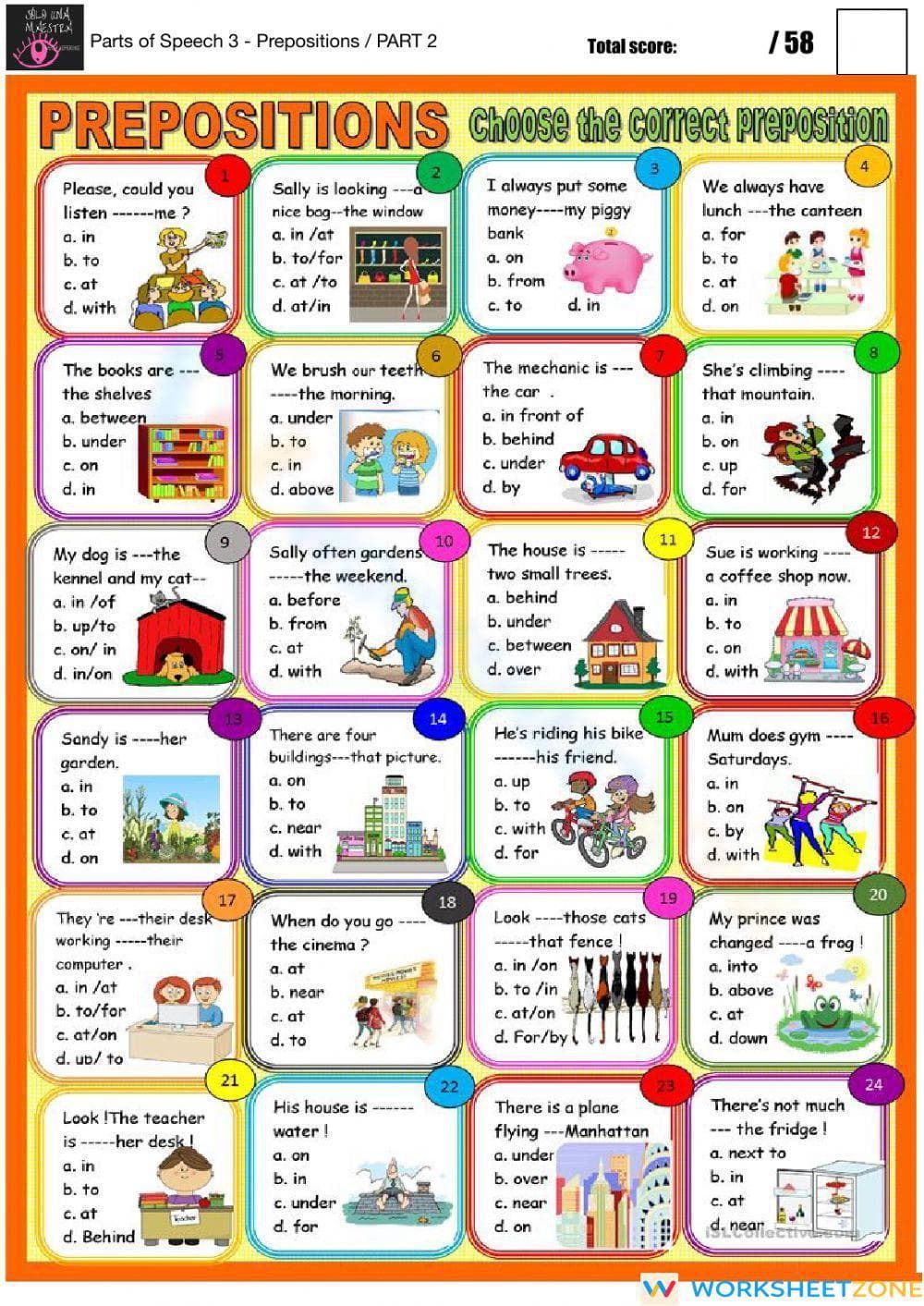
This comprehensive Grade 6-8 English Language Arts worksheet focuses on the critical use of prepositions of place and time. Students will strengthen their command of standard English grammar by identifying and applying correct prepositions across 58 varied practice tasks. This printable resource ensures students can accurately express spatial and temporal relationships in their writing.
At a Glance
- Grade: 6–8 · Subject: English Language Arts
- Standard:
CCSS.ELA-LITERACY.L.6.1— Demonstrate command of the conventions of standard English grammar and usage- Skill Focus: Prepositions of Place and Time
- Format: 2 pages · 58 problems · Answer key included · PDF
- Best For: Grammar review and formative assessment
- Time: 25–35 minutes
What's Inside
The worksheet consists of two distinct pages of practice. The first page features 24 multiple-choice scenarios where students select the most appropriate preposition from four options, often paired with colorful illustrations for context. The second page challenges students with 25 fill-in-the-blank sentences, requiring them to recall and write the correct preposition without prompts. Totaling 58 individual blanks, this set covers common prepositions like in, at, on, to, between, and under.
Zero-Prep Workflow
Implementing this resource in your classroom is a seamless process designed for busy educators. First, print the two-page PDF in approximately 30 seconds. Next, distribute the worksheets to your students as a bell-ringer or independent practice activity. Finally, use the included answer key to conduct a quick whole-class review or individual grading. Total teacher preparation time is less than two minutes, making it an ideal choice for emergency sub plans.
Standards Alignment
This resource is directly aligned with CCSS.ELA-LITERACY.L.6.1, which requires students to demonstrate command of the conventions of standard English grammar and usage. Specifically, it addresses the correct application of function words to establish relationships between nouns and other parts of a sentence. Both standard codes can be copied directly into lesson plans, IEP goals, or district curriculum mapping tools.
How to Use It
This worksheet is best used during the independent practice phase of a lesson. After a brief direct instruction on the differences between prepositions of place and time, assign the first page to check for immediate understanding. Use the second page as a follow-up homework assignment or a formative assessment. Teachers should observe students during multi-blank tasks, as these often reveal nuances in student understanding.
Who It's For
Designed for middle school students, this worksheet is particularly effective for learners who need concrete visual cues to grasp abstract prepositional concepts. It serves as an excellent reinforcement tool for English Language Learners (ELL) and can be paired with an anchor chart detailing common prepositional phrases for added classroom support.
Grammar instruction that integrates visual context with varied task types, such as multiple-choice and fill-in-the-blank exercises, significantly improves student retention of functional word classes. According to Fisher & Frey (2014), the gradual release of responsibility model is essential for students to internalize the conventions of standard English. This worksheet provides exactly that progression, addressing CCSS.ELA-LITERACY.L.6.1 through 58 targeted problems. By requiring students to differentiate between prepositions of place and time in both isolated and contextualized formats, the resource builds the linguistic foundation necessary for complex writing. Such structured practice is a hallmark of high-quality ELA curriculum materials as identified in NAEP reports, ensuring that students can reliably communicate relationships between objects and events across all academic disciplines.


