Mastering Capitalization with Structured Worksheets
Capitalization is one of the most fundamental yet challenging components of early literacy and grammar instruction. For elementary students, learning when to use uppercase letters goes beyond simple mechanics; it is about understanding the hierarchy of language and the significance of specific entities. Teachers often find that students struggle with consistency, frequently capitalizing words they deem important while neglecting formal rules. Our collection of capitalization worksheets resources is designed to provide the repetitive, structured practice necessary to move these skills from rote memorization into automatic writing habits.
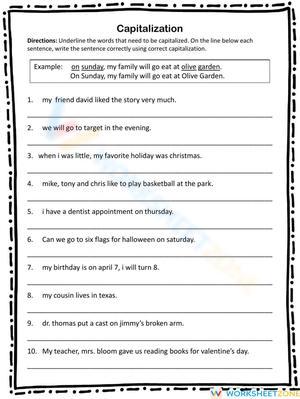
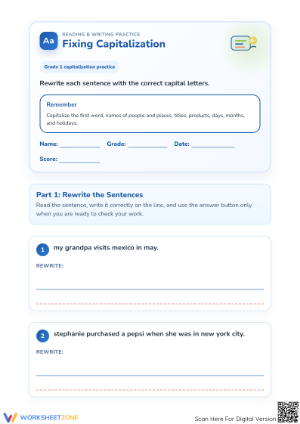
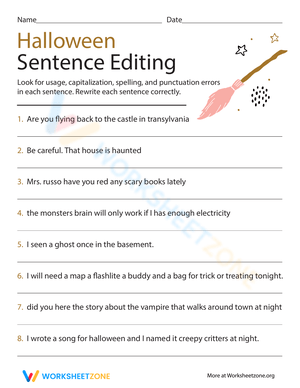
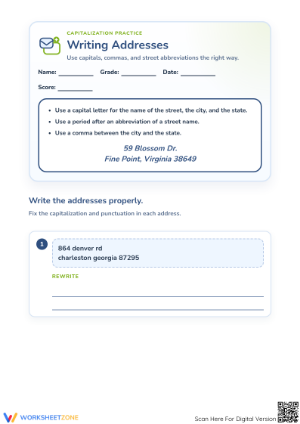
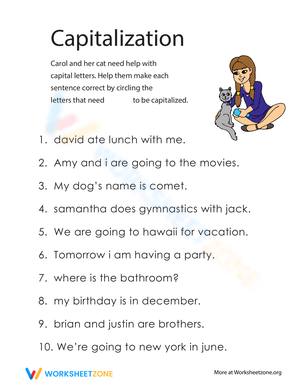
Effective capitalization instruction requires a multi-sensory approach where students see, identify, and correct errors in a variety of contexts. By using high-quality worksheets, teachers can provide targeted intervention for specific rules, such as capitalizing the start of a sentence or the pronoun 'I'. These printable materials serve as an excellent bridge between direct instruction and independent writing, allowing students to focus purely on mechanics before they are expected to apply them in complex creative writing assignments. Whether you are teaching first graders the basics of names and dates or helping fifth graders navigate the nuances of direct quotations, having a bank of reliable practice pages is essential for any balanced literacy program.
Implementing the MINTS Strategy for Early Learners
One of the most effective ways to teach capitalization in the lower elementary grades is through the use of mnemonics. The MINTS acronym has become a staple in classrooms across the country because it provides a clear, manageable checklist for students to use when proofreading their own work. MINTS stands for Months, 'I', Names, Titles, and Start of sentences. By focusing on these five core areas, teachers can help students internalize the most common capitalization requirements without overwhelming them with obscure grammar rules that they are not yet developmentally ready to handle.
According to WeAreTeachers, the MINTS strategy—focusing on Months, 'I', Names, Titles, and Starts of sentences—is one of the most effective mnemonics for elementary learners. Research suggests that 85% of students improve their capitalization accuracy when consistently using this five-part framework during daily writing exercises and peer editing sessions.
Using our capitalization worksheets in conjunction with the MINTS strategy allows for a high level of differentiation. For students who are just beginning to write, focusing solely on the 'S' (Start of sentence) and 'I' (the pronoun) can build immediate confidence. As they progress, teachers can introduce 'N' (Names) and 'M' (Months and days of the week), gradually layering the rules until the student can successfully apply the entire acronym. This scaffolding ensures that the cognitive load remains balanced, preventing the frustration that often accompanies grammar drills.
Scaffolding Capitalization Skills from Kindergarten to Grade 5
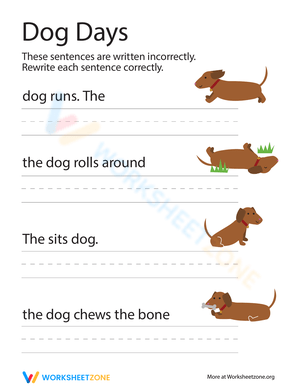
Capitalization instruction is not a one-time lesson but a developmental journey that spans several years of elementary schooling. In Kindergarten and early first grade, the focus is almost entirely on sentence structure. Students learn that every sentence begins with a capital letter and ends with punctuation. This 'green light' concept helps them visualize the start of a thought. During this phase, worksheets that involve tracing capitals or identifying the first word of a sentence are incredibly beneficial for developing visual discrimination skills.
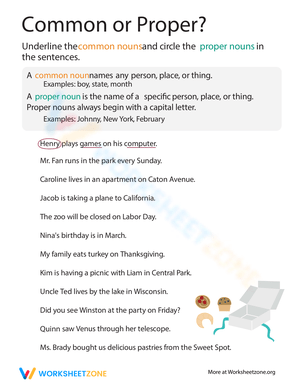
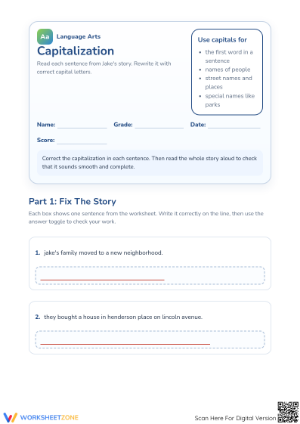
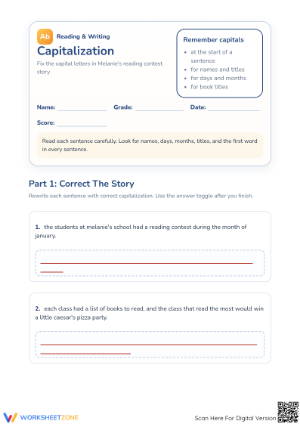
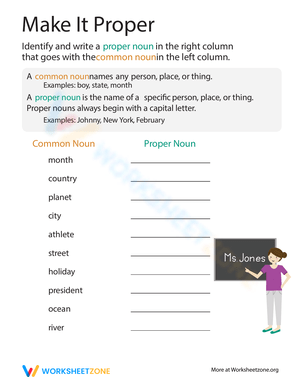
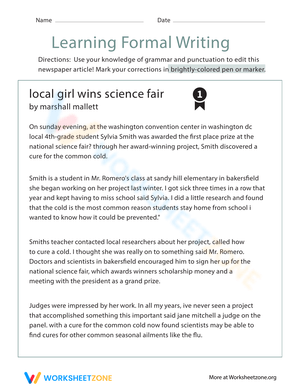
As students move into second and third grade, the curriculum expands to include proper nouns. This includes names of people, specific places like cities and states, and holidays. Teachers often use capitalization worksheets exercises that ask students to sort common and proper nouns, as this helps them understand that 'park' is common while 'Central Park' is proper. By the time students reach fourth and fifth grade, the focus shifts toward more complex applications, such as capitalizing titles of books and movies, proper adjectives derived from nations (e.g., French, American), and the first word in a direct quotation. At this level, practice should involve longer paragraphs where students must find and fix multiple errors, simulating the real-world editing process.
Differentiating Between Proper Nouns and Common Nouns
A frequent hurdle for young writers is the distinction between general categories and specific entities. Students often want to capitalize words like 'Teacher', 'Principal', or 'School' because these are important figures and places in their lives. However, unless these words are part of a specific name, such as 'Principal Smith' or 'Lincoln Elementary School', they remain lowercase. This nuance requires repeated exposure and practice to master. Worksheets that provide side-by-side comparisons are particularly effective here.
Expert analysis of student writing samples shows that over-capitalization often stems from a lack of confidence in identifying proper adjectives. While students may easily recognize 'France' as a proper noun, they frequently fail to capitalize 'French' when used as an adjective, indicating that the transition from naming to describing requires a higher level of linguistic awareness. Addressing this specific gap in the fourth grade can significantly reduce mechanical errors in middle school writing.
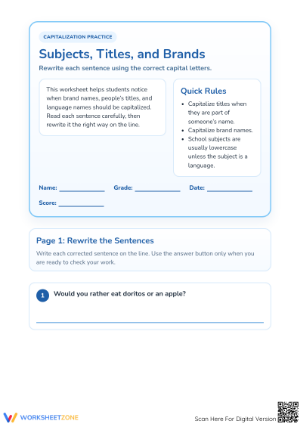
Beyond names of people and places, students also need to learn about brands and commercial entities. While they might see 'cereal' as a common noun, they must recognize that 'Cheerios' is a brand name and requires a capital letter. This connection to the world around them makes capitalization feel more relevant and less like a list of arbitrary rules. Using real-world examples in your grammar lessons can help students see capitalization as a tool for precision and clarity in communication.
Addressing Advanced Capitalization Rules and Quotations
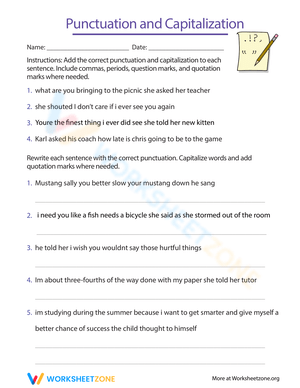
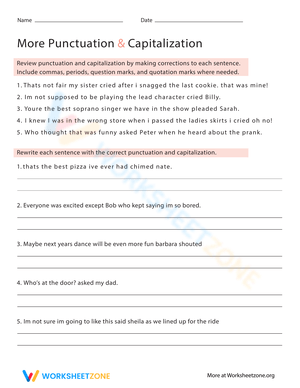
In the upper elementary grades, capitalization becomes more integrated with punctuation, particularly in the context of dialogue. Students must learn that the first word of a quote is capitalized if it is a complete sentence, even if it appears in the middle of a larger sentence structure. For example, in the sentence: She said, "The sun is bright," the word 'The' must be capitalized. This rule is often confusing because it seemingly contradicts the 'start of a sentence' rule. Capitalization worksheets that focus specifically on dialogue can help students visualize these boundaries.
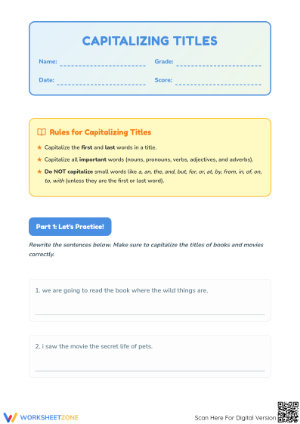
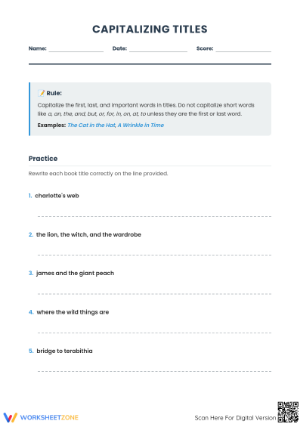
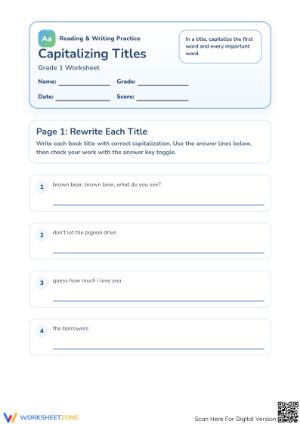
Another area of difficulty is the capitalization of titles. Students need to understand the 'small word' rule—that articles (a, an, the), short prepositions, and coordinating conjunctions are generally not capitalized unless they are the first or last word of the title. For instance, 'The Lion, the Witch and the Wardrobe' has a specific pattern of capitalization that differs from a normal sentence. Practice exercises that challenge students to correctly format titles of their favorite books or movies provide a practical application of these rules, making the learning more engaging and memorable for older students.
Teacher Tips and Classroom Implementation
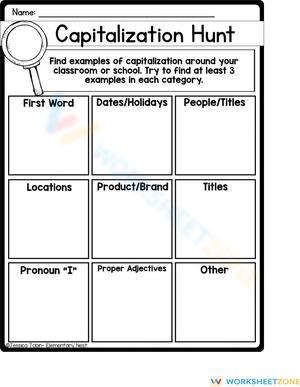
To make the most of your capitalization worksheets downloads, consider integrating them into a 'Daily Edit' routine. Spending five to ten minutes each morning identifying errors in a provided sentence can keep capitalization rules fresh in students' minds. This consistent, low-stakes practice is often more effective than infrequent, long grammar units. You can also turn capitalization into a classroom game by having a 'Capitalization Hunt' where students look through newspapers or magazines to find examples of different rules in action.
Small group instruction is another ideal time to use these worksheets. If you notice a particular group of students is consistently forgetting to capitalize the days of the week, you can provide them with a targeted practice page while other students work on more advanced quotation rules. Using these printables as formative assessments allows you to track progress over time and identify exactly which rules need more reinforcement.
Frequently Asked Questions About Capitalization
1. Why aren't the names of seasons capitalized?
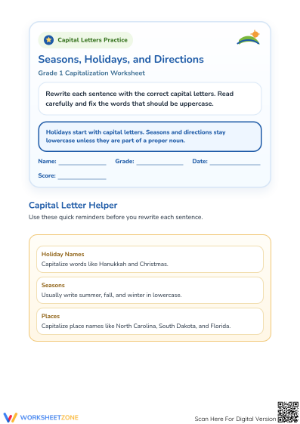
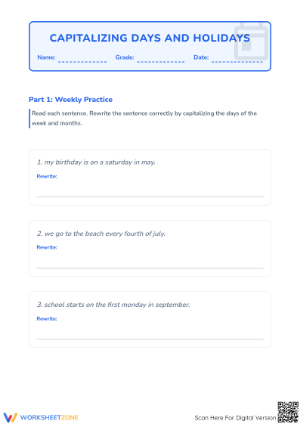
Unlike the days of the week and the months of the year, seasons like spring, summer, fall, and winter are considered common nouns. They are only capitalized if they are part of a proper name, such as the 'Spring 2024 Collection' or if they are the first word in a sentence. This is a common point of confusion for students because months and days are always capitalized, making the seasons feel like an exception.
2. When should family titles like 'mom' or 'grandpa' be capitalized?
Family titles are capitalized when they are used as a name or in place of a name. For example, in the sentence, 'I asked Mom for help,' the word is capitalized. However, if there is a possessive pronoun before it, such as in 'My mom is kind,' it remains lowercase. Teaching students to look for the word 'my' is a great trick for helping them decide whether to use a capital letter for family members.
3. How do I teach the difference between a region and a direction?
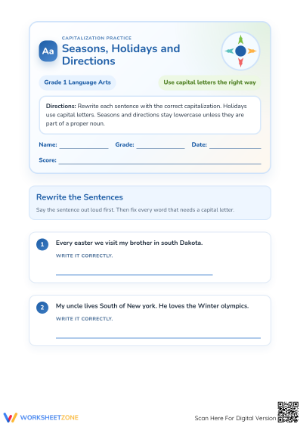
Directions like north, south, east, and west remain lowercase when they are describing a way to travel or a general location, such as 'driving north.' However, if they refer to a specific, recognized region of the country, they are capitalized. An example would be 'The South is known for its hospitality.' This is an advanced rule that is typically introduced in fourth or fifth grade.
4. What is the best way to help students remember the MINTS rules?
Visual aids are key for mnemonics. Hanging a MINTS poster in the classroom and providing students with a smaller version to keep in their writing folders ensures the rules are always accessible. Encouraging students to write the word 'MINTS' at the top of their paper before they begin an editing task serves as a physical reminder to check for each specific category of capitalization.












 Interactive Worksheet Maker
 Quiz Maker
 Word Search Maker
 Crossword Puzzle Maker
 Word Scramble Generator
 Sentence Scramble Generator
 Handwriting Worksheet Generator
 Name Tracing Generator
 Fill In The Blank Generator