


























Views
Plays

Printable Possessives, Plurals, and Contractions Worksheet
Paste this activity's link or code into your existing LMS (Google Classroom, Canvas, Teams, Schoology, Moodle, etc.).
Students can open and work on the activity right away, with no student login required.
You'll still be able to track student progress and results from your teacher account.
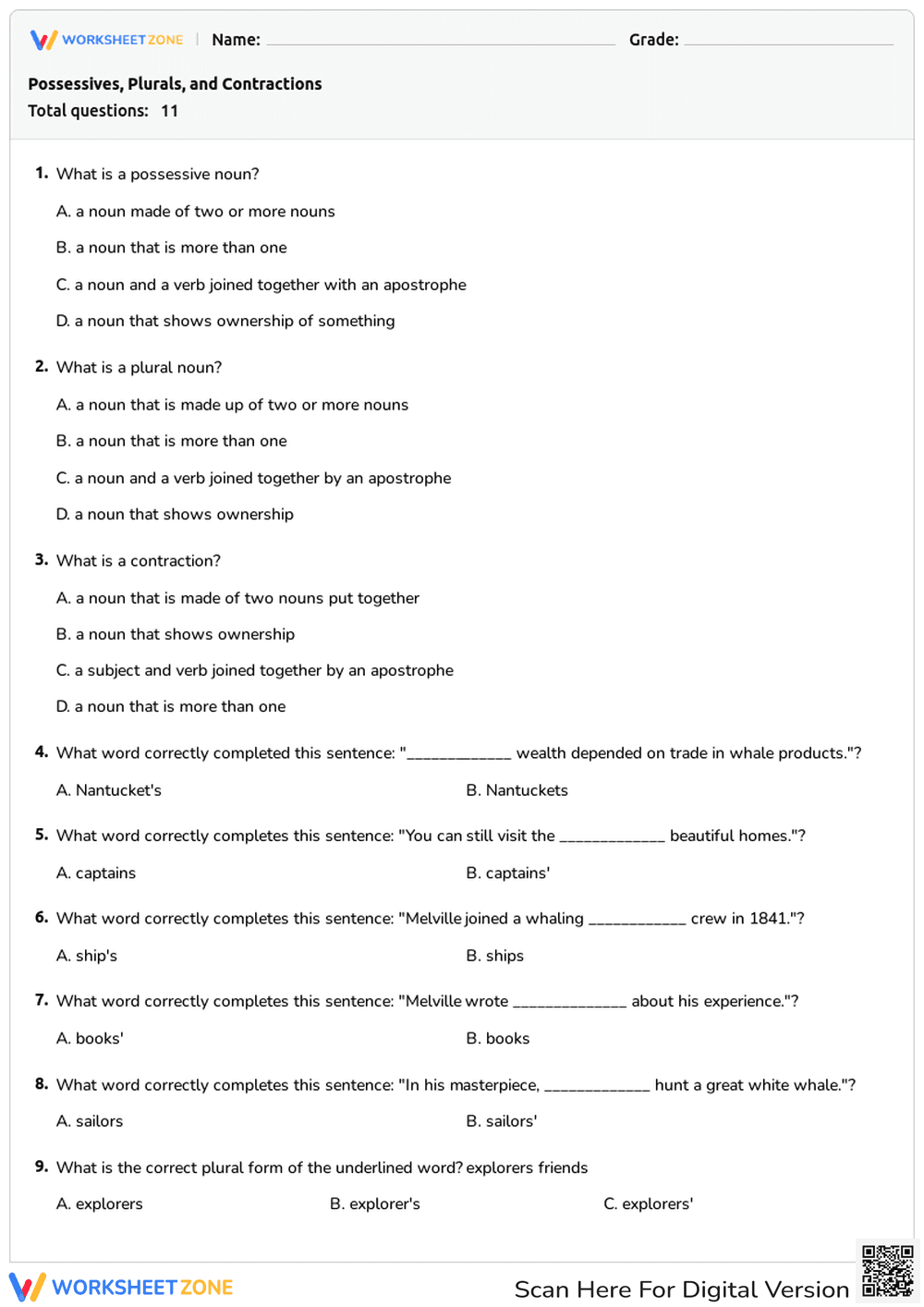
This Grade 4 and 5 grammar worksheet helps students master the often-confusing differences between possessive nouns, plural nouns, and contractions. By focusing on the specific placement of apostrophes and the meaning of word endings, students develop the mechanical precision required for clear academic writing. This resource ensures learners can accurately identify ownership versus quantity.
At a Glance
- Grade: 4–5 · Subject: ELA Grammar
- Standard:
CCSS.ELA-LITERACY.L.4.2— Use standard English capitalization, punctuation, and spelling when writing- Skill Focus: Possessives, Plurals, and Contractions
- Format: 2 pages · 11 problems · Answer key included · PDF
- Best For: Quick formative assessment or bell ringer
- Time: 10–15 minutes
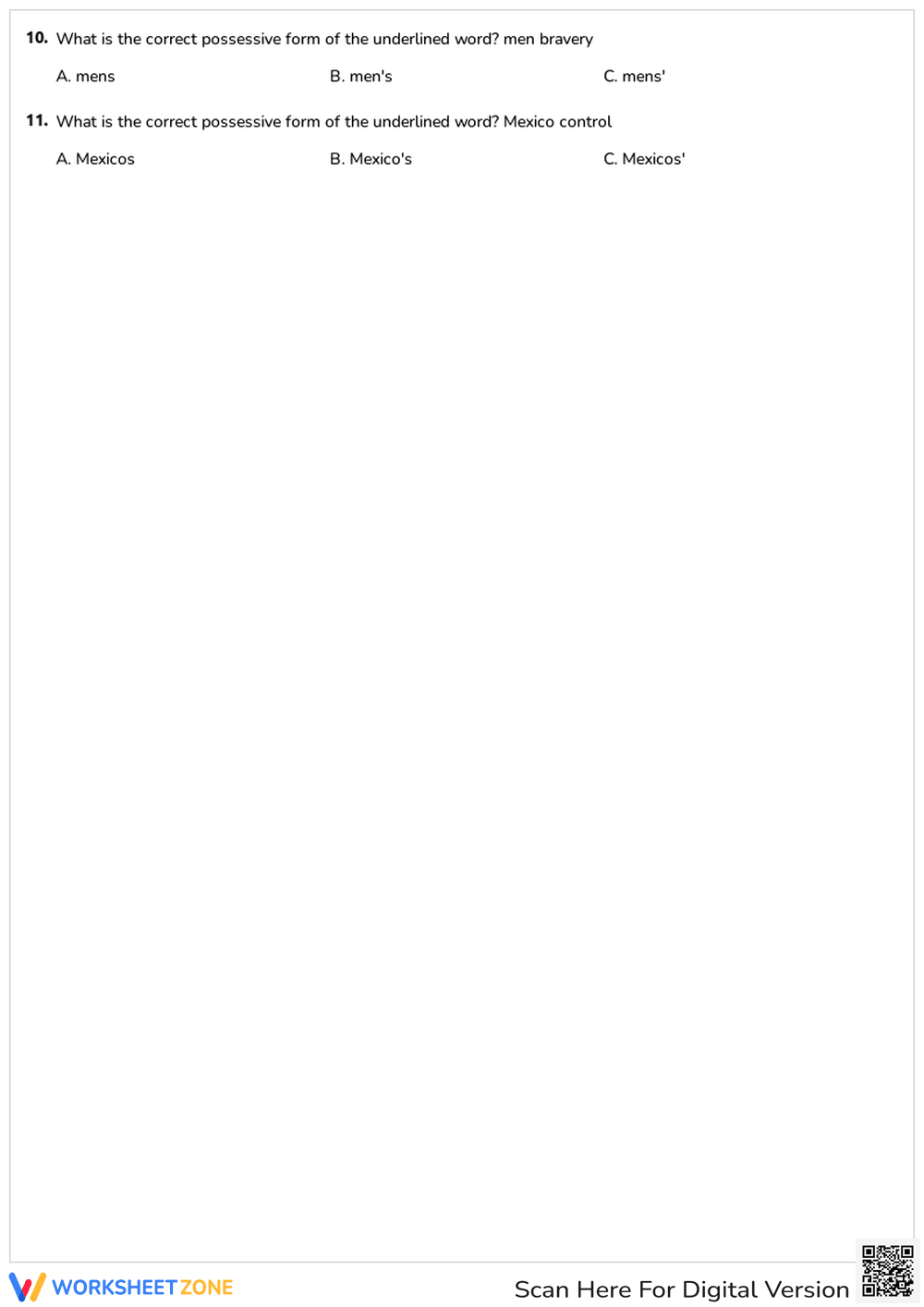
The worksheet consists of 11 multiple-choice questions spread across two clean, distraction-free pages. The first three questions establish a conceptual foundation by asking students to define possessive nouns, plural nouns, and contractions. The remaining eight questions provide contextual sentences where students must choose the correct word form to complete the thought, ensuring they understand how these rules function in real-world writing.
The zero-prep design of this resource allows for an efficient classroom workflow. First, print the two-page PDF (30 seconds). Second, distribute the 11-question quiz to students as a quiet bell-ringer or transition activity (1 minute). Finally, use the included answer key to review the three definitions and eight application problems as a whole group (5 minutes). Total teacher preparation time is under 2 minutes, making this an ideal solution for sub plans.
This resource is primarily aligned with `CCSS.ELA-LITERACY.L.4.2`, which requires students to demonstrate command of the conventions of standard English capitalization, punctuation, and spelling when writing. Specifically, it addresses the use of apostrophes to form possessives and contractions. It also supports `CCSS.ELA-LITERACY.L.3.2.D` by reinforcing the formation and use of possessives. Both standard codes can be copied directly into lesson plans or district curriculum mapping tools.
Use this worksheet as a formative assessment after a direct instruction lesson on apostrophes. It works well as an exit ticket to gauge which students still struggle with the distinction between plural "s" and possessive "'s." Teachers should observe if students are guessing on the definition questions or if they can apply the logic to the sentence-completion tasks. Expect most students to complete the 11 items within 12 minutes.
This resource is designed for general education students in grades 4 and 5, as well as middle school students requiring Tier 2 intervention for grammar mechanics. It is particularly helpful for English Language Learners (ELLs) who may find the phonetic similarities of these word forms challenging. Pair this worksheet with a visual anchor chart for a complete instructional cycle.
According to the RAND AIRS 2024 report on instructional materials, high-quality grammar worksheets that isolate specific punctuation rules, such as the distinction between possessive apostrophes and plural suffixes, significantly reduce cognitive load during the drafting phase of student writing. This worksheet targets CCSS.ELA-LITERACY.L.4.2 by requiring students to identify the functional difference between ownership, quantity, and omission. By providing 11 targeted multiple-choice items, the resource allows for rapid diagnostic assessment of a student's ability to apply conventions of standard English. Research from Fisher & Frey (2014) emphasizes that such focused practice is most effective when used as a check for understanding following direct instruction. This resource provides the necessary repetition to move these mechanics from short-term memory to automaticity, ensuring that students can focus on higher-order composition tasks without being hindered by basic mechanical errors.


