Understanding the Mechanics of Contractions
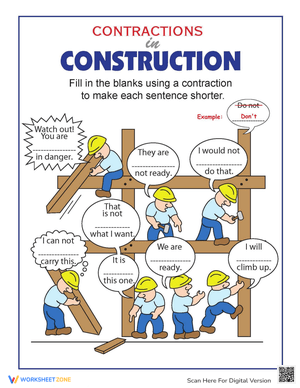
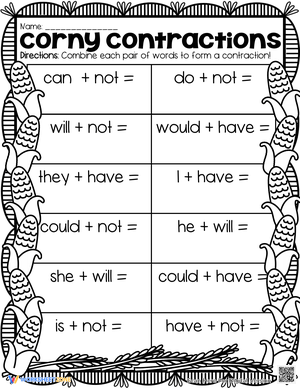
At its core, a contraction is the result of merging two separate words into a single unit, with an apostrophe acting as a physical placeholder for the letters that have been removed. This process isn't merely a spelling exercise; it is an introduction to the rhythmic nature of English and the efficiency of communication. When teachers introduce contractions pdf worksheets, they provide students with a structured way to practice this morphological transformation, helping them bridge the gap between formal grammar rules and the practical application of language.
Why Teaching Contractions in Early Elementary is Essential
At this stage, students are transitioning from decoding individual words to reading for meaning and fluency. Contractions appear frequently in the books and stories they encounter, and a lack of familiarity with these forms can hinder their reading pace. If a student pauses every time they see 'it's' or 'don't' because they aren't sure how to pronounce or interpret the word, their overall comprehension suffers. Therefore, providing consistent practice through contractions pdf worksheets is a vital component of a balanced literacy program.
Beyond reading, contractions are a staple of expressive writing. They allow students to write dialogue that sounds natural and engaging. Without contractions, student writing can often feel stiff or overly formal, which may not match the tone of the stories they are trying to tell. Teaching them when and how to use these shortened forms gives them more agency over their writing style. Furthermore, this instruction builds a strong foundation for more advanced punctuation lessons later in their academic careers. According to the Common Core State Standards for English Language Arts, 2nd-grade students must demonstrate command of standard English conventions by using an apostrophe to form contractions and possessives, a foundational skill that significantly impacts 100% of their early reading fluency and written communication. By mastering these standards early, students are better prepared for the rigors of upper elementary grammar.
The Role of the Apostrophe: A Visual Guide for Students
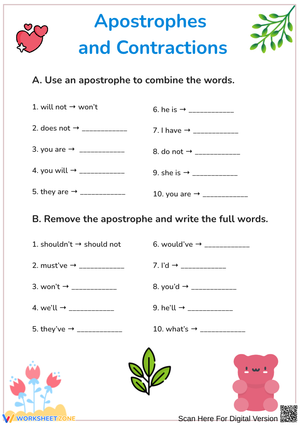
For many young learners, the apostrophe is a mysterious floating mark that seems to appear at random. To demystify its role, teachers should emphasize its function as a 'letter thief' or a 'placeholder.' In a contraction, the apostrophe isn't just an extra decoration; it is there because something else was taken away. Visualizing this can be incredibly helpful for students who struggle with the abstract nature of grammar.
Using worksheets that highlight the missing letters—perhaps by having students physically cross out the letters before replacing them with an apostrophe—can solidify this concept. This tactile approach turns a linguistic rule into a concrete action, making it much easier for the brain to process and retain.
Categorizing Contractions for Focused Instruction
To prevent students from becoming overwhelmed by the sheer number of contractions in the English language, it is effective to teach them in categories. This thematic approach allows students to master one pattern before moving on to the next, building confidence and accuracy. Common categories include:
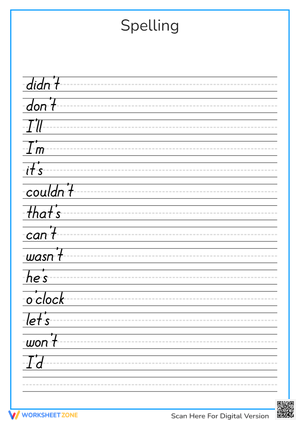
- The 'Not' Contractions: These are often the first ones students learn, such as don't, can't, isn't, and won't. These worksheets focus on the 'n't' ending and the specific letters that are dropped.
- The 'Is' and 'Has' Contractions: These use the ''s' ending, like it's, he's, and she's. These are particularly important for distinguishing between contractions and possessives.
- The 'Will' Contractions: Words like I'll, you'll, and they'll introduce students to the ''ll' ending, which can be tricky because of the double letter.
- The 'Have' and 'Are' Contractions: Examples like I've, we've, they're, and you're require students to recognize more subtle sound changes.
By breaking the instruction down into these manageable groups, teachers can tailor their lessons to the specific needs of their classroom. If a group of students is struggling specifically with the 'will' contractions, the teacher can pull specific contractions pdf worksheets from Worksheetzone that focus solely on that pattern. This targeted intervention is much more effective than a generic overview and ensures that no student is left behind as the class moves through the grammar curriculum.
Common Pitfalls: Distinguishing Contractions from Possessives
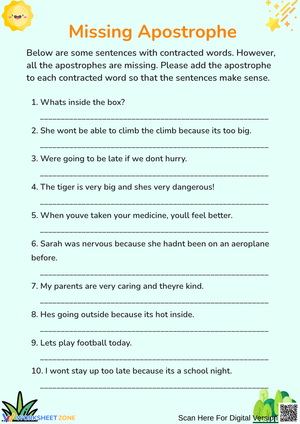
One of the most persistent challenges for elementary students (and even many adults) is the confusion between contractions and possessive nouns. Because both use apostrophes, it is easy for students to assume they serve the same purpose. The classic struggle between 'it's' and 'its' or 'they're' and 'their' can lead to significant frustration. To address this, instruction must be explicit. Teachers should provide side-by-side comparisons, showing how 'it's' is a shortcut for 'it is,' while 'its' indicates that something belongs to 'it.' This distinction is not just a minor detail; it is a critical part of clear writing and a core requirement of many state standards.
Using diagnostic contractions pdf worksheets can help teachers identify which students are making these specific errors. Once identified, small-group instruction can focus on the 'replacement test.' If you can replace the word with the two original words (e.g., replace 'it's' with 'it is') and the sentence still makes sense, then you need a contraction. If you can't, you likely need a possessive. This simple logic check gives students a reliable strategy they can use independently during writing workshops. Reinforcing this rule through repetitive practice ensures that students develop the 'grammatical ear' necessary to catch these mistakes in their own work before they turn it in.
Contractions are not just linguistic shortcuts; they are essential tools that reflect the natural prosody of spoken English, and students who master them early show significantly higher levels of oral reading fluency because they recognize the phonetic blending of words rather than stumbling over individual syllables. This recognition allows them to read with more expression and better intonation, which are key indicators of advanced comprehension and linguistic maturity.
Teacher Tips: Classroom Implementation
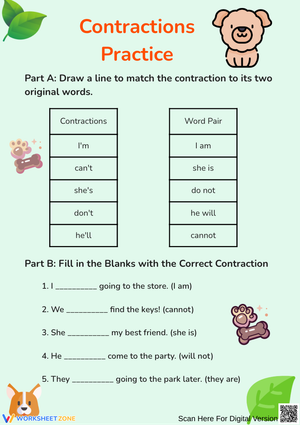
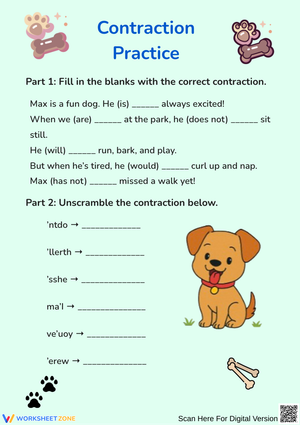
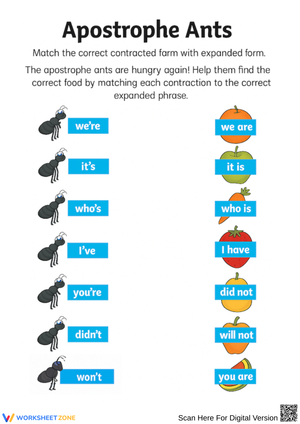
Start with a daily 'Contraction of the Day' where you display two words on the board and have the students come up and replace the letters with a large, colorful apostrophe magnet. This quick, five-minute activity keeps the concept fresh in their minds without taking up a huge chunk of your instructional time. Additionally, incorporate contractions pdf worksheets into your center rotations. You can have a dedicated grammar station where students work on matching games, sentence sorting, or even a 'Contraction Surgery' activity where they use band-aids as apostrophes to join words together.
Another effective strategy is to use mentor texts. During your read-aloud time, ask students to listen for contractions. When they hear one, have them give a quiet signal, like touching their nose. This keeps them engaged and helps them see how professional authors use contractions to create a specific voice and tone. You can then transition into a writing activity where students are challenged to rewrite a formal paragraph using as many contractions as possible to make it sound more like a conversation. This transition from identifying to applying is where the real learning happens. By utilizing the wide array of resources available at Worksheetzone, you can ensure that your grammar instruction is both rigorous and fun, leading to better outcomes for all your students.
Frequently Asked Questions
1. What grade level should students start learning contractions?
Most teachers introduce basic contractions in the first grade, with more complex forms and formal standards-based instruction occurring in the second and third grades. This allows students to build on their existing phonemic awareness and spelling skills as they become more comfortable with the English language.
2. Why do we use contractions in writing?
We use contractions to make our writing sound more natural, conversational, and efficient. They help mimic the way we actually speak, which is especially important in dialogue and informal storytelling. For teachers, contractions are a gateway to teaching tone and voice in writing.
3. How to help students distinguish between possessives and contractions?
The best way is to use the 'replacement test.' Have students check if the word can be split back into two separate words that make sense in the sentence. If 'it is' fits, use 'it's.' If not, and it shows ownership, it is likely a possessive.
4. Are contractions appropriate for formal writing?
Generally, contractions are avoided in very formal academic or professional writing. However, for elementary students, the focus is on mastering the mechanics and using them correctly in creative and narrative contexts. As they grow, they will learn more about the nuances of formal versus informal tone.
5. How can Education World help with teaching contractions?
According to Education World - Teaching Contractions, interactive games and creative hands-on activities are highly effective for reinforcing the rules of apostrophe use, providing teachers with various strategies to keep students engaged during grammar lessons.












 Interactive Worksheet Maker
 Quiz Maker
 Word Search Maker
 Crossword Puzzle Maker
 Word Scramble Generator
 Sentence Scramble Generator
 Handwriting Worksheet Generator
 Name Tracing Generator
 Fill In The Blank Generator