


























Views
Downloads


Plant Habitats Worksheet | Essential Grade 2 Science
Paste this activity's link or code into your existing LMS (Google Classroom, Canvas, Teams, Schoology, Moodle, etc.).
Students can open and work on the activity right away, with no student login required.
You'll still be able to track student progress and results from your teacher account.
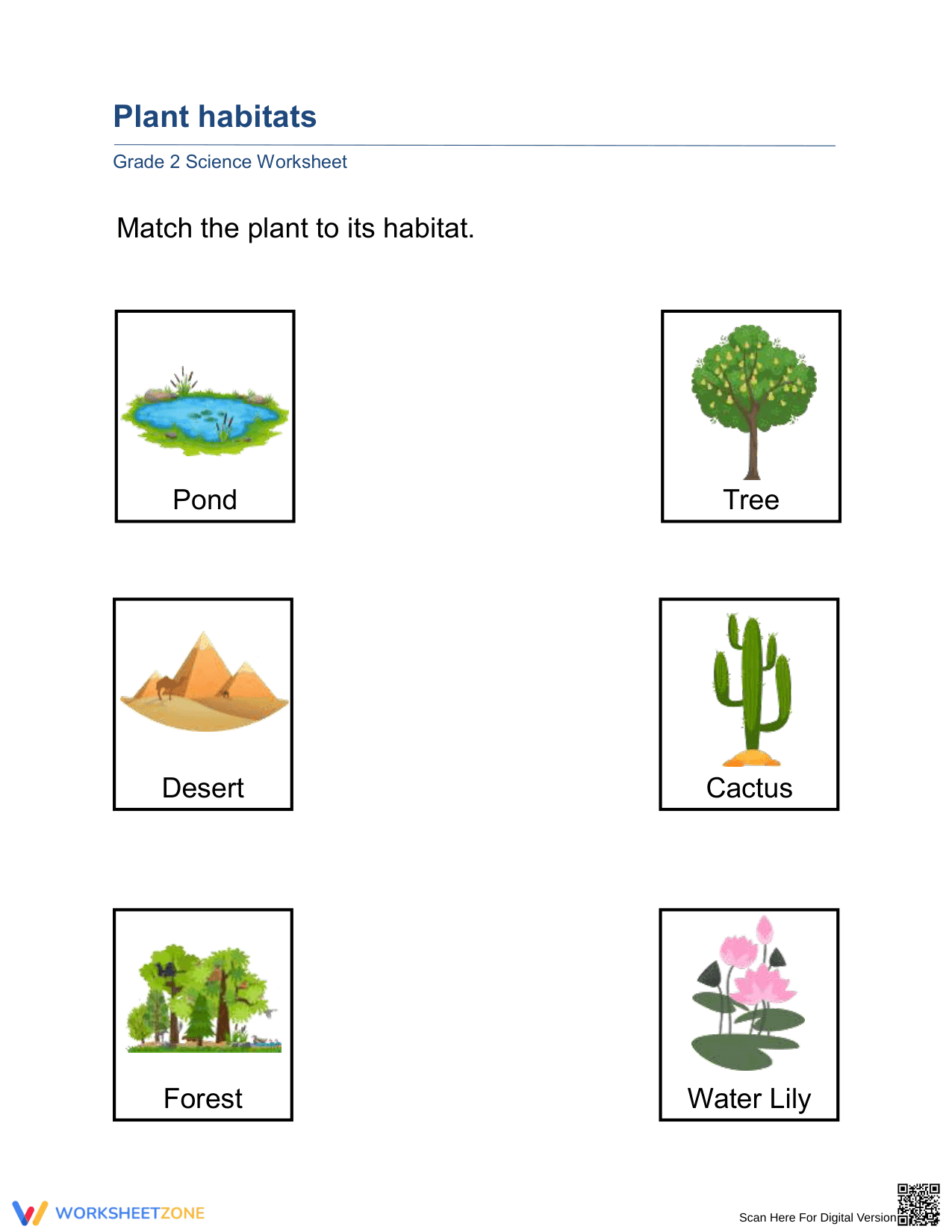
This Grade 2 plant habitats worksheet helps students identify the critical relationships between living things and their environments. By matching specific plants to the correct biomes, learners develop a foundational understanding of biological diversity and environmental suitability. Students will observe visual cues to connect flora to the pond, desert, and forest habitats.
At a Glance
- Grade: 2 · Subject: Science
- Standard:
2-LS4-1— Make observations of plants and animals to compare the diversity of life in different habitats- Skill Focus: Plant-habitat matching
- Format: 2 pages · 3 problems · Answer key included · PDF
- Best For: Independent practice or quick formative assessment
- Time: 10–15 minutes
What's Inside: This resource consists of a 2-page PDF designed for immediate classroom use. The first page features three distinct habitat images—a pond, a desert, and a forest—paired with three corresponding plants: a tree, a cactus, and a water lily. The second page provides a full-color answer key with clear red connecting lines, allowing for rapid student self-correction or teacher grading.
Zero-Prep Workflow: Teachers can implement this resource in three simple steps. First, print the required number of copies (less than 1 minute). Second, distribute the worksheets to students during a science block or as a transition activity (under 1 minute). Third, review the answers as a class using the provided key (5 minutes). This streamlined process requires less than 2 minutes of total teacher preparation time, making it ideal for busy schedules or emergency sub plans.
Standards Alignment: This activity is directly aligned to `2-LS4-1`, which requires students to make observations of plants and animals to compare the diversity of life in different habitats. By categorizing plants based on their environmental needs, students meet the core requirements of this NGSS performance expectation. This standard code can be copied directly into lesson plans, IEP goals, or district curriculum mapping tools.
How to Use It: This worksheet is best utilized during the "Explain" or "Elaborate" phase of a 5E science lesson. It serves as an effective formative assessment tool to check if students can distinguish between terrestrial and aquatic environments. Educators should observe whether students recognize the physical characteristics of the plants—such as the water lily's pads or the cactus's structure—to determine their habitat placement.
Who It's For: This resource is tailored for Grade 2 students beginning their exploration of life science and ecology. While it is designed for general classroom use, it can be easily differentiated by providing verbal descriptions of each habitat for English Language Learners or as a supplemental resource alongside a reading passage about biomes.
The 2-LS4-1 standard emphasizes the critical need for early learners to observe and categorize the diversity of life within specific environmental contexts. This Plant Habitats worksheet facilitates the identification of plant-habitat relationships, a foundational skill in ecological literacy. According to the RAND AIRS 2024 report, high-quality visual matching tasks in primary science education significantly improve a student's ability to recall biological characteristics and environmental adaptations. By connecting specific flora like the cactus or water lily to their respective biomes, students move beyond rote memorization toward a conceptual understanding of biodiversity. This resource provides a structured environment for students to practice these classification skills independently. The inclusion of a clear answer key ensures that teachers can provide immediate corrective feedback, which is essential for reinforcing scientific accuracy in Grade 2. This worksheet serves as a reliable tool for assessing a student's grasp of how plants thrive in diverse conditions across the globe.


