


























Views
Downloads


Essential Grade 3 Ratios Worksheet | Visual Practice Pack
Paste this activity's link or code into your existing LMS (Google Classroom, Canvas, Teams, Schoology, Moodle, etc.).
Students can open and work on the activity right away, with no student login required.
You'll still be able to track student progress and results from your teacher account.
This ratios worksheet pack helps students master part-to-part relationships through a structured visual approach. By starting with icons and progressing to word problems, students build the confidence to describe mathematical comparisons with precision. It is an ideal resource for introducing proportional reasoning in a clear, accessible format.
At a Glance
- Grade: Grade 3 · Subject: Math
- Standard:
6.RP.A.1— Understand the concept of a ratio and use ratio language to describe relationships- Skill Focus: Visual and verbal ratio identification
- Format: 5 pages · 22 problems · Answer key included · PDF
- Best For: Independent practice and introductory math enrichment
- Time: 25–35 minutes
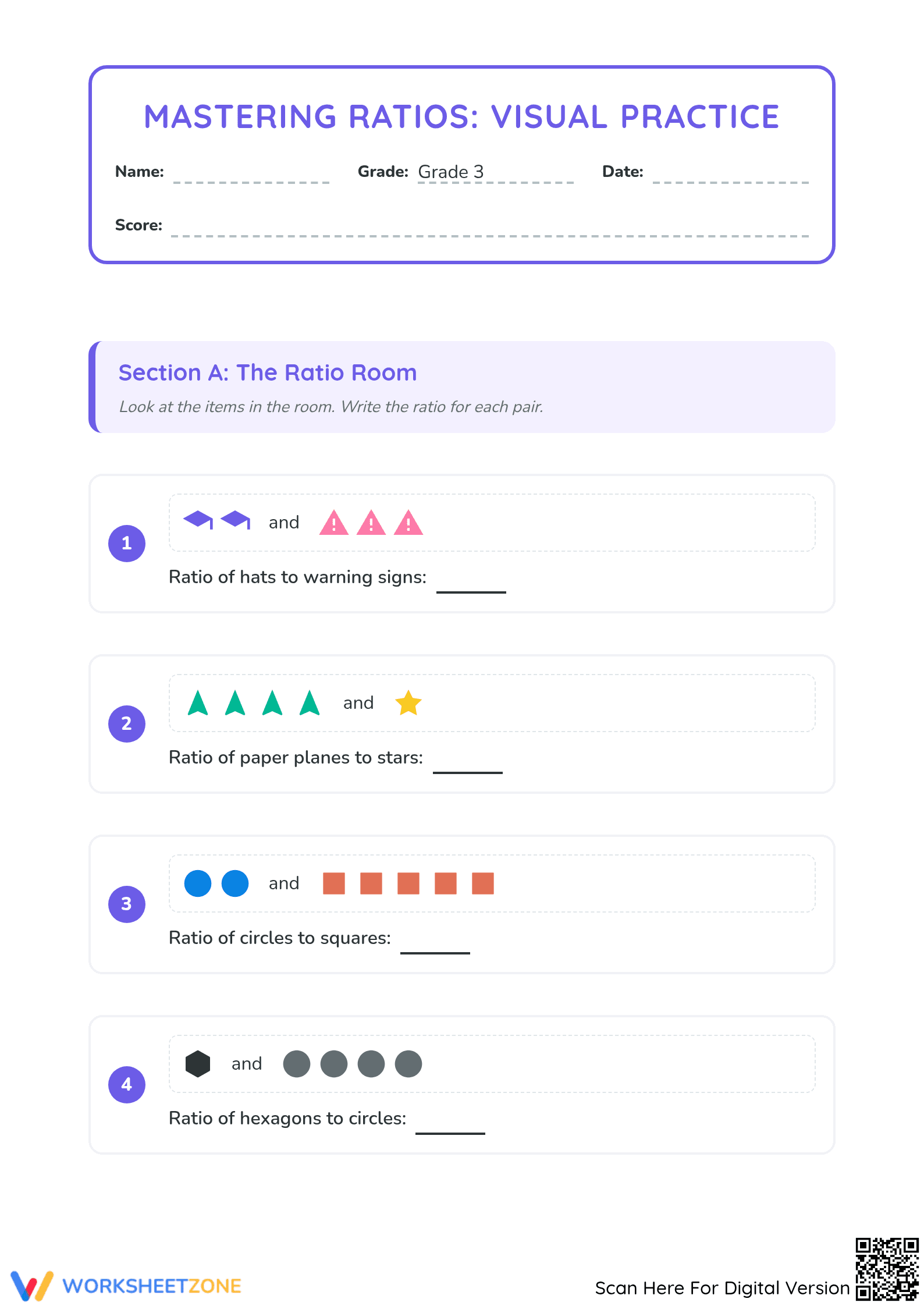
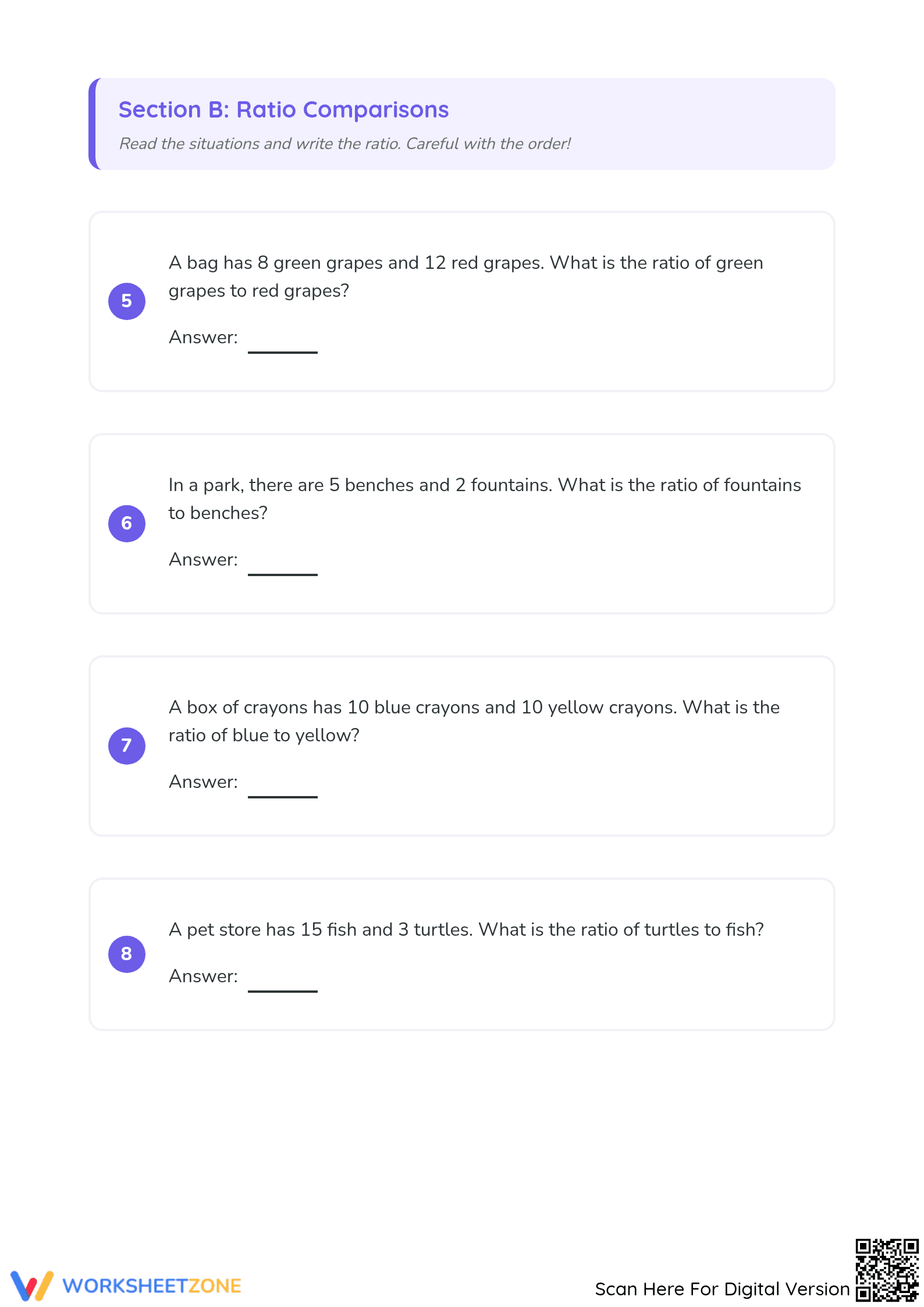
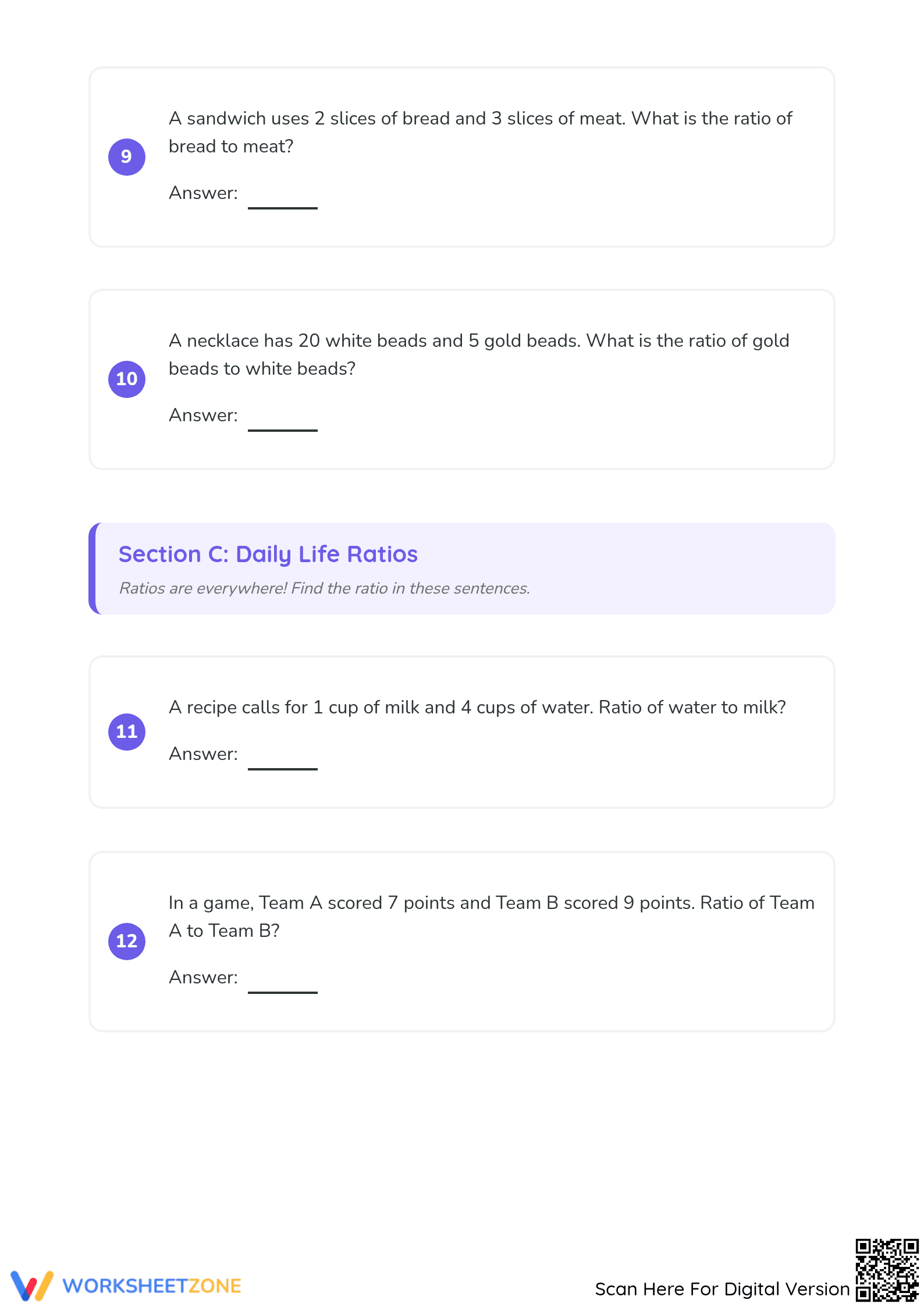
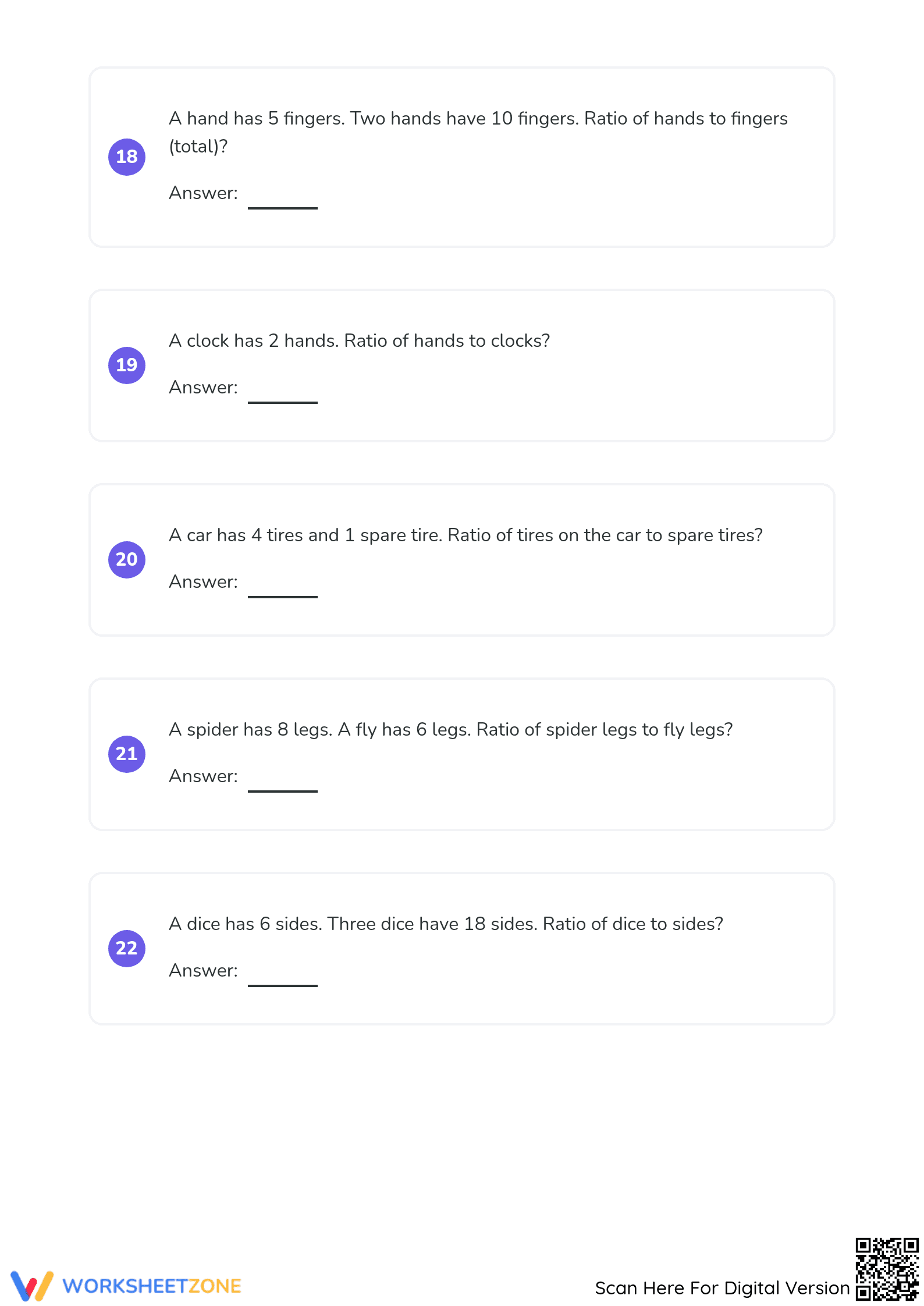
This 5-page PDF includes 22 problems divided into three thematic sections. Section A provides visual support with paired icons, while Section B challenges students with scenario-based comparisons. Section C applies skills to daily life situations like recipes and sports scores. A full answer key ensures students receive immediate feedback on their accuracy and reasoning.
Zero-Prep Workflow
The zero-prep design allows for immediate classroom implementation with a total teacher prep time of less than one minute. Teachers can print the 5-page packet in 10 seconds and distribute it without additional set-up. Reviewing the 22 problems takes 5 minutes using the included answer key, making it an excellent choice for sub-plans, morning work, or a focused homework assignment requiring no teacher intervention.
Standards Alignment
The primary focus is `6.RP.A.1`, requiring students to understand ratio concepts and use ratio language for relationships. Although ratios are usually middle school topics, this Grade 3 version serves as an enrichment tool for high-ability learners. The standard code can be copied directly into lesson plans, IEP goals, or curriculum mapping tools to document student progress.
How to Use It
Use this worksheet as a bridge between visual models and abstract notation. After instruction on ratio language, assign the visual section to verify comprehension of quantity order. During work, observe if students correctly identify the 'parts' in word problems. The 30-minute completion time is perfect for math centers or formative assessments.
Who It's For
This resource is for Grade 3 students ready for enrichment and Grade 6 students needing a visual refresher. It is effective for students benefiting from transitions between pictures and text. Pair this with a ratio anchor chart that emphasizes colon notation for maximum impact during small-group rotations.
According to the principles of scaffolded instruction outlined by Fisher & Frey (2014), the gradual release of responsibility is crucial for mastering abstract mathematical concepts like ratios. This worksheet implements that framework by transitioning students from high-support visual cues to independent problem-solving in real-world contexts. By providing 22 varied tasks, the resource ensures that students encounter enough repetitions to solidify their understanding of the `6.RP.A.1` standard. Research from the NAEP consistently highlights that early exposure to proportional reasoning is a key predictor of success in higher-level algebra. This resource addresses that need by making ratios accessible to younger learners without sacrificing mathematical rigor. The structured layout promotes cognitive endurance, allowing students to focus on the relationships between quantities rather than being overwhelmed by complex calculations. Teachers can use this tool to collect high-quality data for curriculum mapping and student growth portfolios.


