


























Views
Downloads

Printable Grade 3 Ratios Worksheet: Fun Picture Patterns
Paste this activity's link or code into your existing LMS (Google Classroom, Canvas, Teams, Schoology, Moodle, etc.).
Students can open and work on the activity right away, with no student login required.
You'll still be able to track student progress and results from your teacher account.
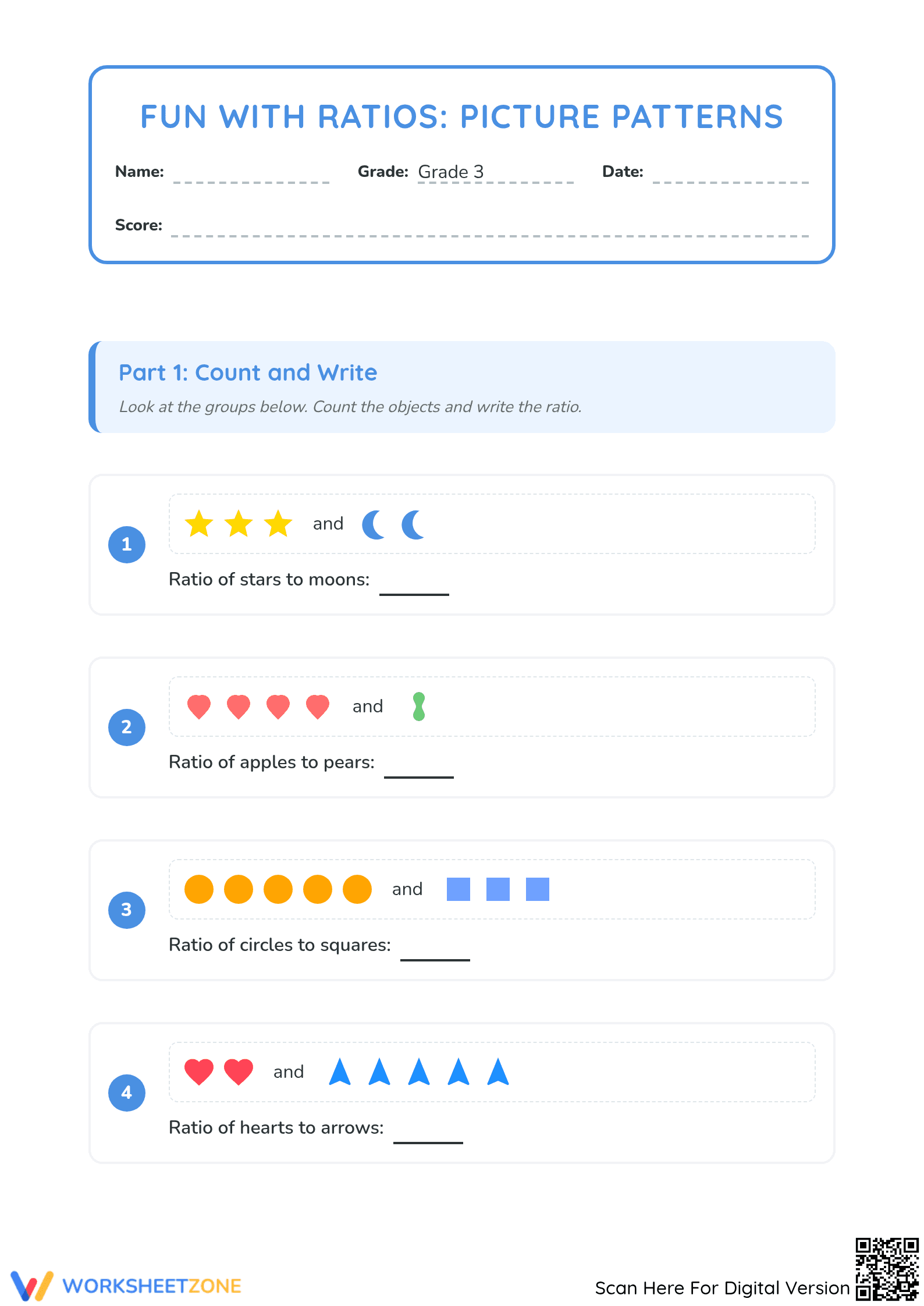
This Grade 3 Math worksheet introduces students to ratios through engaging visual patterns and word problems. By counting objects like stars and moons, learners develop a concrete understanding of part-to-part relationships. This 5-page resource ensures young mathematicians grasp ratio identification with confidence and accuracy.
At a Glance
- Grade: Grade 3 · Subject: Math
- Standard:
6.RP.A.1— Understand the concept of a ratio and use ratio language to describe a relationship- Skill Focus: Ratio Identification & Representation
- Format: 5 pages · 24 problems · Answer key included · PDF
- Best For: Independent practice and introductory math units
- Time: 25–35 minutes
What's Inside
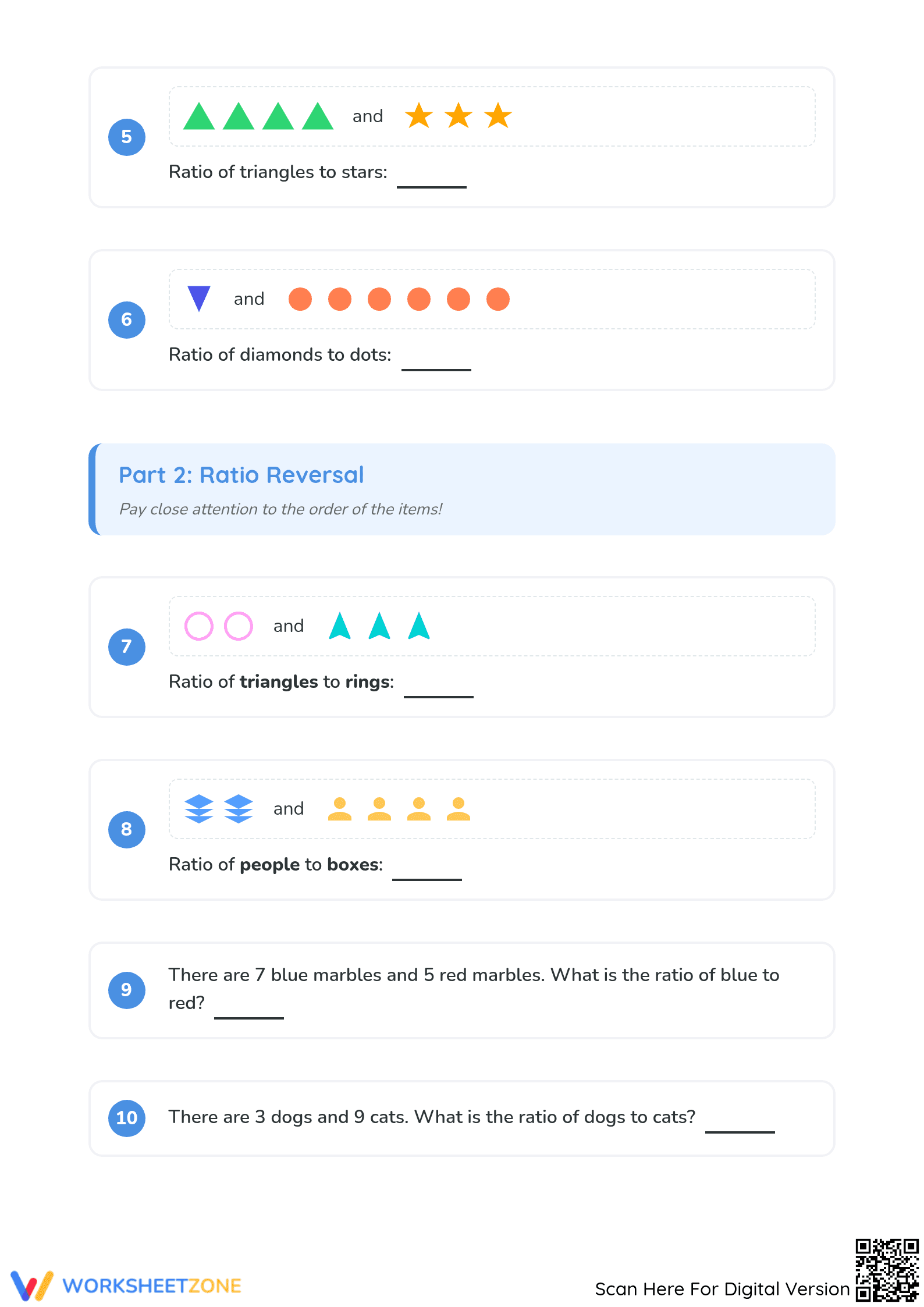
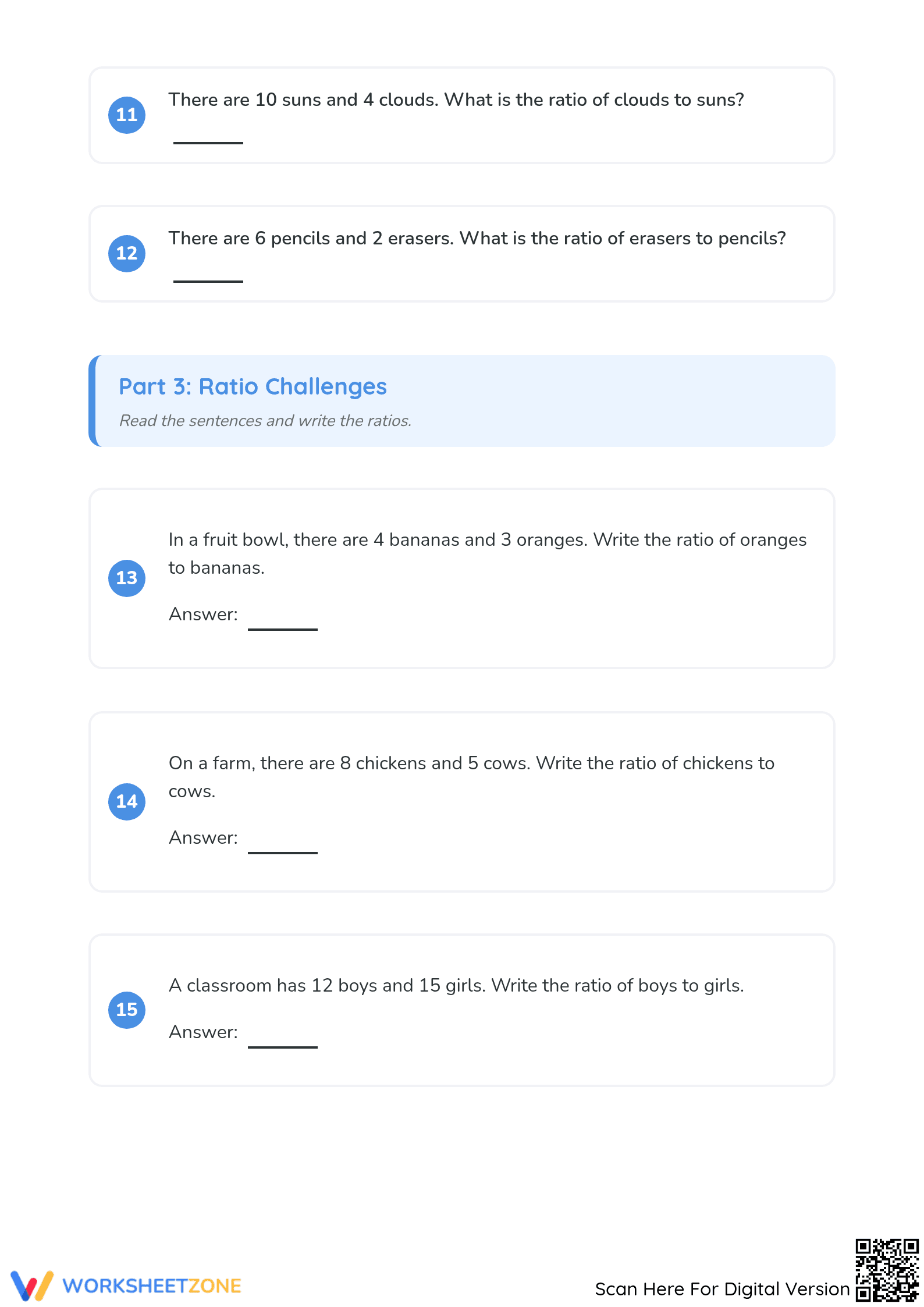
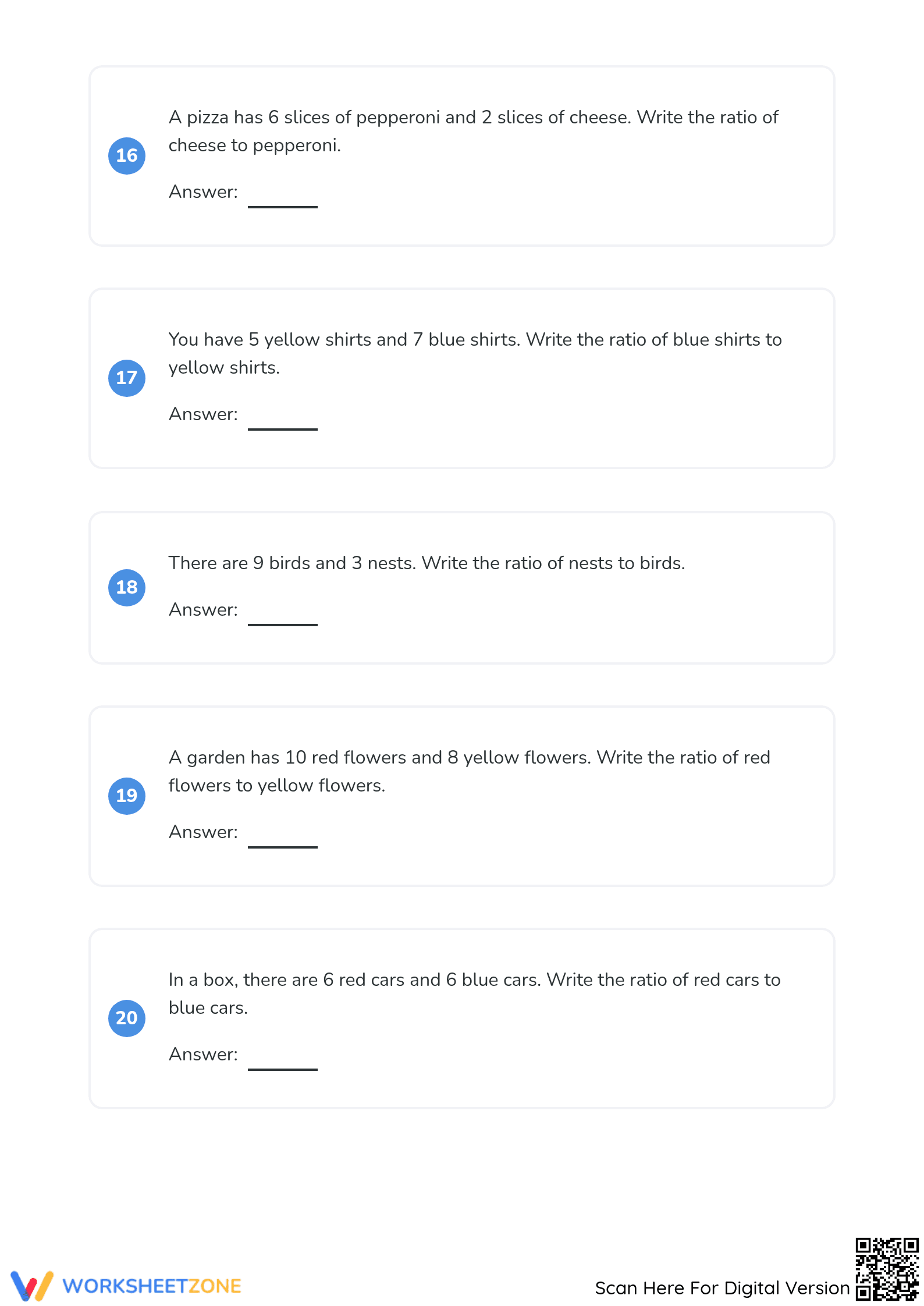
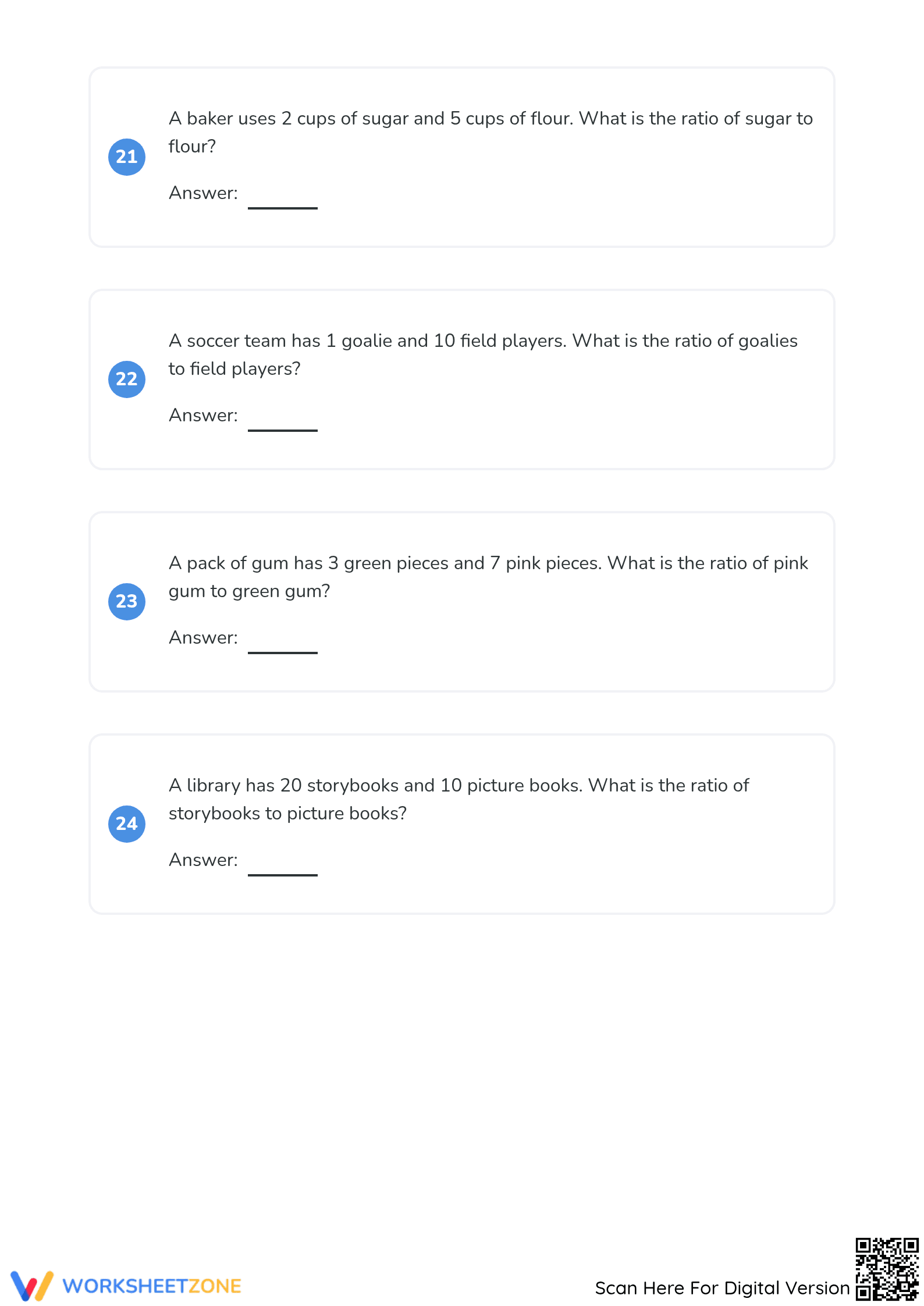
The worksheet features 24 diverse problems organized into three distinct parts: Count and Write, Ratio Reversal, and Ratio Challenges. Students progress from simple visual counting tasks to more complex word problems involving familiar objects like fruit, animals, and school supplies. Each page is clearly formatted with ample space for student answers and includes a scanable QR code for digital access.
Zero-Prep Workflow
Teachers can implement this resource in under two minutes. Simply print the 5-page PDF, distribute to students, and use the included answer key for rapid grading or peer review. The logical progression from pictures to text makes it an ideal choice for emergency sub plans, morning work, or a focused homework assignment that requires zero teacher preparation.
Standards Alignment
This resource is aligned to 6.RP.A.1, which requires students to understand the concept of a ratio and use ratio language to describe a relationship between two quantities. While typically a middle school standard, this Grade 3 version provides the necessary scaffolding for early exposure. Both standard codes can be copied directly into lesson plans, IEP goals, or district curriculum mapping tools.
How to Use It
Use this worksheet as a formative assessment during your introductory unit on fractions or proportional reasoning. Begin with Part 1 as a whole-class guided activity to model ratio notation. Observe how students handle the "Ratio Reversal" in Part 2 to identify those needing support with item order. Expect most students to complete the 24 tasks within a single 30-minute instructional block.
Who It's For
This worksheet is designed for Grade 3 students beginning their journey with proportional thinking. It is highly effective for visual learners who benefit from concrete representations before moving to abstract word problems. It also serves as an excellent enrichment tool for Grade 2 students or a remediation resource for Grade 4 learners needing to solidify their understanding of basic ratios.
Developing early proportional reasoning is a critical milestone in elementary mathematics, serving as the gateway to algebraic thinking. Research from ScienceDirect TpT Analysis (2024) indicates that visual-to-textual scaffolding significantly improves student retention of mathematical vocabulary. By grounding the abstract concept of comparison in observable groups of stars and hearts, this worksheet adheres to the gradual release of responsibility model. Aligned to the 6.RP.A.1 standard, the tasks require students to respect the specific order of terms—a common hurdle for novice learners. Mastery of these 24 problems demonstrates a student's ability to recognize part-to-part relationships and translate them into mathematical notation. This foundational skill is essential for future success in middle school math, providing the conceptual bridge between basic multiplication and complex rate problems found in higher-level curricula. It specifically builds the mental flexibility required for complex proportional reasoning tasks.


