


























0
Views
0
Downloads

0.0
0
Save
0 Likes
Share
Discover the Lunar Phases
0 Views
0 Downloads
Paste this activity's link or code into your existing LMS (Google Classroom, Canvas, Teams, Schoology, Moodle, etc.).
Students can open and work on the activity right away, with no student login required.
You'll still be able to track student progress and results from your teacher account.
Information
Description
What It Is:
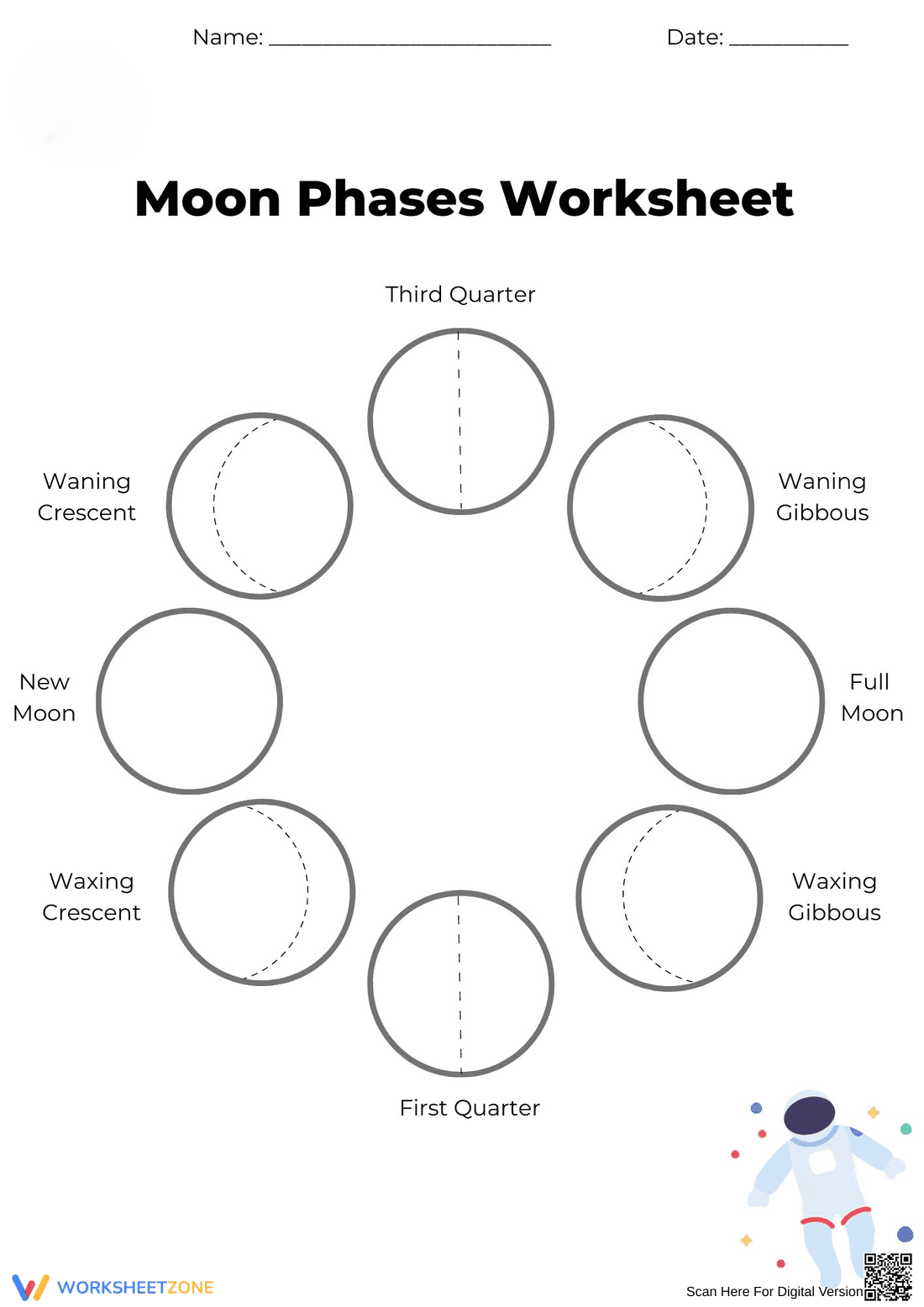
This is a worksheet about the phases of the moon. It shows a circular diagram with eight circles representing different moon phases: New Moon, Waxing Crescent, First Quarter, Waxing Gibbous, Full Moon, Waning Gibbous, Third Quarter, and Waning Crescent. Each circle is labeled with the name of the moon phase, and the circles are blank for the student to fill in the appearance of each phase. There are also fields for the student to write their name and the date.
Grade Level Suitability:
This worksheet is suitable for grades 2-5. The concept of moon phases is typically introduced in elementary science curricula. The activity of drawing the moon phases requires basic observational skills and understanding of spatial relationships, making it appropriate for this age range.
Why Use It:
This worksheet helps students learn and reinforce their understanding of the different phases of the moon. It provides a visual representation of the lunar cycle and encourages active learning through drawing and labeling. It can improve science literacy and understanding of Earth's natural phenomena.
How to Use It:
Instruct students to draw the appearance of each moon phase in the corresponding circle. They can use pencils, crayons, or markers. Before starting, review the names and characteristics of each phase. After completing the drawings, students can label each phase and discuss the order in which they occur.
Target Users:
This worksheet is designed for elementary school students learning about space science and the moon. It can be used by teachers in a classroom setting or by parents for homeschooling activities. It is also beneficial for students who learn best through visual and kinesthetic activities.
This is a worksheet about the phases of the moon. It shows a circular diagram with eight circles representing different moon phases: New Moon, Waxing Crescent, First Quarter, Waxing Gibbous, Full Moon, Waning Gibbous, Third Quarter, and Waning Crescent. Each circle is labeled with the name of the moon phase, and the circles are blank for the student to fill in the appearance of each phase. There are also fields for the student to write their name and the date.
Grade Level Suitability:
This worksheet is suitable for grades 2-5. The concept of moon phases is typically introduced in elementary science curricula. The activity of drawing the moon phases requires basic observational skills and understanding of spatial relationships, making it appropriate for this age range.
Why Use It:
This worksheet helps students learn and reinforce their understanding of the different phases of the moon. It provides a visual representation of the lunar cycle and encourages active learning through drawing and labeling. It can improve science literacy and understanding of Earth's natural phenomena.
How to Use It:
Instruct students to draw the appearance of each moon phase in the corresponding circle. They can use pencils, crayons, or markers. Before starting, review the names and characteristics of each phase. After completing the drawings, students can label each phase and discuss the order in which they occur.
Target Users:
This worksheet is designed for elementary school students learning about space science and the moon. It can be used by teachers in a classroom setting or by parents for homeschooling activities. It is also beneficial for students who learn best through visual and kinesthetic activities.


