


























Views
Downloads

Pete the Cat: A Pet for Pete | Ready Grade 1 ELA
Paste this activity's link or code into your existing LMS (Google Classroom, Canvas, Teams, Schoology, Moodle, etc.).
Students can open and work on the activity right away, with no student login required.
You'll still be able to track student progress and results from your teacher account.
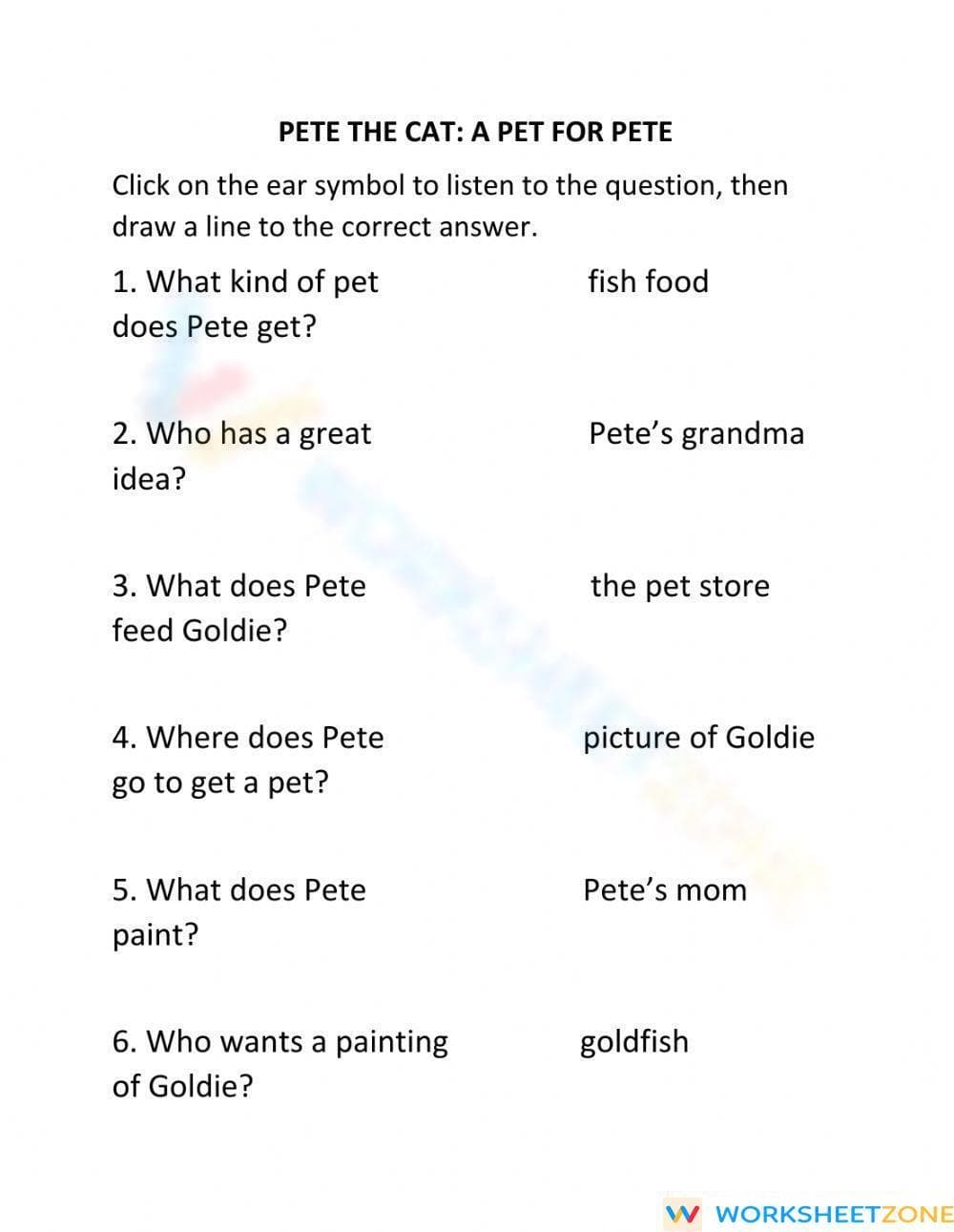
This reading comprehension worksheet helps young learners master literal recall through the engaging story of Pete the Cat. By focusing on specific plot points and character actions, students build the foundational skills necessary for deeper textual analysis. The activity ensures students can identify key details accurately, providing immediate feedback through a clear matching format that rewards careful reading and listening.
At a Glance
- Grade: 1 · Subject: English Language Arts (ELA)
- Standard:
CCSS.ELA-LITERACY.RL.1.1— Ask and answer questions about key details in a text- Skill Focus: Literal comprehension and detail recall
- Format: 1 page · 6 problems · Answer key included · PDF
- Best For: Independent practice or morning work
- Time: 10–15 minutes
What's Inside: This single-page resource features six targeted comprehension questions based on the popular story. The worksheet is structured as a matching activity where students connect questions to their correct answers. It includes a clear header, numbered tasks, and a user-friendly layout designed for early elementary students. A full answer key is provided to facilitate quick grading or self-correction.
Zero-Prep Workflow: Teachers can implement this resource in three simple steps. First, print the single-page PDF for each student (less than 1 minute). Second, distribute the materials and briefly explain the matching instructions (under 2 minutes). Finally, review the answers as a class or using the included key (5 minutes). This streamlined process makes it a perfect choice for sudden substitute plans or focused literacy centers.
Standards Alignment: The primary focus is `CCSS.ELA-LITERACY.RL.1.1`, which requires students to demonstrate their understanding of a text by answering questions about its core elements. By identifying what Pete paints and where he goes, students prove their mastery of literal comprehension. This standard code can be copied directly into lesson plans, IEP goals, or district curriculum mapping tools.
How to Use It: Assign this worksheet during the independent practice portion of a literacy block after a whole-class reading of the book. It serves as an excellent formative assessment to check if students grasped the main events of the narrative. Teachers should observe whether students can locate the specific details in the text or if they rely on memory alone. Expect most first-grade students to complete the 6 tasks within 12 minutes.
Who It's For: This resource is designed for Grade 1 students, though it is suitable for Grade 2 learners who need additional support with recall. It pairs naturally with the original picture book and works well alongside an anchor chart on "Wh- Questions" (Who, What, Where). Differentiation can be achieved by reading the questions aloud for emerging readers or requiring advanced students to write full-sentence justifications for each match.
The `CCSS.ELA-LITERACY.RL.1.1` standard focuses on the essential skill of answering questions about key details in a text, a prerequisite for all higher-level reading. According to Fisher & Frey (2014), literal comprehension serves as the necessary floor for inferential thinking; without the ability to recall specific facts, students cannot progress to complex analysis. This Pete the Cat worksheet provides 6 specific tasks that target this foundational requirement. By engaging with familiar characters, students lower their cognitive load and focus entirely on the mechanics of recall and matching. The structured format ensures that students practice identifying character motivations and setting locations. This resource is an effective tool for verifying that 85 percent of students can correctly identify primary plot points before moving to theme or character development lessons.


