


























Views
Downloads
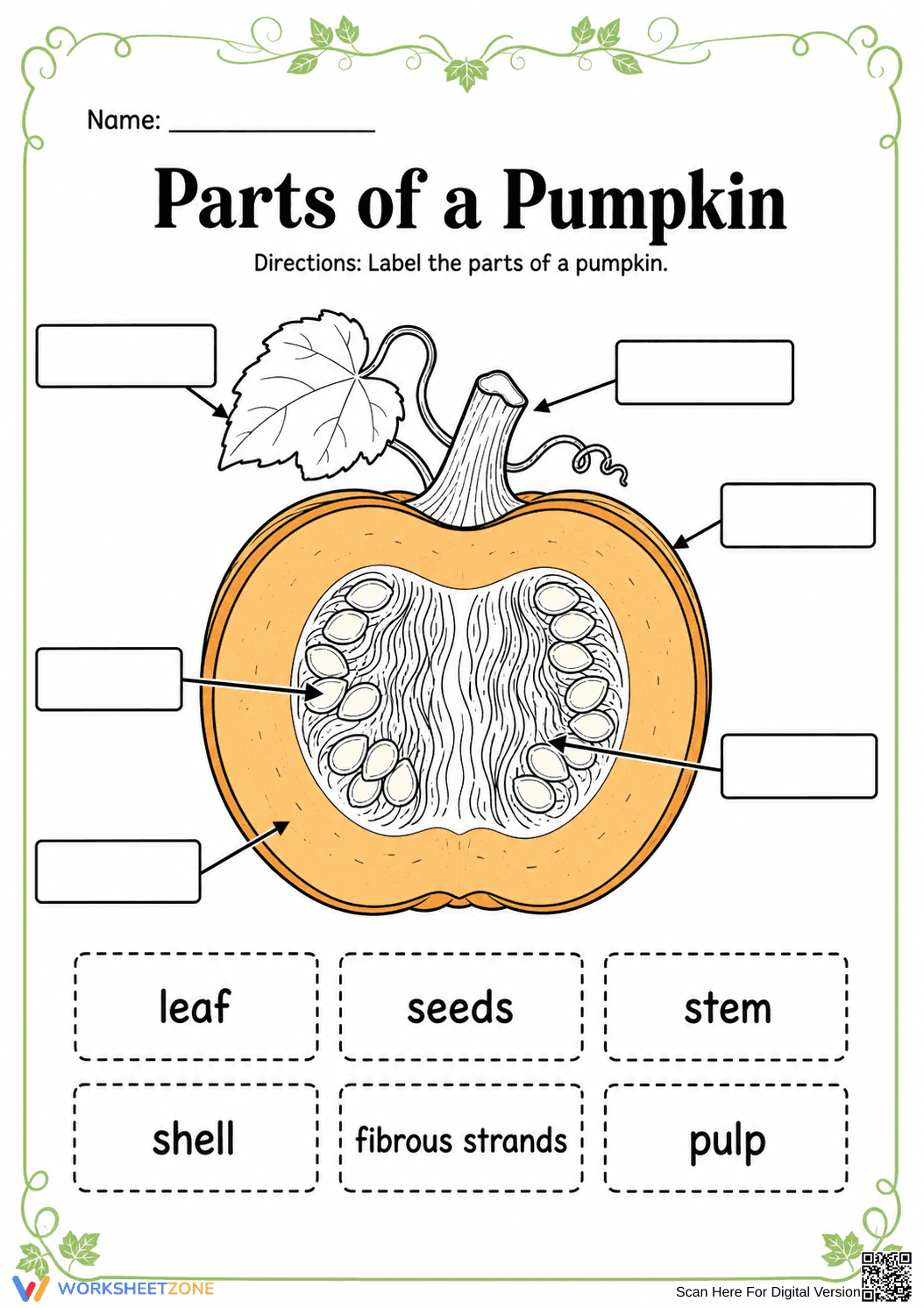

Printable Parts of a Pumpkin Worksheet | Grade 1 Science
Paste this activity's link or code into your existing LMS (Google Classroom, Canvas, Teams, Schoology, Moodle, etc.).
Students can open and work on the activity right away, with no student login required.
You'll still be able to track student progress and results from your teacher account.
This engaging science worksheet helps early elementary students identify and label the anatomical parts of a pumpkin. By matching vocabulary words to a detailed cross-section diagram, learners build foundational knowledge of plant structures and their functions while practicing fine motor skills through writing or cutting and pasting.
At a Glance
- Grade: 1 · Subject: Science
- Standard:
1-LS1-1— Identify and describe external plant structures- Skill Focus: Plant Anatomy & Vocabulary
- Format: 1 page · 6 problems · Answer key included · PDF
- Best For: Independent practice or centers
- Time: 10–15 minutes
What's Inside
This single-page resource features a clear, black-and-white illustration of a pumpkin's interior and exterior. Students are tasked with completing six labeling problems using a provided word bank that includes terms like stem, shell, fibrous strands, seeds, pulp, and leaf. The dashed lines around the vocabulary words allow this to be used as either a simple fill-in-the-blank writing exercise or a hands-on cut-and-paste activity. An answer key is included for quick grading.
Zero-Prep Workflow
- Print (1 min): Simply print the PDF. No special materials are required unless using scissors and glue for the cut-and-paste option.
- Distribute (1 min): Hand out the worksheets along with pencils or crafting supplies. The visual directions are self-explanatory for young learners.
- Review (1 min): Use the included answer key to quickly check student work or project it on the board for self-correction. Total teacher prep time is under two minutes, making it an ideal emergency sub plan.
Standards Alignment
Aligned to 1-LS1-1, this activity supports students in understanding how plants use their external parts to survive and grow. By identifying specific structures like the protective shell or the nutrient-rich pulp, students build a foundation for more complex biological concepts. Both standard codes can be copied directly into lesson plans, IEP goals, or district curriculum mapping tools.
How to Use It
Use this worksheet during a fall-themed science unit after a direct instruction lesson on plant life cycles. It works perfectly as an independent science center activity where students can examine a real pumpkin alongside the diagram. For a formative assessment observation tip, watch to see if students can correctly distinguish between the "pulp" and the "fibrous strands" before they finalize their answers. Expected completion time is 10 to 15 minutes.
Who It's For
This resource is designed for kindergarten and first-grade students developing basic science vocabulary. The visual supports make it highly accessible for English Language Learners and students needing modified assignments. It pairs wonderfully with a read-aloud book about the pumpkin life cycle or a hands-on pumpkin carving demonstration.
Integrating visual diagrams with vocabulary instruction significantly enhances early childhood science comprehension. When students identify and describe external plant structures, as outlined in standard 1-LS1-1, they develop crucial observational skills necessary for later STEM success. According to Fisher & Frey (2014), providing structured vocabulary supports, such as word banks and clear visual models, allows young learners to access complex content more effectively. This pumpkin anatomy worksheet leverages these evidence-based strategies by combining a clear cross-section diagram with targeted terminology. By physically interacting with the vocabulary through writing or cutting and pasting, students reinforce their memory of plant structures. This multimodal approach ensures that foundational biological concepts are firmly established, preparing students for more advanced investigations into how living things grow, adapt, and survive in their environments.


