




























Views
Downloads

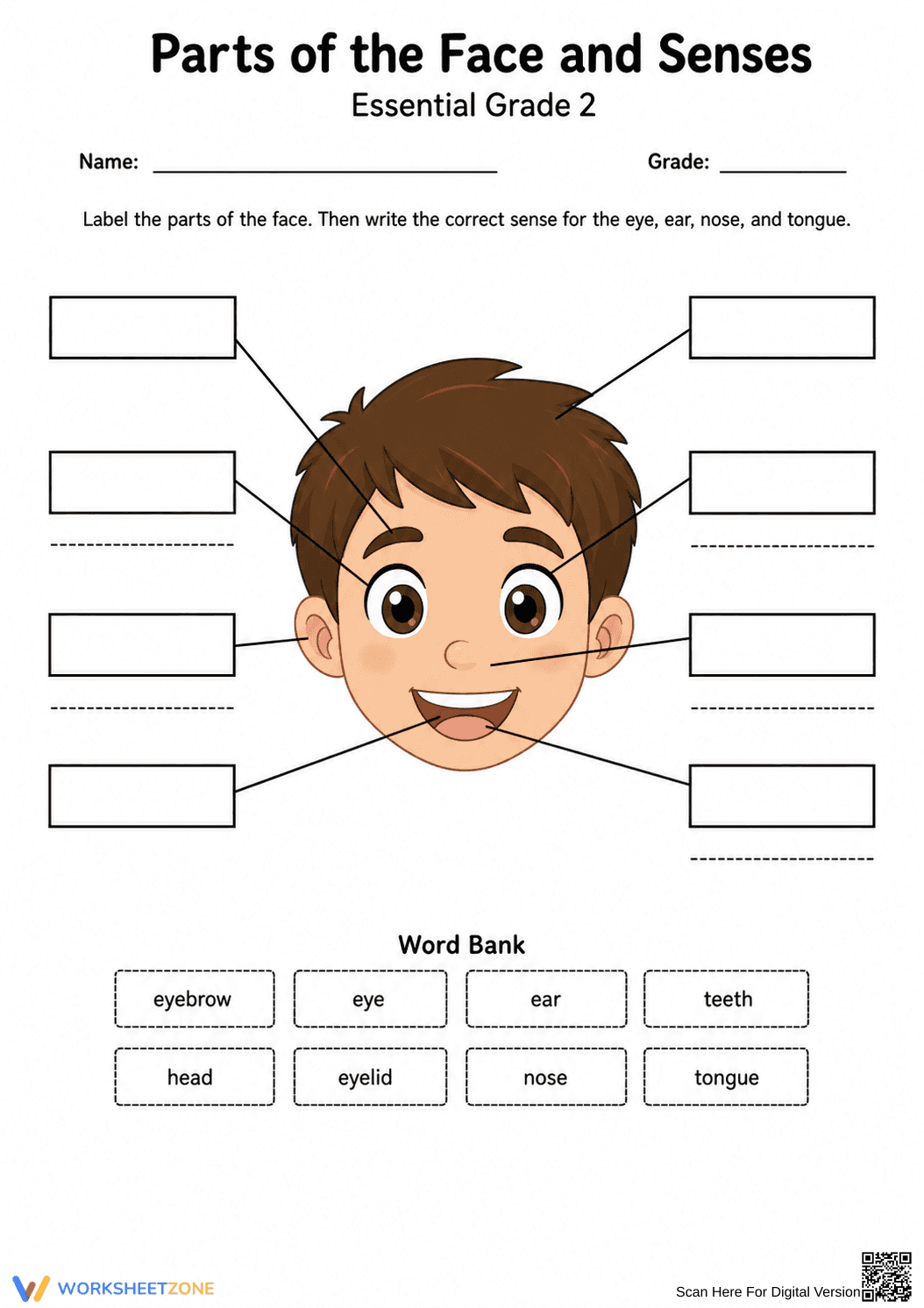

Grade 2 Face and Senses — Printable No-Prep Worksheet

Paste this activity's link or code into your existing LMS (Google Classroom, Canvas, Teams, Schoology, Moodle, etc.).
Students can open and work on the activity right away, with no student login required.
You'll still be able to track student progress and results from your teacher account.
This Grade 2 science worksheet helps students identify external facial features and connect them to the five senses. By labeling a clear diagram and categorizing sensory functions, learners build essential biological vocabulary and observation skills. This resource provides a structured way to assess student understanding of human anatomy.
At a Glance
- Grade: 2 · Subject: Science
- Standard:
1-LS1-1— Identify how external body parts function to sense the environment- Skill Focus: Human body parts and sensory association
- Format: 2 pages · 12 problems · Answer key included · PDF
- Best For: Zero-prep science centers or sub plans
- Time: 15–20 minutes
What's Inside
Inside this resource, you will find a high-quality illustration of a child's face featuring eight clear labeling lines and an integrated word bank. The vocabulary includes specific anatomical terms like eyelid, eyebrow, and tongue. Below the primary diagram, a secondary task requires students to map specific senses—smell, taste, sight, and hearing—to the correct facial features. A complete answer key is provided for rapid verification.
Zero-Prep Workflow
This worksheet is designed for maximum efficiency in busy classrooms, requiring under two minutes of total teacher prep time. First, print the PDF, which takes seconds for a full class set. Second, distribute the handouts during your science block; the included word bank ensures students can work independently without constant teacher prompts. Finally, use the provided answer key to review the 12 tasks quickly. This self-explanatory format makes it an ideal, reliable option for emergency sub plans.
Standards Alignment
This worksheet aligns with 1-LS1-1, focusing on how organisms use their external parts to help them survive, grow, and meet their needs by sensing their environment. It also supports CCSS.ELA-LITERACY.L.2.4 by expanding domain-specific vocabulary related to the human body. Both standard codes can be copied directly into lesson plans, IEP goals, or district curriculum mapping tools.
How to Use It
Use this worksheet as a formative assessment during a unit on the five senses. After a direct instruction lesson on sensory organs, assign this task to check for individual mastery. Alternatively, it serves as an excellent morning work activity to activate prior knowledge. Teachers should observe if students correctly associate the tongue with taste versus the teeth, which is a common point of confusion. Expected completion time is 15 to 20 minutes.
Who It's For
This resource is tailored for Grade 2 students but is also appropriate for Grade 1 enrichment or Grade 3 review. It is particularly helpful for English Language Learners due to the visual nature of the labeling task and the provided word bank. Pair this worksheet with a short reading passage about sensory nerves or a hands-on mystery bag smell test for a comprehensive lesson.
The integration of visual diagrams with vocabulary labeling is a core component of effective science instruction for primary students. According to Fisher & Frey (2014), the use of graphic organizers and annotated diagrams supports the gradual release of responsibility, allowing students to transition from guided observation to independent mastery of complex biological concepts. This Grade 2 worksheet specifically targets the 1-LS1-1 standard by requiring students to identify how external body parts function to sense the environment across 12 distinct anatomical features and sensory functions. By providing a structured word bank and a clear visual target, this resource reduces cognitive load and ensures that learners can focus on the relationships between body parts and sensory input. It serves as a reliable tool for classroom data collection and curriculum alignment.


