


























Views
Downloads
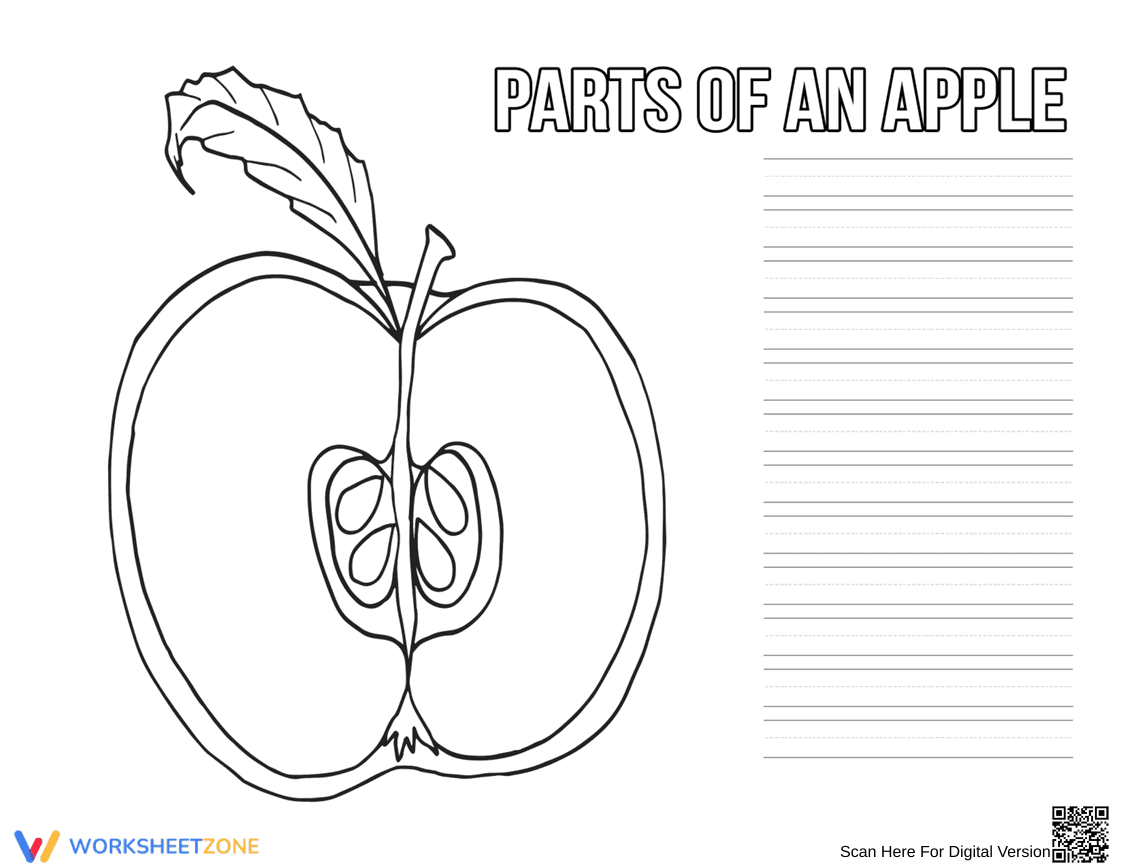

Grade 1 Parts of an Apple — Printable No-Prep Worksheet
Paste this activity's link or code into your existing LMS (Google Classroom, Canvas, Teams, Schoology, Moodle, etc.).
Students can open and work on the activity right away, with no student login required.
You'll still be able to track student progress and results from your teacher account.
This printable parts of an apple worksheet develops foundational informative writing and domain vocabulary skills for early elementary students. Combining a clear anatomical illustration with structured handwriting lines, the activity prompts young learners to identify key plant structures while practicing descriptive sentence formation and proper handwriting mechanics.
At a Glance
- Grade: 1 · Subject: English Language Arts (ELA)
- Standard:
CCSS.ELA-LITERACY.W.1.2— Write informative texts naming a topic and supplying facts- Skill Focus: Informative Writing and Vocabulary
- Format: 1 page · 1 writing task · Answer key included · PDF
- Best For: Independent writing practice and science centers
- Time: 15–20 minutes
This single-page resource features a cross-section illustration of an apple alongside ten primary handwriting lines with dotted midlines. The diagram displays the stem, leaf, skin, flesh, core, and seeds. A complete sample answer key and vocabulary word bank are included to support teachers in guiding students through accurate anatomical labeling and factual sentence generation.
Zero-Prep Classroom Workflow
Designed for immediate classroom deployment, this worksheet requires minimal teacher preparation.
- Print (30 seconds): The single-page PDF generates clear copies instantly without complex formatting concerns.
- Distribute (30 seconds): Hand out sheets directly to student tables or literacy centers with zero cutting required.
- Review (1 minute): Display the sample answer key on the projector to establish expectations for vocabulary usage.
With total teacher prep time under two minutes, this resource serves as an excellent emergency sub plan or quick morning work assignment.
Standards Alignment
This worksheet aligns directly to primary standard CCSS.ELA-LITERACY.W.1.2, requiring students to write informative texts in which they name a topic and supply facts. Additionally, it supports science learning by reinforcing basic plant structure identification. Both standard codes can be copied directly into lesson plans, IEP goals, or district curriculum mapping tools.
How to Use It in the Classroom
Teachers can utilize this resource during literacy blocks or following direct instruction on plant life cycles. Students examine the diagram, label the parts, and write complete sentences describing each structure. For formative assessment, teachers should observe handwriting mechanics on the dotted midlines and verify that vocabulary words like core and stem are spelled correctly. Expected completion time ranges from 15 to 20 minutes.
Target Audience and Differentiation
This worksheet is designed for first-grade students developing informative writing capabilities, adapting easily to kindergarten or second-grade classrooms. For emerging writers, teachers can provide sentence frames to reduce cognitive load. Advanced students can write complex sentences detailing the biological purpose of seeds. This activity pairs naturally with an anchor chart displaying apple vocabulary.
Integrating visual diagrams with structured writing tasks provides essential scaffolding for early elementary literacy development. Addressing CCSS.ELA-LITERACY.W.1.2 to write informative texts naming a topic and supplying facts requires explicit connections between domain vocabulary and sentence formation. According to Fisher & Frey (2014), structured guided practice combined with clear visual representations significantly improves student retention of academic vocabulary and enhances overall writing quality in primary classrooms. By providing immediate visual context alongside primary handwriting lines, this worksheet reduces working memory strain and allows young learners to focus directly on factual content generation and proper syntax. This dual-modality approach ensures that students actively connect scientific concepts with literacy skills, establishing a strong foundation for future informational writing tasks across various academic disciplines.


