


























Views
Downloads

Grade 3 Parts of a Seed — Essential Printable Worksheet
Paste this activity's link or code into your existing LMS (Google Classroom, Canvas, Teams, Schoology, Moodle, etc.).
Students can open and work on the activity right away, with no student login required.
You'll still be able to track student progress and results from your teacher account.
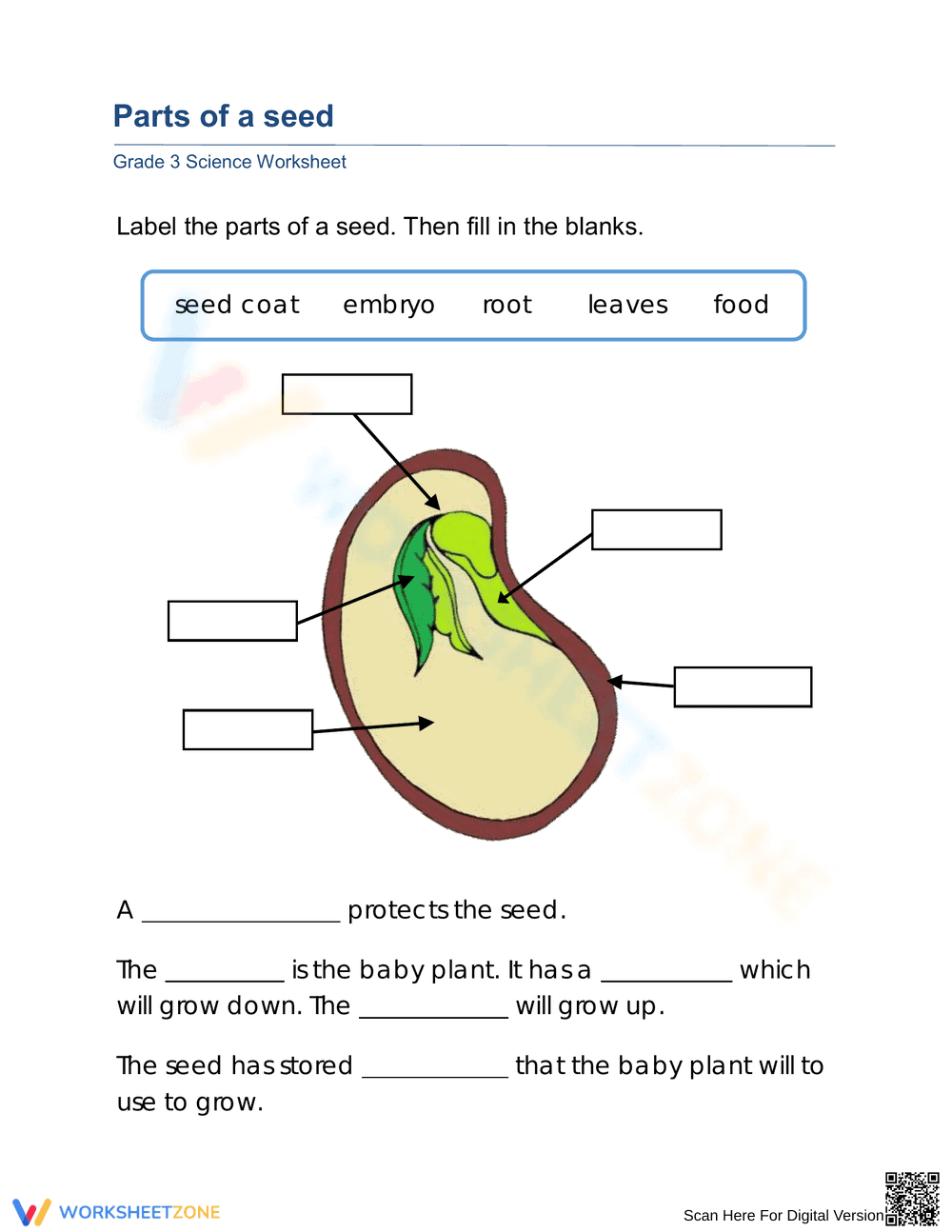
This Grade 3 Science worksheet provides a clear, structured way for students to master seed anatomy and biological functions. By labeling a detailed diagram and completing descriptive sentences, learners identify how seeds protect, nourish, and develop into new plants. It is an ideal resource for introductory life science lessons.
At a Glance
- Grade: 3 · Subject: Living Things
- Standard:
3-LS1-1— Identify seed parts and explain their role in plant growth- Skill Focus: Seed anatomy and function
- Format: 1 page · 10 tasks · Answer key included · PDF
- Best For: Independent practice or quick formative assessment
- Time: 15–20 minutes
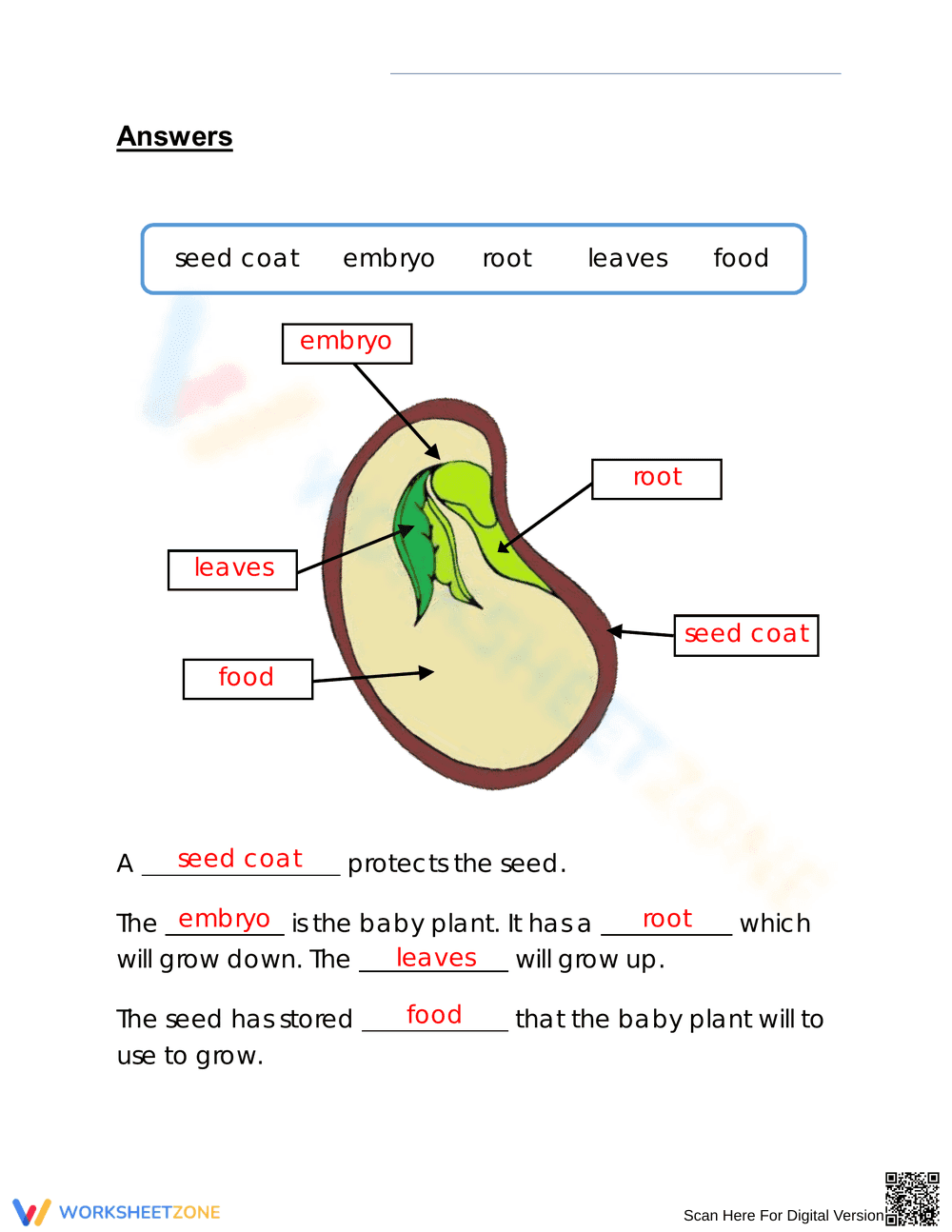
Students engage with a two-part activity spanning one comprehensive page. The first section features a high-quality cross-section illustration of a bean seed with five labeling callouts and a helpful word bank. The second section provides five fill-in-the-blank cloze sentences that reinforce the vocabulary through functional descriptions. A full-color answer key is included for rapid grading.
This resource is designed for immediate classroom implementation with three simple steps. First, print the single-page PDF (30 seconds). Second, distribute to students for independent or small-group work (1 minute). Third, review the answers using the provided key for instant feedback (2 minutes). The entire teacher prep cycle takes under two minutes, making it a perfect sub-plan or bell-ringer.
Aligned to 3-LS1-1, this worksheet supports the understanding that plants have specific structures that facilitate their life cycles. By identifying the embryo, seed coat, and food storage, students build the foundational knowledge required to describe how organisms grow and reproduce. This standard code can be copied directly into lesson plans, IEP goals, or district curriculum mapping tools.
Use this worksheet during the "Explain" phase of a 5E lesson after students have explored real seeds. It serves as an excellent formative assessment to check if students can differentiate between the embryo and the stored food. Expected completion time is 15 to 20 minutes, allowing it to fit easily into a standard science block or as a homework reinforcement.
This resource is tailored for third-grade students beginning their study of botany and life cycles. It includes scaffolds like a word bank and diagrammatic arrows to support diverse learners, including ENL students. It pairs naturally with a hands-on seed dissection lab or a classroom reading passage about plant reproduction.
The 3-LS1-1 standard emphasizes the use of models to describe life cycles, a practice that Fisher & Frey (2014) identify as critical for developing disciplinary literacy in science. By requiring students to transition from visual labeling to linguistic description, this worksheet reinforces the connection between anatomical structure and biological function. This dual-modal approach ensures that Grade 3 learners don't just memorize names like "seed coat" or "embryo" but understand their roles in the survival of the baby plant. Research from the NAEP highlights that early mastery of biological structures predicts long-term success in complex environmental science topics. This worksheet provides the 10 structured tasks necessary to bridge that conceptual gap efficiently. At just one page with zero teacher prep, it provides a high-impact, evidence-based intervention for any living things curriculum.


