


























Views
Downloads



Printable Reading Comprehension Quiz | Grade 4 & 5 ELA
Paste this activity's link or code into your existing LMS (Google Classroom, Canvas, Teams, Schoology, Moodle, etc.).
Students can open and work on the activity right away, with no student login required.
You'll still be able to track student progress and results from your teacher account.
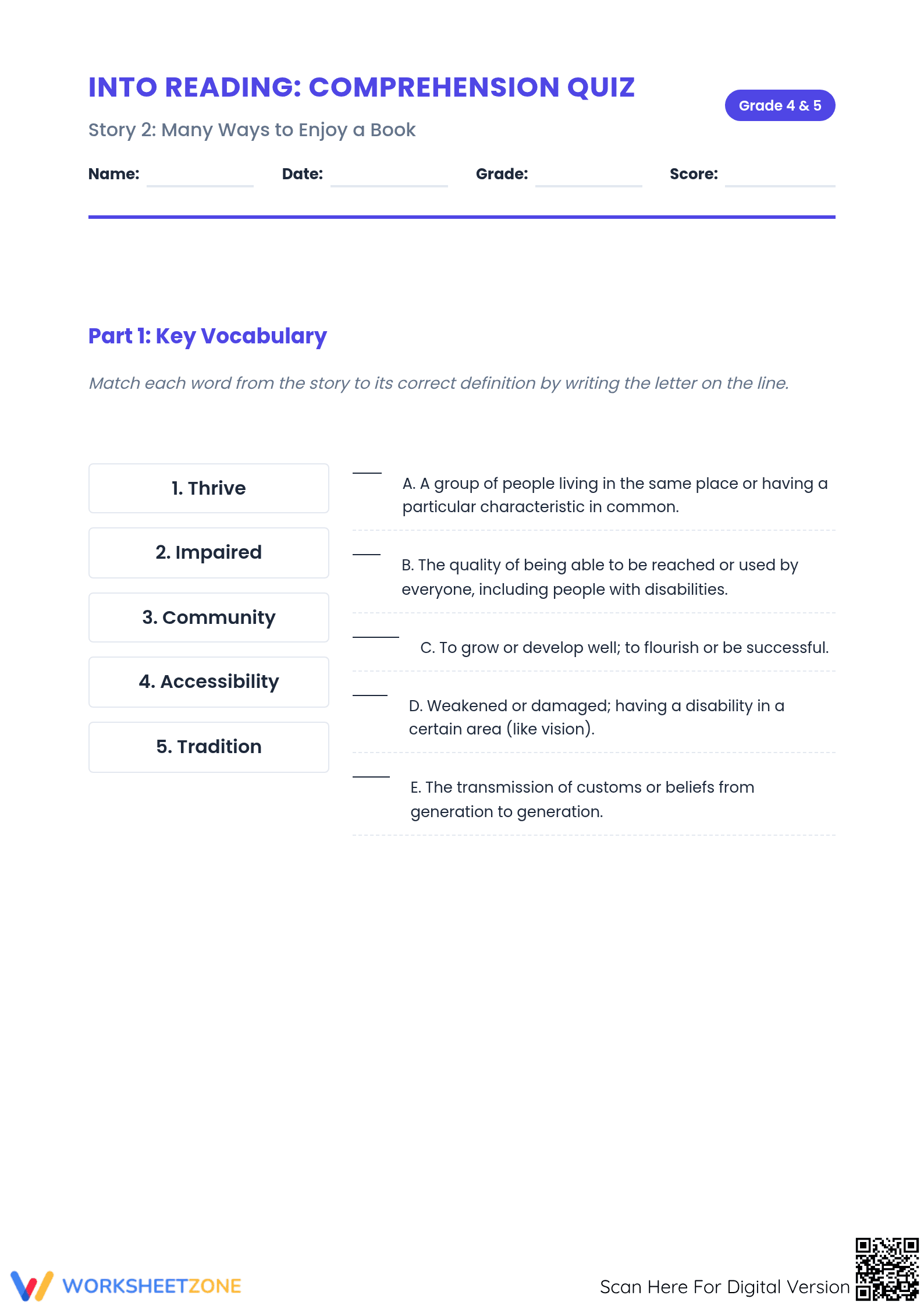
This comprehensive reading quiz evaluates student understanding of key vocabulary and text comprehension. Designed for fourth and fifth graders, the assessment requires students to match definitions, answer multiple-choice questions, and provide text-based evidence in short-answer responses, ensuring a thorough check of their literacy skills.
At a Glance
- Grade: 4 · Subject: ELA
- Standard:
CCSS.ELA-LITERACY.RI.4.1— Refer to details and examples in a text.- Skill Focus: Reading comprehension and vocabulary
- Format: 4 pages · 15 problems · Answer key included · PDF
- Best For: Formative assessment or independent practice
- Time: 25–35 minutes
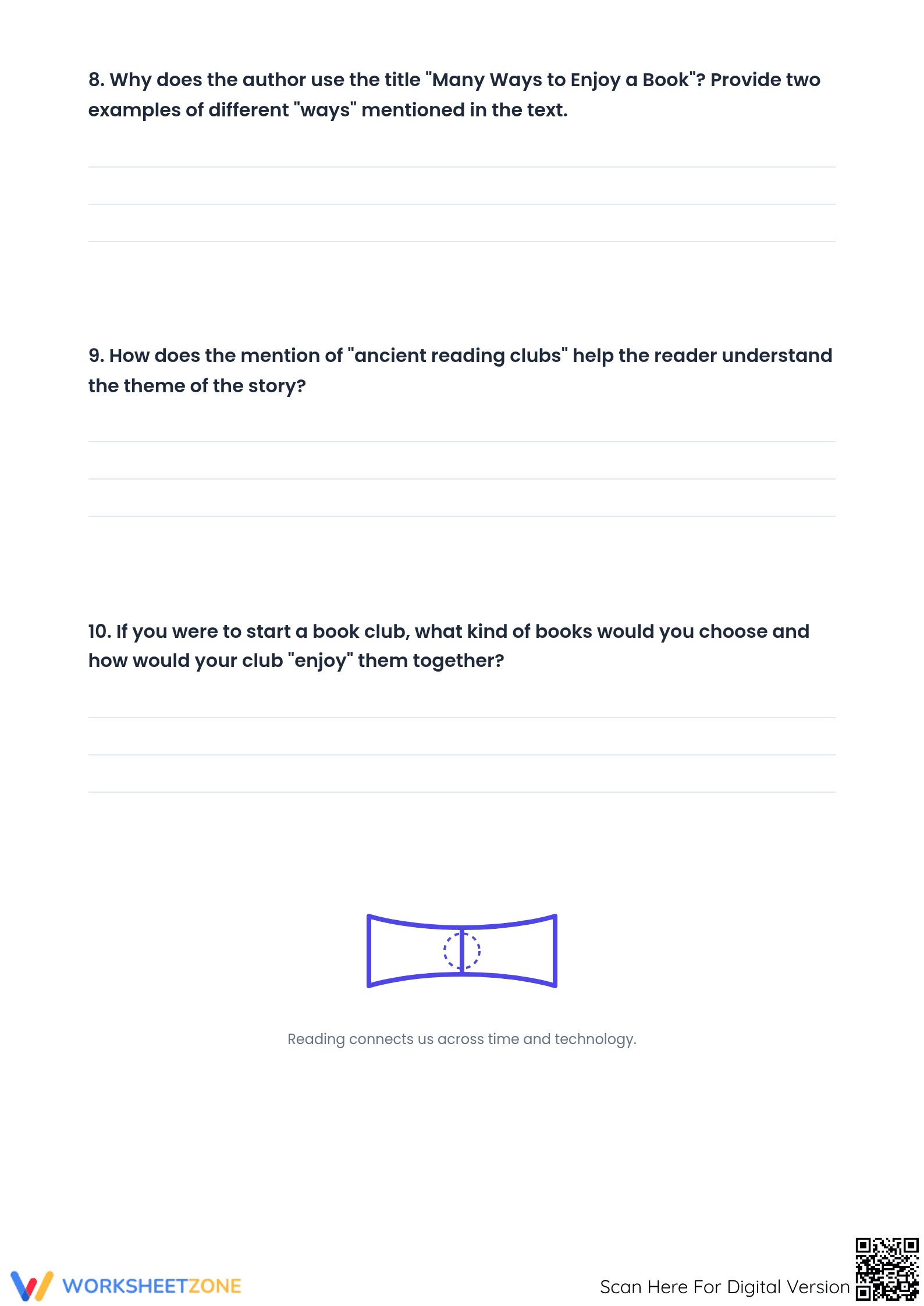
This four-page assessment features three distinct sections to measure student learning. Part one includes five vocabulary matching questions focusing on context-specific terms. Part two contains seven multiple-choice comprehension questions that test recall and inference. Finally, part three challenges students with three critical thinking short-answer prompts that require complete sentences and textual evidence. A complete answer key is provided for quick grading.
This resource is designed for immediate classroom implementation with a streamlined workflow:
- Print (1 minute): Simply print the four-page student packet and the corresponding answer key.
- Distribute (1 minute): Hand out the assessment after completing the associated reading passage or unit.
- Review (3 minutes): Use the included answer key to quickly grade the multiple-choice and matching sections, leaving more time to evaluate the short-answer responses.
Total teacher prep time is under two minutes, making this an excellent option for emergency sub plans or quick end-of-week assessments.
This worksheet is tightly aligned to CCSS.ELA-LITERACY.RI.4.1, requiring students to refer to details and examples in a text when explaining what the text says explicitly and when drawing inferences. It also supports vocabulary acquisition standards by asking students to define words like "thrive" and "accessibility" based on their reading. Both standard codes can be copied directly into lesson plans, IEP goals, or district curriculum mapping tools.
Teachers can deploy this quiz as a summative assessment at the end of a reading unit to measure comprehension and vocabulary retention. Alternatively, it works well as an independent practice packet during literacy centers. As a formative assessment tip, review the short-answer responses to identify students who struggle with citing text evidence; these students can be pulled into a small group for targeted reteaching. Students will typically complete this activity in 25 to 35 minutes.
This resource is ideal for fourth and fifth-grade general education students, but it can easily be adapted for diverse learners. For students requiring accommodations, teachers might reduce the multiple-choice options or allow oral responses for the critical thinking section. It pairs perfectly with direct instruction on finding text evidence and using context clues to determine word meaning.
Developing strong reading comprehension and vocabulary skills is essential for upper elementary students transitioning to more complex texts. This assessment targets CCSS.ELA-LITERACY.RI.4.1, requiring learners to refer to details and examples in a text to support their answers. According to Fisher & Frey (2014), providing structured opportunities for students to engage with text-dependent questions significantly improves their ability to draw inferences and articulate their understanding. By combining vocabulary matching, multiple-choice recall, and critical thinking prompts, this resource ensures a balanced approach to literacy evaluation. Regular practice with these varied question types builds stamina and prepares students for more rigorous academic demands. Utilizing targeted assessments like this allows educators to pinpoint specific areas of need, ensuring that all students can successfully navigate and comprehend grade-level informational texts and literature.


