


























Views
Downloads

Newton's Laws Worksheet | Grade 8 Science Ready
Paste this activity's link or code into your existing LMS (Google Classroom, Canvas, Teams, Schoology, Moodle, etc.).
Students can open and work on the activity right away, with no student login required.
You'll still be able to track student progress and results from your teacher account.
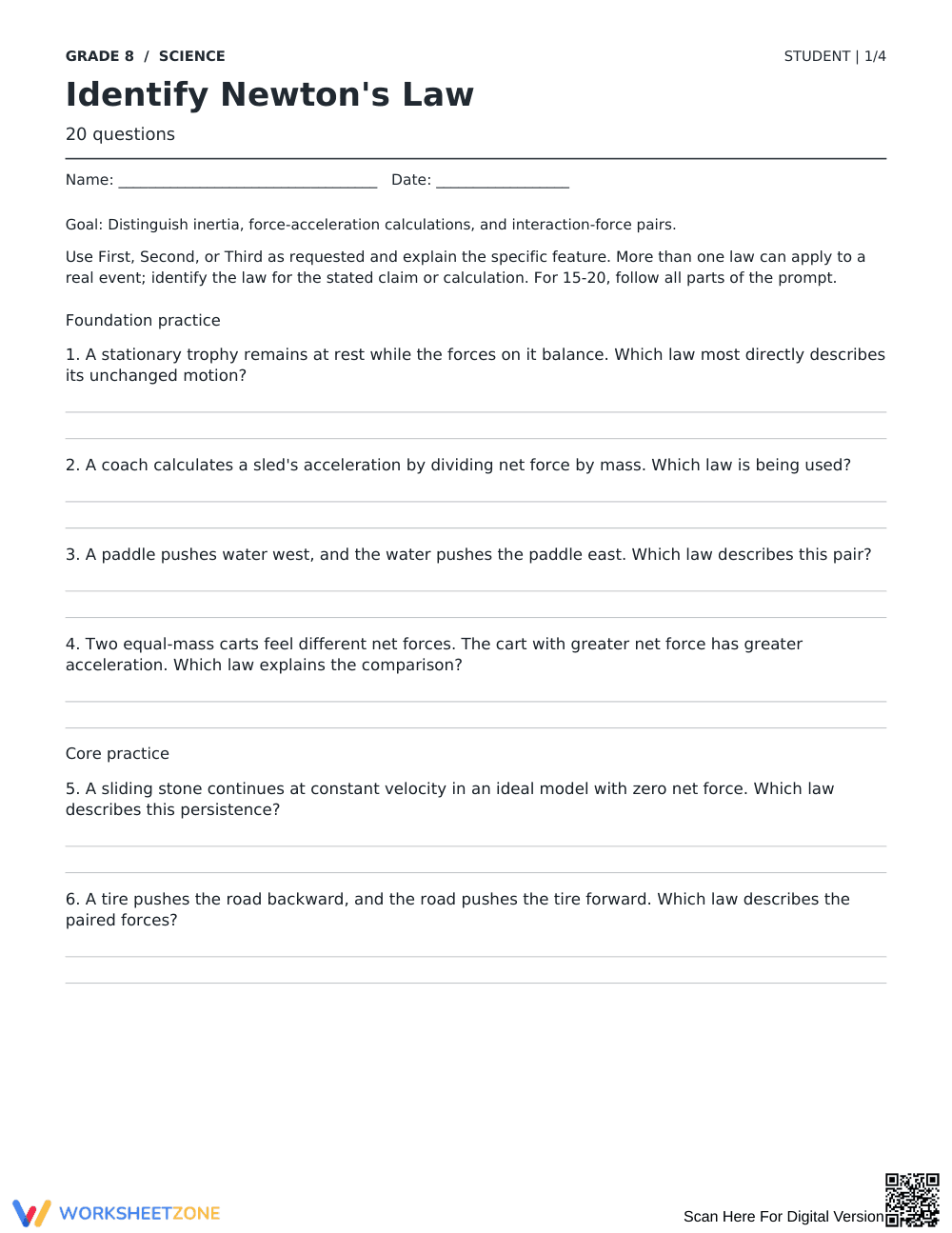
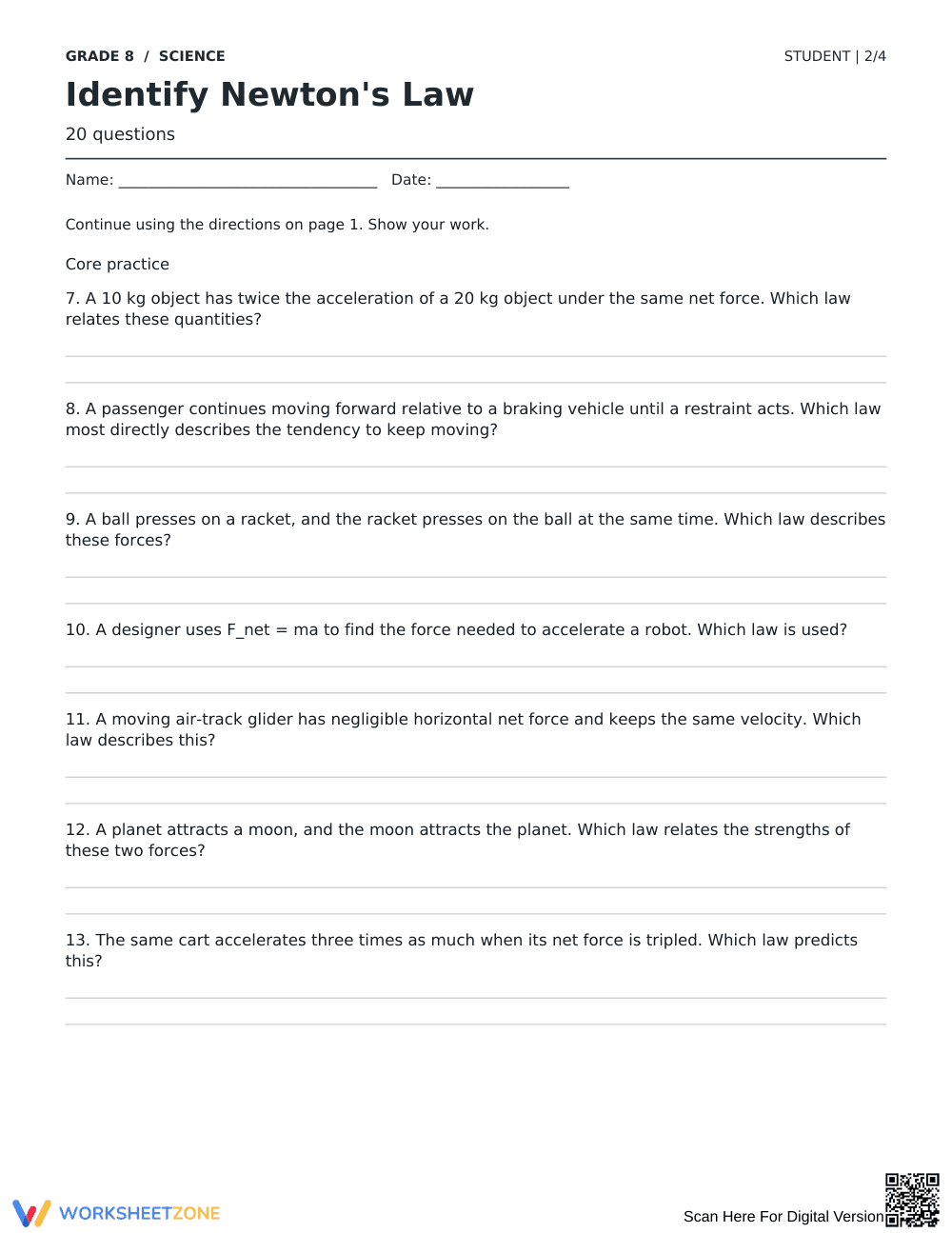
This Newton's laws worksheet trains eighth-grade physical science students to identify, distinguish, and calculate relationships across Newton's First, Second, and Third Laws of Motion. Through 20 targeted scenarios, learners evaluate real-world physical systems, analyze balanced and unbalanced forces, and calculate acceleration to build durable conceptual mastery.
At a Glance
- Grade: 8 · Subject: Science
- Standard:
MS-PS2-2— Plan an investigation to show force and mass change an object's motion- Skill Focus: Newton's First, Second, and Third Laws
- Format: 4 pages · 20 problems · Answer key included · PDF
- Best For: Force and motion unit review
- Time: 30–45 minutes
What's Inside
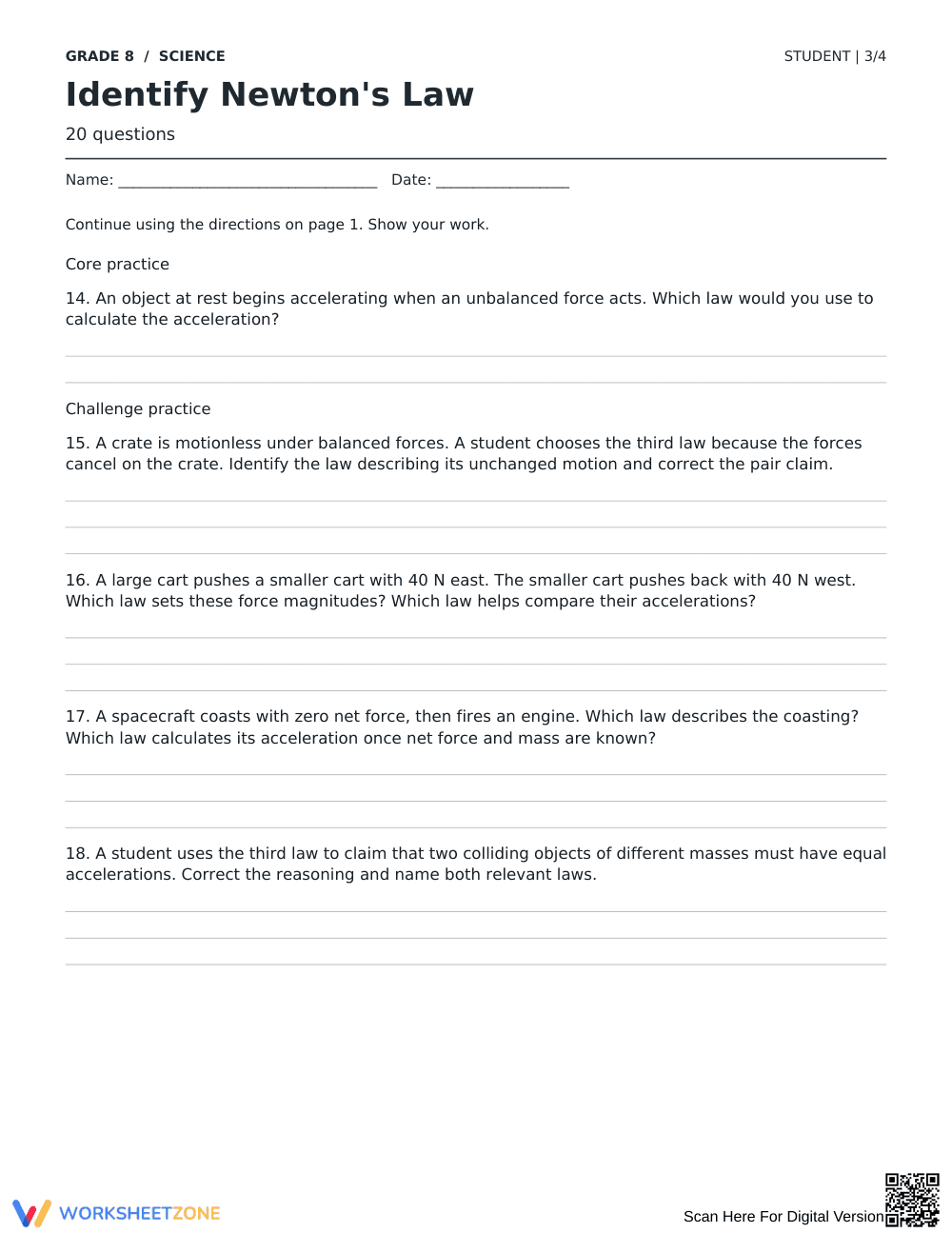
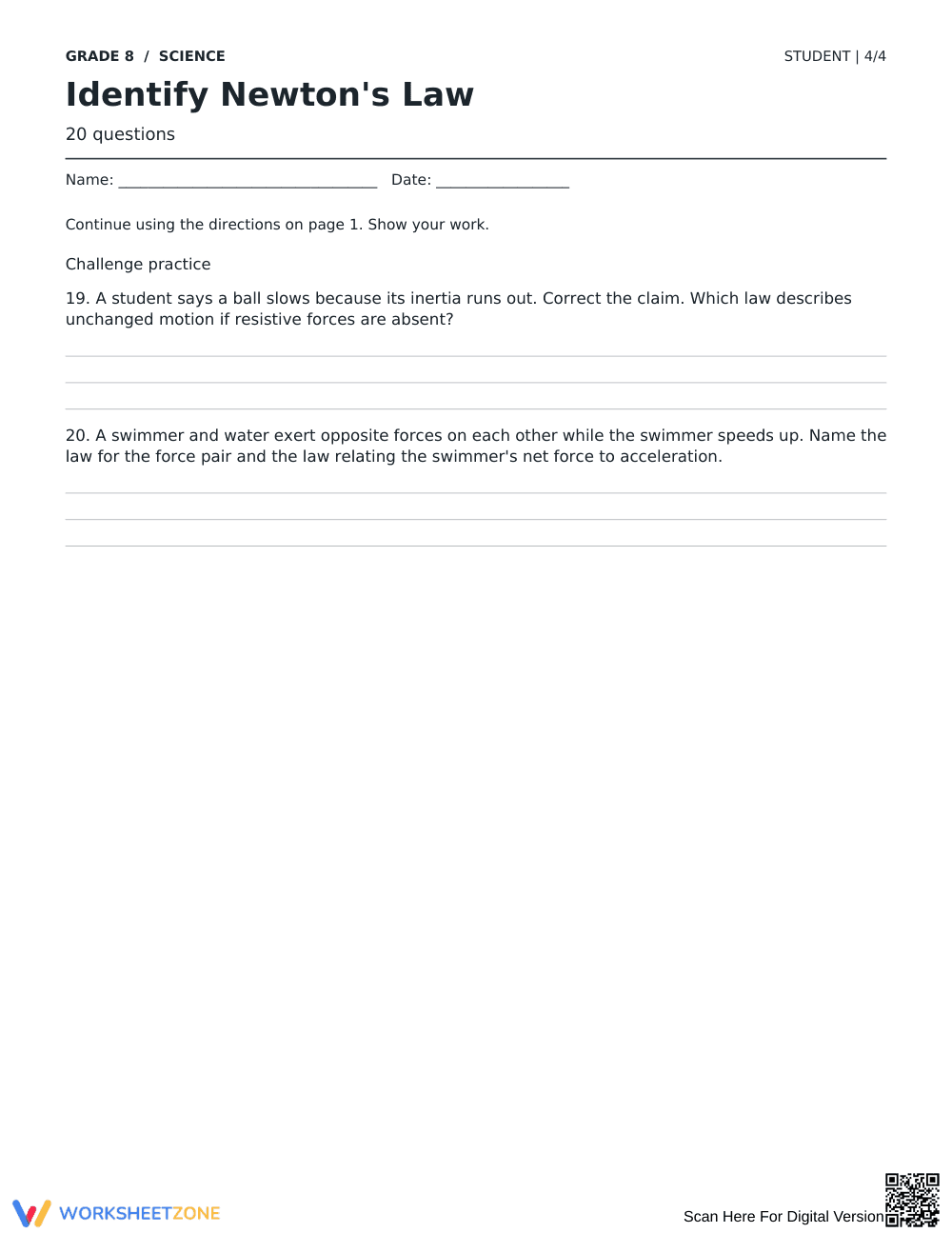
The 4-page student activity provides 20 prompt-driven free-response questions divided into three distinct difficulty bands. Students analyze inertia, compute values using the force-acceleration formula, and identify simultaneous action-reaction interaction pairs. A comprehensive 2-page answer key provides complete conceptual explanations and suggested point allocations for immediate feedback.
Skill Progression
- Foundation practice (Problems 1–4): Guided practice featuring baseline identification of balanced stationary forces, formula division for acceleration, and direct opposite action-reaction pairs with low scaffolded complexity.
- Core practice (Problems 5–14): Supported practice challenging students to analyze proportional changes, proportional acceleration ratios, vehicular inertia, and simultaneous contact forces across multi-step scenarios.
- Challenge practice (Problems 15–20): Independent practice requiring error analysis, correcting common misconceptions about interaction pairs, and explaining multi-stage physical events such as coasting spacecraft and propulsion.
This structured progression reflects the gradual-release model, shifting students smoothly from scaffolded recall to independent conceptual synthesis.
Standards Alignment
This resource aligns directly to `MS-PS2-2`: Plan an investigation to provide evidence that the change in an object's motion depends on the sum of the forces on the object and the mass of the object. It also supports `MS-PS2-1` by requiring students to apply Newton's Third Law to identify simultaneous forces acting on distinct colliding bodies. Both standard codes can be copied directly into lesson plans, IEP goals, or district curriculum mapping tools.
How to Use It
Deploy this worksheet after direct instruction on balanced forces and Newton's laws to solidify conceptual distinctions before laboratory investigations. Alternatively, administer it as a mid-unit checkpoint to identify student confusion between balanced net forces and interaction pairs. Formative observation tip: inspect student explanations on questions 15 and 18 to verify that learners recognize third-law force pairs act on two different bodies rather than canceling on one. Expected completion time is 30 to 45 minutes.
Who It's For
This activity is designed for Grade 8 physical science classes, introductory high school physics courses, and targeted intervention groups. The tiered layout enables teachers to assign foundation items for emerging learners while reserving multi-step prompts for advanced students. Pair this printable directly with a hands-on cart-and-pulley laboratory or digital motion simulation.
Rigorous science instruction demands that learners move beyond memorizing definitions toward analyzing physical dynamics under standard MS-PS2-2. According to Fisher & Frey (2014), purposeful scaffolding through guided, supported, and independent practice tiers establishes durable transfer of abstract scientific principles. This 4-page physical science worksheet provides 20 contextual prompts that isolate inertia, proportional acceleration, and simultaneous force interactions. Students confront common misconceptions, such as confusing third-law reaction pairs with balanced equilibrium forces, through written justification and mathematical reasoning. Teachers obtain clear, actionable data regarding student mastery of forces and motion through the included multi-point answer key and diagnostic explanations.


