


























Views
Downloads
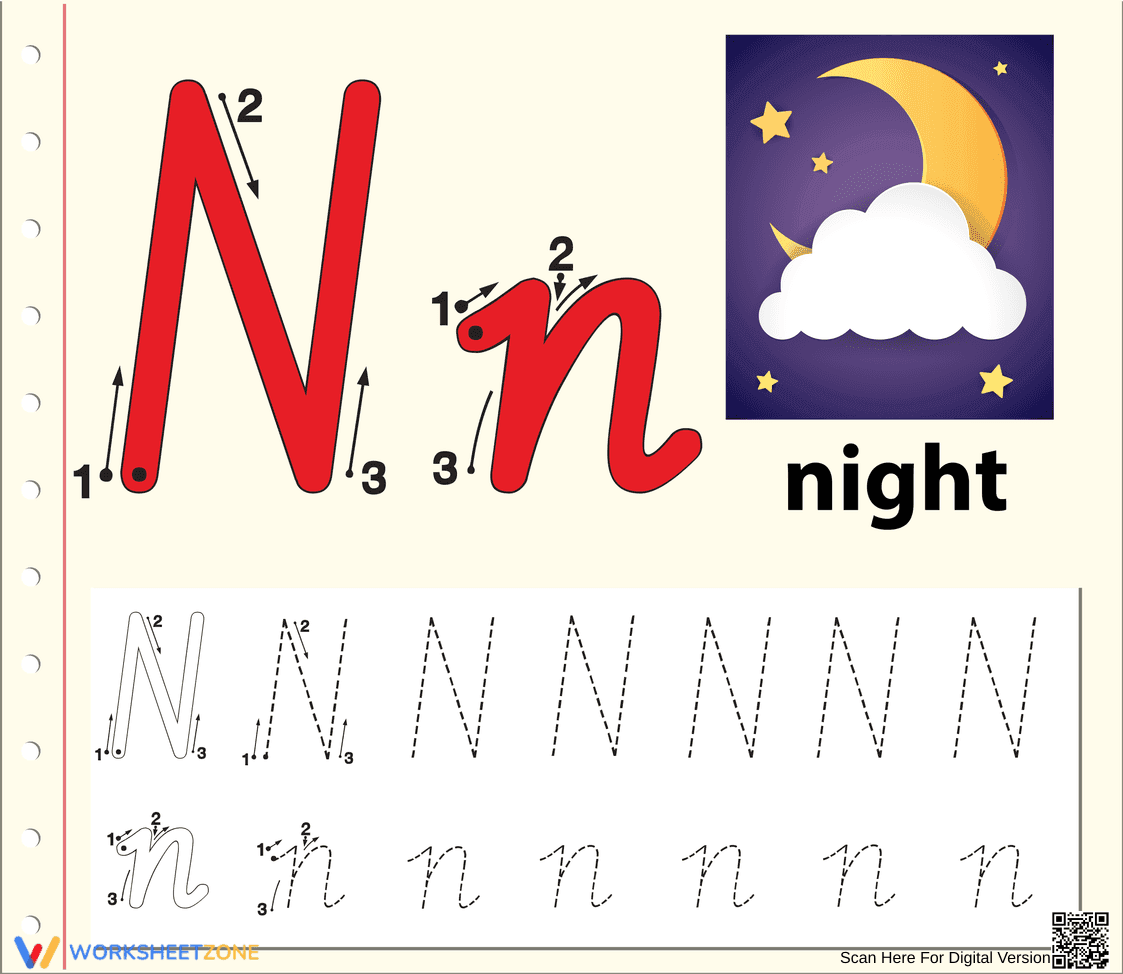

Letter N Tracing Worksheet | Printable Kindergarten Ready
Paste this activity's link or code into your existing LMS (Google Classroom, Canvas, Teams, Schoology, Moodle, etc.).
Students can open and work on the activity right away, with no student login required.
You'll still be able to track student progress and results from your teacher account.
This Letter N tracing worksheet helps early learners master the specific stroke sequences required for D'nealian cursive formation. By combining visual stroke guides with repetitive practice, students build the muscle memory necessary for fluid handwriting. The "N is for Night" association reinforces phonemic awareness alongside fine motor development.
At a Glance
- Grade: Kindergarten · Subject: Handwriting
- Standard:
CCSS.ELA-LITERACY.L.K.1.A— Print many upper- and lowercase letters correctly- Skill Focus: Letter N formation
- Format: 1 page · 14 problems · PDF
- Best For: Morning work or literacy centers
- Time: 5–10 minutes
The worksheet features a large-scale visual guide for both uppercase 'N' and lowercase 'n' with numbered arrows indicating stroke direction. Below the primary models, two rows provide 14 individual tracing opportunities. The inclusion of a "night" graphic provides a concrete anchor for the letter sound, making it a multi-sensory tool for young writers.
This resource is designed for a zero-prep classroom workflow. Teachers can print the single-page PDF in under 30 seconds. Distribution takes less than a minute during transition periods. Reviewing student work is instantaneous, as the tracing lines provide immediate visual feedback on letter slant and height. It is an ideal grab-and-go sub plan addition for early elementary educators.
Standards Alignment: This activity is aligned to `CCSS.ELA-LITERACY.L.K.1.A`, which requires students to print many upper- and lowercase letters. It also supports foundational phonics by linking the grapheme to the /n/ phoneme. Both standard codes can be copied directly into lesson plans, IEP goals, or district curriculum mapping tools.
How to Use It: Use this worksheet during the independent practice phase of a handwriting lesson after demonstrating the stroke order on a whiteboard. It also serves as an effective formative assessment tool; observe students to ensure they follow the numbered arrows rather than drawing the letter from the bottom up. Expected completion time ranges from 5 to 10 minutes.
Who It's For: This is designed for Preschool, Kindergarten, and Grade 1 students who are transitioning from block printing to D'nealian styles. It is particularly helpful for students requiring fine motor intervention. Pair this with a tactile sand tray or a letter 'N' alphabet storybook for a comprehensive literacy lesson.
According to the RAND AIRS 2024 report on early literacy, explicit instruction in letter formation is a critical precursor to reading fluency and orthographic mapping. This worksheet addresses the need for structured, repetitive practice that Fisher & Frey (2014) identify as essential for the gradual release of responsibility in foundational skills. By providing 14 distinct tracing tasks, the resource ensures that students move from guided observation to independent execution within a single session. Research from the NAEP suggests that students who master handwriting early are better able to focus cognitive resources on higher-level composition tasks in later grades. This printable resource provides the necessary scaffolding to bridge the gap between letter recognition and production, ensuring that the standard CCSS.ELA-LITERACY.L.K.1.A is met with high fidelity and consistent student engagement across diverse classroom settings.


