


























Views
Downloads



Printable Family Vocabulary Worksheet | Grade 1 ELA
Paste this activity's link or code into your existing LMS (Google Classroom, Canvas, Teams, Schoology, Moodle, etc.).
Students can open and work on the activity right away, with no student login required.
You'll still be able to track student progress and results from your teacher account.
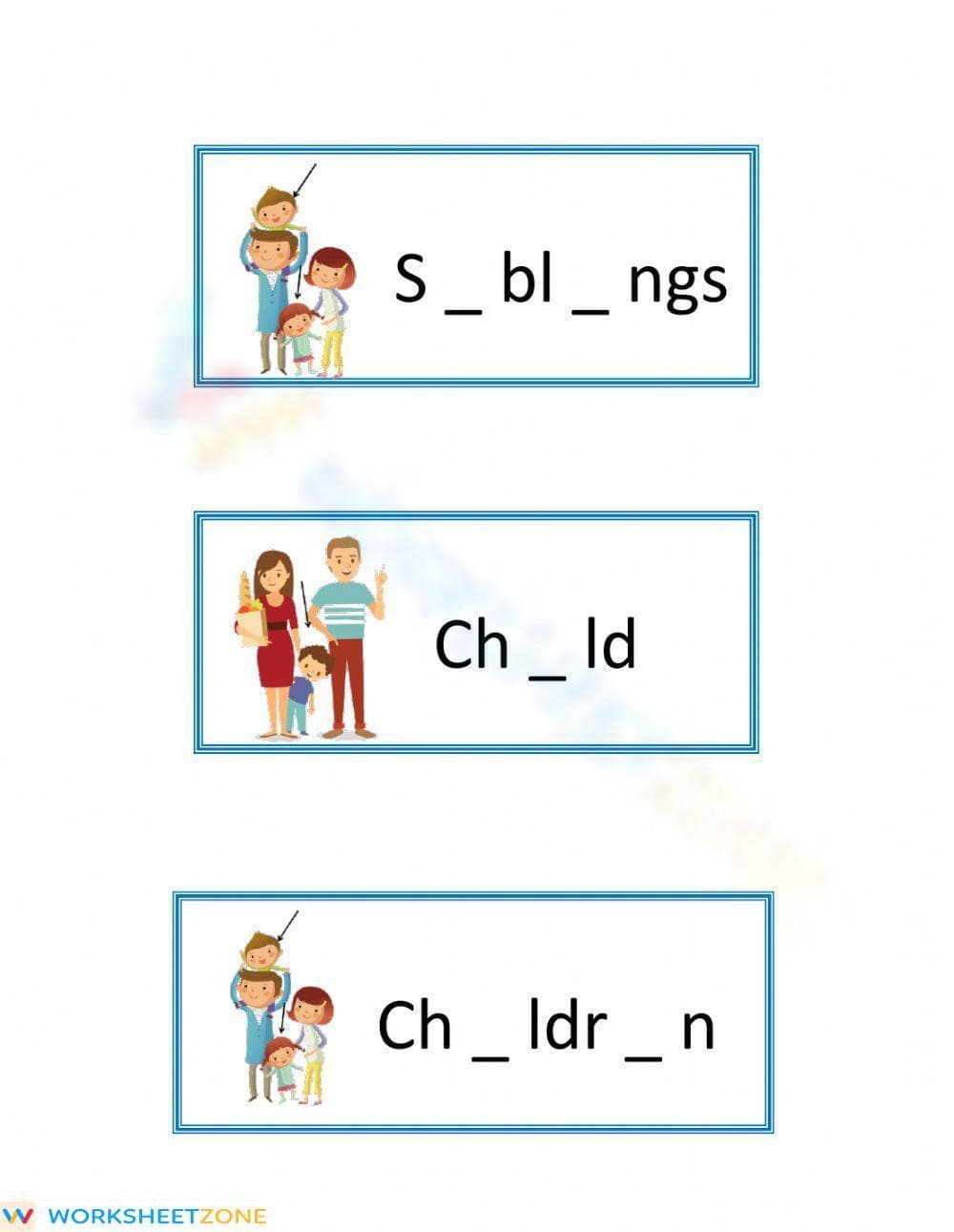
This printable worksheet helps primary students master family-themed vocabulary while strengthening their phonemic awareness. By identifying missing vowels in common family titles, learners bridge the gap between recognizing relatives and spelling their names correctly. It is a fundamental exercise for building early literacy and confidence in written communication during English blocks.
At a Glance
- Grade: 1 · Subject: ELA
- Standard:
CCSS.ELA-LITERACY.L.1.2.E— Spell untaught words phonetically using phonemic awareness and basic spelling conventions- Skill Focus: Family vocabulary and vowel placement
- Format: 3 pages · 9 problems · Answer key included · PDF
- Best For: Literacy centers and morning work
- Time: 15–20 minutes
What's Inside: This three-page PDF package contains nine distinct spelling challenges featuring high-frequency family words such as "Parents," "Siblings," and "Grandparents." Each word is accompanied by a clear, colorful illustration that provides essential visual scaffolding for early readers. The layout is clean and spacious, ensuring that students have enough room to write their answers clearly. A full answer key is included.
Zero-Prep Workflow: Teachers can implement this resource in under two minutes of total preparation. Simply print the three pages, distribute them to your students during an ELA block or as an independent morning warm-up, and review the answers together using the provided key. This workflow makes it an ideal solution for substitute teacher folders or as a quick supplementary activity for early finishers.
Standards Alignment: This resource is aligned with CCSS.ELA-LITERACY.L.1.2.E, which requires students to spell untaught words phonetically, drawing on phonemic awareness and spelling conventions. It also supports broader vocabulary acquisition by helping students recognize the orthographic patterns of words they use in daily speech. Both standard codes can be copied directly into lesson plans, IEP goals, or district curriculum mapping tools.
How to Use It: Assign this worksheet after a whole-group discussion about family structures to reinforce the connection between spoken and written vocabulary. Use it as a formative assessment tool by observing which students struggle with specific vowel combinations (such as the "ie" in niece) to inform your future small-group spelling instruction. Most students will complete all tasks within 20 minutes.
Who It's For: This activity is primarily designed for learners in Grades 1 and 2, but it also serves as an excellent intervention for Grade 3 students or English Language Learners (ELL) who need extra practice with basic spelling rules. It pairs naturally with a "Me and My Family" reading unit, a family tree project, or an anchor chart displaying common kinship terms.
According to the RAND AIRS 2024 report on early literacy interventions, phonemic awareness remains a critical predictor of long-term reading success. This worksheet targets the specific skill of vowel identification within high-frequency family vocabulary words like "Parents" and "Grandparents." By providing visual cues through illustrations, the resource reduces the cognitive load on Grade 1 and 2 students, allowing them to focus entirely on the orthographic patterns of English vowels. Research indicates that structured spelling practice using familiar concepts helps cement word-recognition pathways more effectively than isolated rote memorization. The inclusion of multi-syllabic words like "Siblings" and "Children" challenges students to apply CCSS.ELA-LITERACY.L.1.2.E across varying word lengths and complexities. This systematic approach ensures that learners develop the necessary phonological skills to decode and encode complex terms. Educators can use these 9 targeted tasks to gather evidence of mastery during the foundational stages of student spelling development.


