


























Views
Downloads

My Family and Culture Worksheet | Grade 4 Essential
Paste this activity's link or code into your existing LMS (Google Classroom, Canvas, Teams, Schoology, Moodle, etc.).
Students can open and work on the activity right away, with no student login required.
You'll still be able to track student progress and results from your teacher account.
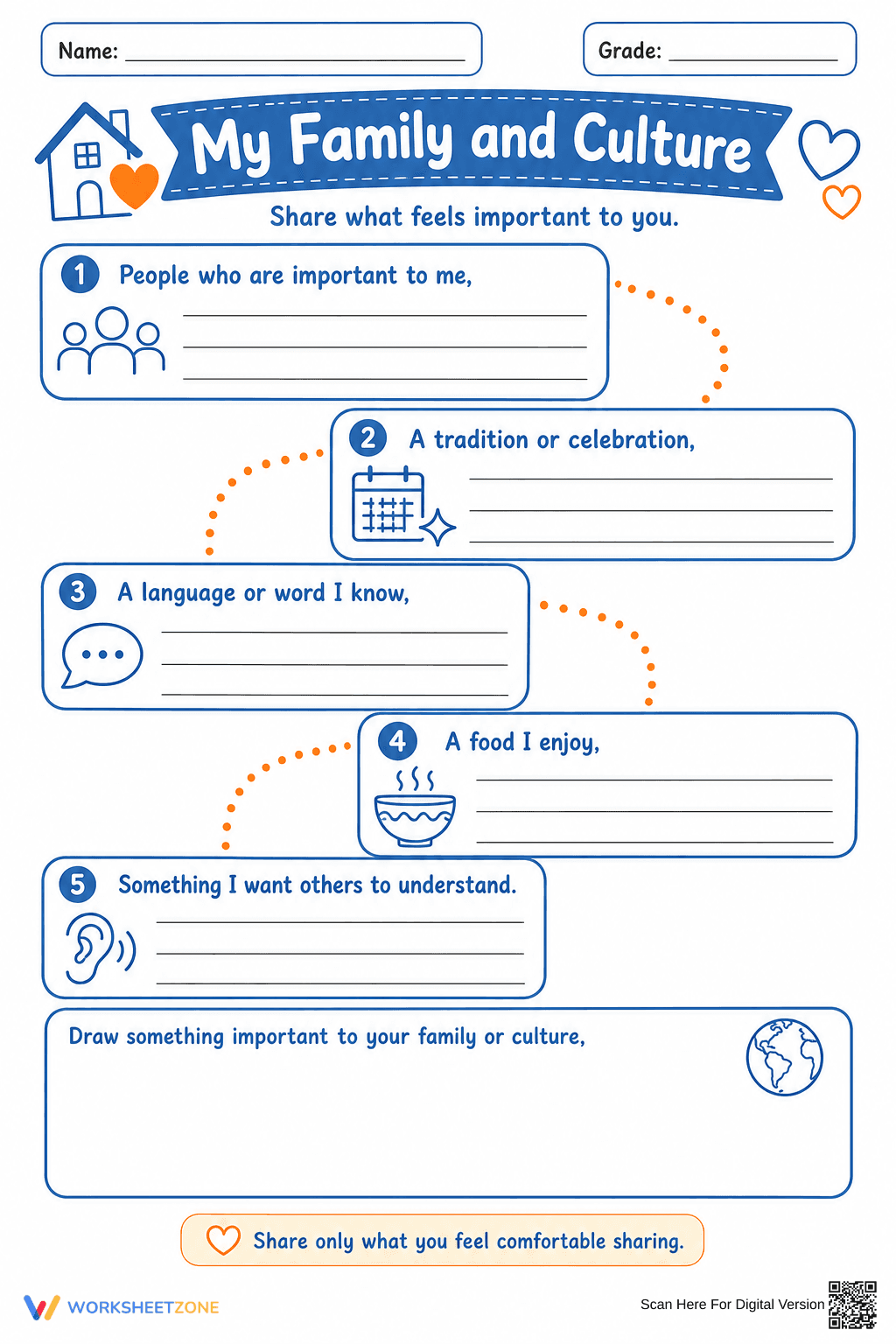
This Grade 4 social studies and writing worksheet helps students explore and articulate their personal identity through cultural reflection. By responding to specific prompts about traditions, language, and family, students build self-awareness and empathy for others. It provides a structured space for students to share their unique backgrounds in a supportive classroom environment.
At a Glance
- Grade: 4 · Subject: Social Studies
- Standard:
CCSS.ELA-LITERACY.SL.4.4— Recount an experience or personal topic with organized, descriptive details- Skill Focus: Cultural Identity & Reflection
- Format: 1 page · 6 tasks · Answer key N/A · PDF
- Best For: Back-to-school icebreakers or community building
- Time: 20–30 minutes
This single-page PDF features a visually engaging "reflection path" layout. It includes five ruled writing sections for short-form responses and one large framed drawing box for visual expression. The worksheet uses clean vector icons to support visual learners and includes a privacy reminder to ensure students feel safe while sharing. The design is high-contrast and printer-friendly for any classroom setting.
The zero-prep design allows for immediate classroom implementation. First, print the single-page PDF (30 seconds). Second, distribute the sheets and read the privacy note aloud to establish a safe space (1 minute). Finally, facilitate a voluntary gallery walk for students to review their peers' work (10 minutes). Total teacher preparation time is under 2 minutes, making it an ideal sub-plan or morning work activity.
This resource aligns with `CCSS.ELA-LITERACY.SL.4.4`, which requires students to recount an experience or tell a story in an organized manner, using appropriate facts and relevant, descriptive details to support main ideas. It also supports social-emotional learning goals related to social awareness and relationship skills. Both standard codes can be copied directly into lesson plans, IEP goals, or district curriculum mapping tools.
Use this worksheet during the first week of school as a formative assessment of student writing and a community-building tool. It is also effective during a "Families and Communities" unit in Social Studies. Teachers should observe which prompts students engage with most readily to identify cultural assets within the classroom. Completion typically takes 20 to 30 minutes depending on the depth of student reflection and drawing.
This worksheet is designed for Grade 4 students but is adaptable for Grades 3-6. It is particularly useful for English Language Learners (ELLs) as it provides sentence starters and visual cues. Pair this resource with a diverse picture book or a "Me Museum" project to create a comprehensive unit on identity and heritage.
Research from Fisher & Frey (2014) emphasizes that student engagement increases significantly when classroom tasks connect directly to their personal lives and cultural backgrounds. This worksheet facilitates that connection by providing a structured yet flexible framework for self-expression. By aligning with CCSS.ELA-LITERACY.SL.4.4, the resource ensures that personal reflection is grounded in the academic rigor of organized communication and descriptive detail. The inclusion of both linguistic and visual response areas supports Universal Design for Learning (UDL) principles, allowing students with varying proficiency levels to demonstrate their understanding of cultural identity. According to the RAND AIRS 2024 report, culturally responsive teaching practices that validate student experiences are critical for fostering a sense of belonging and improving long-term academic outcomes. This printable tool serves as a practical bridge between home and school, encouraging students to view their heritage as a valuable academic asset while practicing essential narrative writing and speaking skills.


