


























Views
Downloads

Mushroom Garden Coloring Page | Essential K-5 Printable
Paste this activity's link or code into your existing LMS (Google Classroom, Canvas, Teams, Schoology, Moodle, etc.).
Students can open and work on the activity right away, with no student login required.
You'll still be able to track student progress and results from your teacher account.
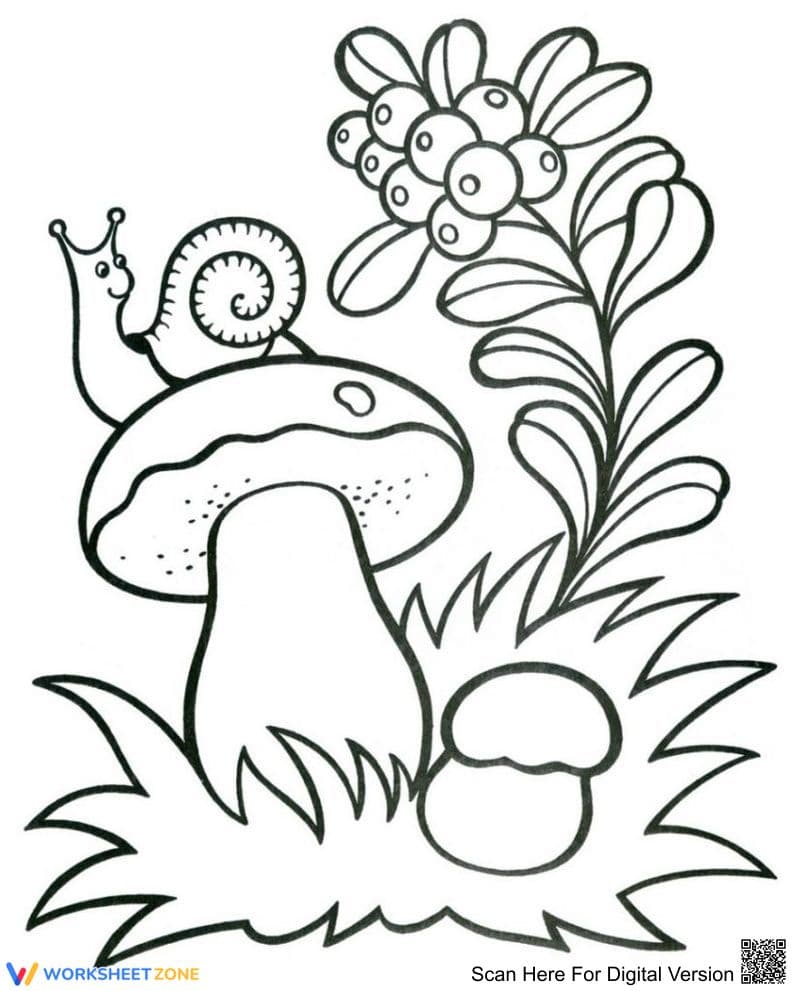
This Mushroom in the garden coloring worksheet provides elementary students with a high-quality creative outlet to develop fine motor control and visual-spatial awareness. By engaging with the detailed illustrations of flora and fauna, learners practice precision and color selection, resulting in a completed artistic representation of a garden ecosystem.
At a Glance
- Grade: K-5 · Subject: Arts & Crafts
- Standard:
VA:Cr1.2.Ka— Engage in exploration and imaginative play with various art materials- Skill Focus: Fine motor coordination
- Format: 1 page · 1 activity · No answer key · PDF
- Best For: Early finishers and morning work
- Time: 15–20 minutes
The worksheet features a single, high-contrast coloring page depicting a whimsical garden scene. Students will find a large mushroom serving as a pedestal for a friendly snail, accompanied by a cluster of wild berries and textured grass. The bold outlines are specifically designed to help younger students stay within lines while providing enough detail to challenge older elementary learners.
This resource is designed for a zero-prep classroom environment. The workflow is simple: Print the single-page PDF (30 seconds), Distribute to students with a box of crayons or colored pencils (1 minute), and Review the completed work to provide positive reinforcement on color choice and boundary control (30 seconds). Total teacher preparation time is under 2 minutes, making it an ideal emergency sub plan component.
Standards Alignment: Primary standard VA:Cr1.2.Ka focuses on engaging in exploration and imaginative play with materials. While primarily an arts standard, it supports ELA development by strengthening the small muscle groups required for handwriting and letter formation. Both standard codes can be copied directly into lesson plans, IEP goals, or district curriculum mapping tools.
How to Use It: Use this worksheet as a calming transition activity after recess or as a reward for completing core subject tasks. It serves as an excellent formative assessment for occupational therapy goals, allowing teachers to observe pencil grip and pressure. Expected completion time ranges from 15 to 20 minutes depending on the student's attention to detail.
Who It's For: This activity is for students in Kindergarten through Grade 5, particularly those needing extra practice with hand-eye coordination. It pairs naturally with a science lesson on fungi or a reading of a nature-themed picture book to provide a multi-sensory connection to the curriculum.
Research from Fisher & Frey (2014) emphasizes the importance of scaffolded creative tasks in developing the executive function and motor skills necessary for academic success. Coloring activities like this one, aligned to VA:Cr1.2.Ka, serve as a foundational bridge between play and formal writing. By focusing on the plain-English skill of controlled coloring and spatial reasoning, students build the stamina required for longer composition tasks. A 2024 RAND AIRS analysis suggests that integrating low-stakes creative breaks can improve student focus during high-intensity instructional blocks. This worksheet provides a structured yet flexible environment for students to demonstrate mastery of fine motor precision. The inclusion of natural elements like mushrooms and snails also encourages environmental vocabulary development, making it a versatile tool for both art and early literacy classrooms.


