




























Views
Downloads
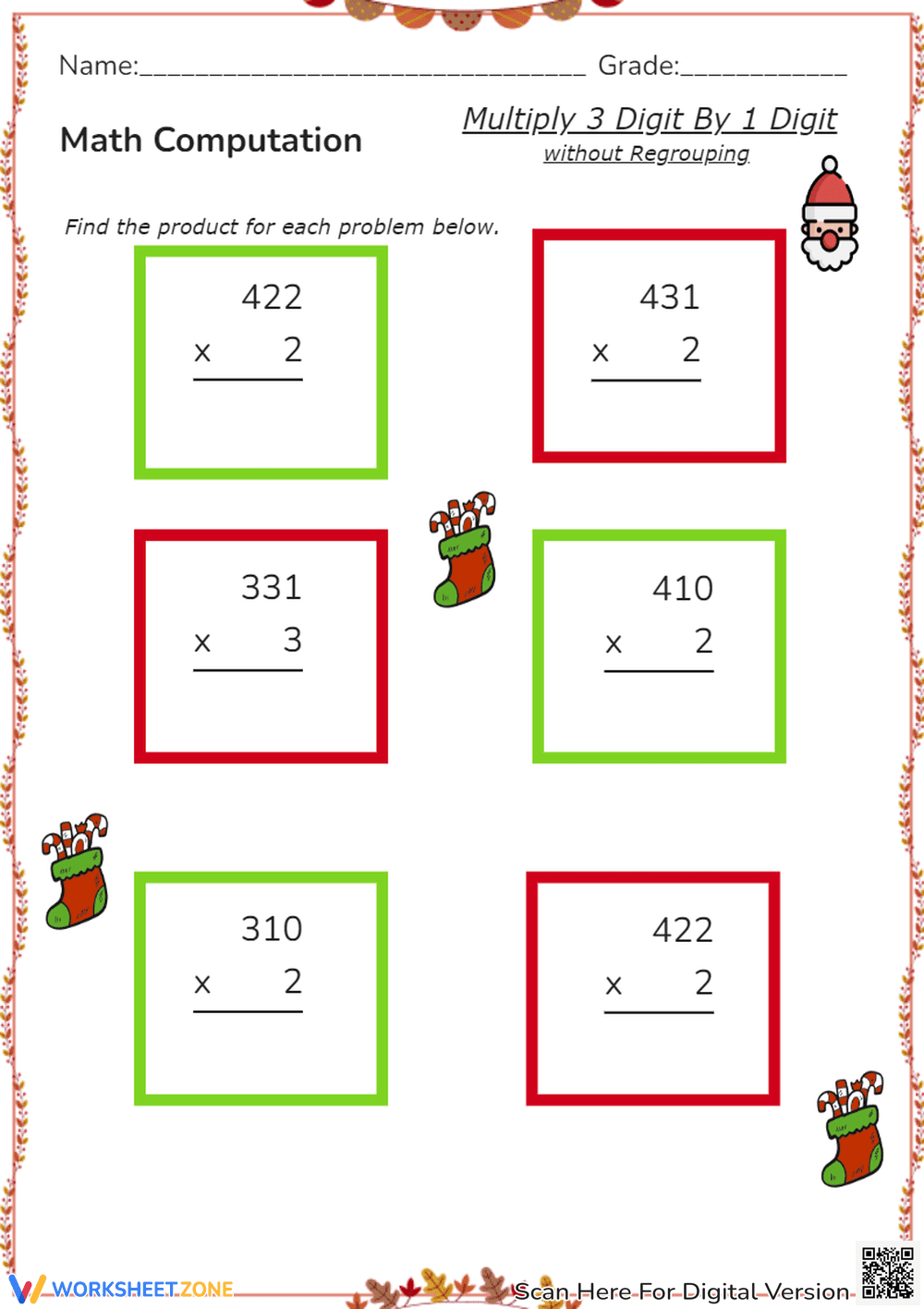

Grade 4 Multiplication — Printable No-Prep Worksheet

Paste this activity's link or code into your existing LMS (Google Classroom, Canvas, Teams, Schoology, Moodle, etc.).
Students can open and work on the activity right away, with no student login required.
You'll still be able to track student progress and results from your teacher account.
This printable Grade 4 math worksheet provides targeted practice on multiplying three-digit numbers by one-digit numbers without regrouping. Students apply basic multiplication facts and place value understanding to find products efficiently. This resource helps build computational confidence and procedural fluency before students transition to more complex multi-digit multiplication tasks.
At a Glance
- Grade: Grade 4 · Subject: Math
- Standard:
CCSS.MATH.CONTENT.4.NBT.B.5— Multiply a whole number of up to four digits by a one-digit whole number- Skill Focus: 3-digit by 1-digit multiplication without regrouping
- Format: 1 page · 6 problems · Answer key included · PDF
- Best For: Independent practice or quick formative assessment
- Time: 10–15 minutes
This single-page PDF worksheet features six vertical multiplication problems designed with clear, spacious grid boxes to help students align their place value columns. The Christmas-themed borders and graphics offer a festive touch without distracting from the mathematical computation. A complete answer key is included to facilitate rapid grading or student self-correction.
This resource is designed for immediate classroom integration with a total teacher preparation time of under two minutes. First, print the single-page PDF for your class, which takes less than a minute. Second, distribute the sheets directly to students as a warm-up, independent desk work, or a seasonal sub plan. Finally, review the answers using the included key in under one minute, allowing for immediate feedback.
This worksheet aligns directly with the Common Core State Standard CCSS.MATH.CONTENT.4.NBT.B.5, focusing on multiplying multi-digit whole numbers using strategies based on place value and the properties of operations. It serves as an essential stepping stone to mastering multi-digit multiplication by isolating the computation step from regrouping. Both standard codes can be copied directly into lesson plans, IEP goals, or district curriculum mapping tools.
Use this worksheet during the independent practice phase of your lesson after introducing the concept of multi-digit multiplication. It is also highly effective as a quick exit ticket to assess student mastery of basic place value multiplication. Teachers can observe if students correctly align their partial products in the vertical format. The expected completion time is 10 to 15 minutes.
This resource is ideal for fourth-grade students learning multi-digit multiplication, as well as third-grade students ready for enrichment. It also supports fifth-grade students requiring targeted intervention or review. Pair this worksheet with concrete base-ten blocks or an anchor chart showing place value multiplication strategies to scaffold learning for struggling students.
This math worksheet targets the foundational skill of multi-digit multiplication without regrouping, aligning with CCSS.MATH.CONTENT.4.NBT.B.5. According to research by Fisher & Frey (2014) on the gradual release of responsibility, providing structured, scaffolded practice tasks allows students to consolidate procedural knowledge before facing complex cognitive loads like regrouping. By isolating the multiplication of three-digit by one-digit numbers, this resource helps students build computational automaticity and confidence. The clean layout with 6 distinct problems prevents cognitive overload, ensuring that students focus entirely on place value alignment and basic fact recall. Educators can reliably integrate this tool into daily math instruction, homework, or formative assessment routines to track student progress toward state standards. The inclusion of a clear answer key supports immediate feedback loops, which are critical for correcting mathematical misconceptions early in the learning cycle.


