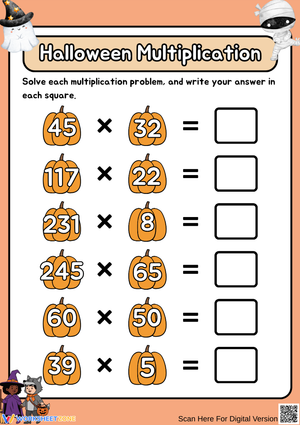
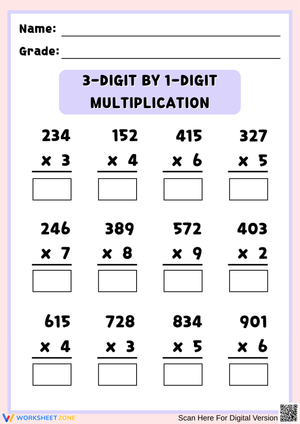
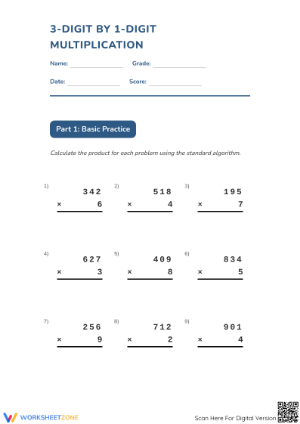
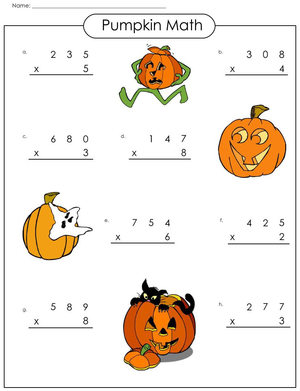
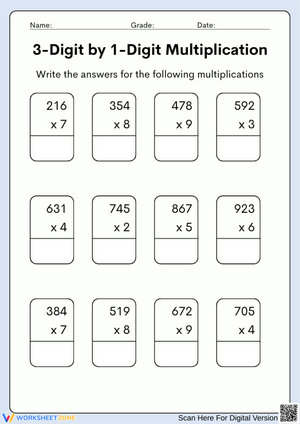
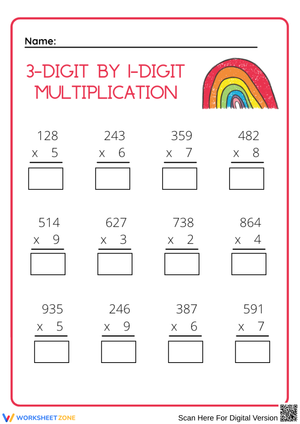
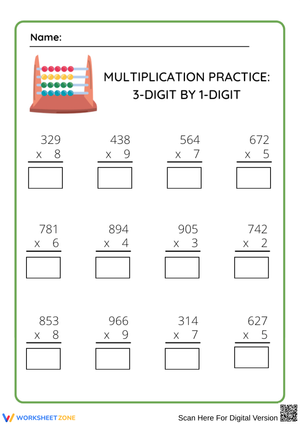
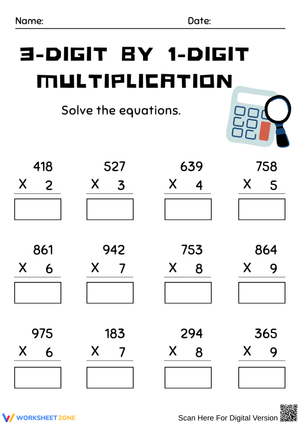
These multiplying 3-digit by 1-digit worksheets give fourth-grade teachers a structured, sequenced set of practice materials that cover every major strategy and difficulty level their students need — from no-regrouping introduction through full carrying across all three place values. The set includes standard algorithm practice, area model work, partial products, and word problems, so teachers can match the format to whatever stage of instruction they're in.
The Specific Skills Targeted
Each worksheet focuses on a distinct piece of the 3-by-1 multiplication picture. Some worksheets isolate the standard algorithm with grid alignment built in, so students can concentrate on the multiplication and regrouping sequence without losing digits to misalignment. Others walk students through the area model, breaking a number like 347 into 300, 40, and 7 before multiplying each part by the single-digit factor — a format that makes the distributive property visible rather than abstract. Partial products worksheets record every sub-calculation on its own line, which helps students who lose track of what they've already multiplied when using the more compact algorithm.
Word problem worksheets round out the set. These require students to identify the operation, write the setup, and compute — the same three-step reasoning that appears on state assessments. Problems draw on contexts students recognize: calculating total items packed in multiple boxes, figuring out how many minutes pass across several equal-length periods, totaling costs when a unit price is multiplied by a quantity in the hundreds.
How Difficulty Progresses Across the Set
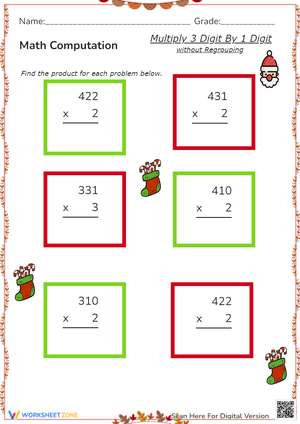
The worksheets sequence deliberately from problems that require no carrying — 213 × 3, 421 × 2 — up through single-place regrouping, then regrouping in two places, then all three. That progression exists for a specific instructional reason: when you hand students a worksheet that requires carrying at every step before they've internalized the basic multiply-and-place routine, you're asking them to manage two cognitive demands at once. Starting without regrouping lets students automate the sequencing — ones first, then tens, then hundreds — so that when carrying enters the picture, it's one new thing layered onto a process they already control.
Lesson-Planning Strategies for Getting the Most From These Worksheets
The five to eight minutes before students transition to specials or lunch is enough time for a four-problem no-regrouping check — enough to confirm fluency without burning your instructional block. More involved worksheets, particularly the area model and partial products formats, work well as the independent practice component of a direct-instruction lesson: teach the strategy, model two examples, release students to the worksheet while you circulate. The word problem worksheets hold up well as Friday review or as station work during a rotational math block, since students can work at their own pace without needing a teacher present to launch the task.
One use pattern that works especially well: pair a computation worksheet and the corresponding answer key and run a partner-check. Students complete three problems, swap, verify using the key, then discuss any discrepancy before moving to the next three. The conversation about where the answer diverged — usually a carrying error or a misplaced digit — produces more durable learning than silent solo practice followed by whole-class correction.
Mistakes Students Make That These Worksheets Help You Catch
The most common breakdown point isn't the multiplication itself — most fourth graders know their single-digit facts well enough. The errors cluster around regrouping and place value recording. A student will correctly compute 8 × 7 = 56, write the 6 in the ones column, and then forget the carried 5 entirely before multiplying the tens digit. The next step — 8 × 4 = 32 — gets written down as if no carrying existed, producing an answer that's off by 50. This is so predictable that it's worth naming explicitly before students start: "You're going to get the multiplication right. What trips people up is what happens to the number you're holding."
A second error pattern shows up on area model worksheets specifically: students fill in the three boxes correctly (1800, 240, 42 for 347 × 6, say) and then add them inaccurately. The multiplication was fine; the multi-digit addition at the final step introduced the error. Keeping a note on which students make this mistake tells you something important — the multiplication instruction is working, but they need more time on addition with regrouping.
Standard Alignment
CCSS.MATH.CONTENT.4.NBT.B.5 requires students to multiply a whole number of up to four digits by a one-digit whole number using strategies based on place value and the properties of operations, and to illustrate and explain the calculation using equations, rectangular arrays, or area models. These worksheets address the standard directly: the algorithm-focused sheets build the procedural fluency the standard requires, and the area model worksheets address the illustrate-and-explain component explicitly. In most fourth-grade pacing guides, this standard lands in the second quarter, after students have solidified multiplication facts and basic two-digit-by-one-digit work, and before the transition to two-digit-by-two-digit multiplication later in the year.
Adjusting the Worksheets for a Range of Learners
For students who are not yet fluent with regrouping, the no-carrying worksheets serve as the starting point regardless of where the rest of the class is. Pairing those with graph paper — or having students turn a sheet of lined paper sideways so the lines run vertically — creates column structure without requiring a specially formatted page. A worked example at the top of the sheet removes the "I don't know how to start" stall that causes some students to sit frozen rather than attempt the first problem.
Students who have the algorithm down and are ready for more can move to the error-analysis problems included in the set, where a completed 3-by-1 calculation contains a deliberate mistake and students have to locate it, identify the type of error, and produce the correct answer. This format demands a different kind of thinking than executing the algorithm from scratch — students have to reason about where in the process something went wrong, which strengthens their metacognitive awareness of their own procedure. It's also a format that shows up on some state assessments, so the exposure is practically useful.
Frequently Asked Questions
When in fourth grade should these worksheets be introduced?
Most pacing guides place 3-by-1 multiplication in the second quarter, after students have solidified multiplication facts through 10 and worked with 2-by-1 problems. Introducing the set before fact fluency is solid creates problems — students get bogged down recalling 7 × 8 in the middle of a multi-step process and lose the thread of the algorithm. If students are still shaky on facts, brief daily fact practice running concurrently with these worksheets helps both skills develop in parallel.
What is the practical difference between area model and partial products worksheets?
The area model is visual and spatial — students draw or fill in a rectangle divided into three labeled sections, which makes the decomposition of the number concrete. Partial products accomplish the same mathematical work in a vertical written format: 347 × 6 produces three separate lines (2400, 280, 42) that are then summed. Some students find the area model clarifying; others find the drawn rectangle unnecessary once they understand the decomposition and prefer the written partial products layout. Having both formats in the set lets teachers try one, and switch if a student isn't connecting with it.
How many problems per worksheet is the right amount for a practice session?
Eight to twelve problems works for most independent practice sessions. Fewer than eight doesn't generate enough repetition for the procedure to feel automatic; more than twelve and student attention degrades noticeably — the last several problems get rushed or skipped. For warm-ups or exit tickets, four to six problems is the more practical range. Word problem worksheets typically work best at four to six problems given the additional reading and setup time each problem requires.
Can these worksheets be used for assessment as well as practice?
Yes, though the distinction matters for how you use them. As formative assessment, a short worksheet at the end of a lesson tells you which students are ready to move to regrouping and which need another day with the current level — that data should change your next day's plan. As summative assessment, a worksheet that spans all difficulty levels and includes at least one word problem gives you a reasonable snapshot of where a student is at the end of the unit. The answer keys included with the set make scoring quick enough that formative use is practical even daily.













 Interactive Worksheet Maker
 Quiz Maker
 Word Search Maker
 Crossword Puzzle Maker
 Word Scramble Generator
 Sentence Scramble Generator
 Handwriting Worksheet Generator
 Name Tracing Generator
 Fill In The Blank Generator