


























Views
Downloads

Printable Homophones Practice Worksheet | Grade 2 ELA
Paste this activity's link or code into your existing LMS (Google Classroom, Canvas, Teams, Schoology, Moodle, etc.).
Students can open and work on the activity right away, with no student login required.
You'll still be able to track student progress and results from your teacher account.
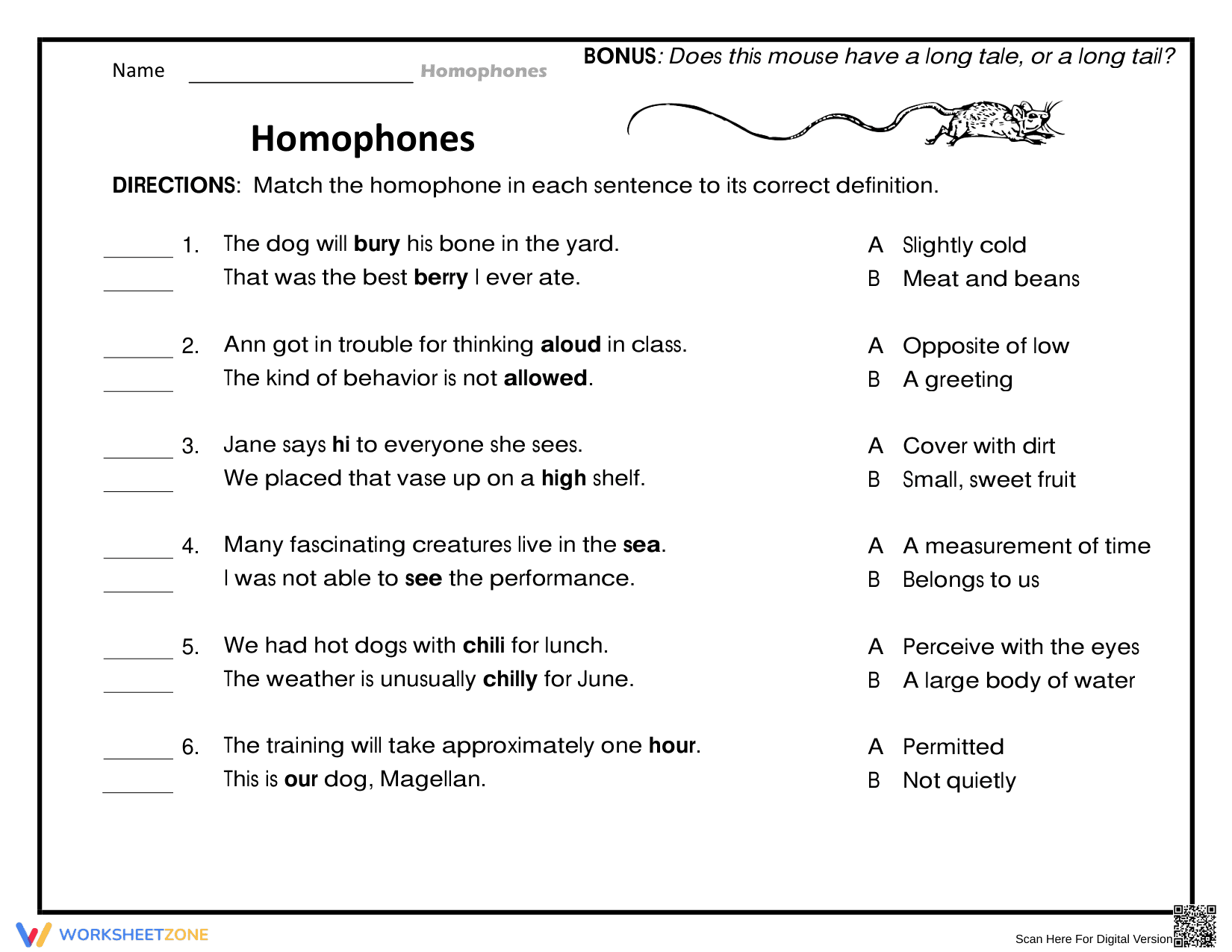
This Essential Homophones Worksheet provides targeted practice in distinguishing between words that sound the same but have different meanings. By matching common homophones like "bury" and "berry" within context-rich sentences, students strengthen their vocabulary and reading comprehension through active linguistic analysis.
At a Glance
- Grade: 2 · Subject: English Language Arts
- Standard:
CCSS.ELA-LITERACY.L.2.4.A— Use sentence-level context as a clue to the meaning of a word- Skill Focus: Homophone Identification and Definition
- Format: 1 page · 12 problems · Answer key included · PDF
- Best For: Independent practice and quick vocabulary checks
- Time: 10–15 minutes
What's Inside
This high-interest worksheet features a playful "Mousy" theme, presenting students with six pairs of sentences that utilize common homophone pairs. Each sentence contains a bolded word that must be matched to one of two provided definitions. The layout includes twelve matching tasks across a single, cleanly formatted page, ensuring a focused learning experience that includes a full answer key for easy grading.
Zero-Prep Workflow
Implementing this worksheet into your daily routine is efficient and straightforward. First, simply print the single-page PDF, which takes less than thirty seconds. Next, distribute the sheets to your students; the clear directions and bolded vocabulary allow for immediate engagement without lengthy teacher explanations. Finally, review the completed work using the provided answer key, a process requiring under two minutes of teacher time, making it an ideal choice for sub plans.
Standards Alignment
This resource is directly aligned to CCSS.ELA-LITERACY.L.2.4.A, which requires students to use sentence-level context as a clue to the meaning of a word or phrase. By analyzing how homophones function within specific narrative contexts, learners develop the morphological awareness necessary for advanced literacy. Both standard codes can be copied directly into lesson plans, IEP goals, or district curriculum mapping tools to ensure instructional compliance and student success.
How to Use It
Use this worksheet as a focused "Exit Ticket" following a direct instruction lesson on multiple-meaning words to gauge student understanding. During the activity, circulate the room and observe if students are reading the entire sentence or merely guessing based on the bolded word; this formative observation tip helps identify students who need additional context-clue support. Expect completion within a ten-minute window, providing a focused assessment of their vocabulary.
Who It's For
This resource is designed for Grade 2 students but is also appropriate for Grade 1 enrichment or Grade 3 remediation. It supports English Language Learners by providing clear, simple definitions alongside contextual usage. Pair this worksheet with an anchor chart for a visual reference during the matching process.
Research from EdReports 2024 emphasizes that systematic vocabulary instruction, particularly focusing on words with high phonological similarity but divergent orthographic representations, is a cornerstone of early literacy development. This Grade 2 ELA worksheet targets the essential skill of homophone discrimination aligned to CCSS.ELA-LITERACY.L.2.4.A, requiring students to synthesize sentence-level context with semantic definitions. By engaging with common pairs such as "hi/high" and "chili/chilly," learners build the cognitive flexibility needed to interpret the nuances of English spelling and meaning. The matching format reduces cognitive load, allowing students to focus on word usage. According to recent NAEP data, students who master these foundational language standards early demonstrate significantly higher reading comprehension scores in later grades. Integrating this resource ensures students receive the consistent practice necessary to meet national benchmarks for language proficiency. Teachers can confidently utilize this tool for consistent literacy gains.


