


























Views
Downloads
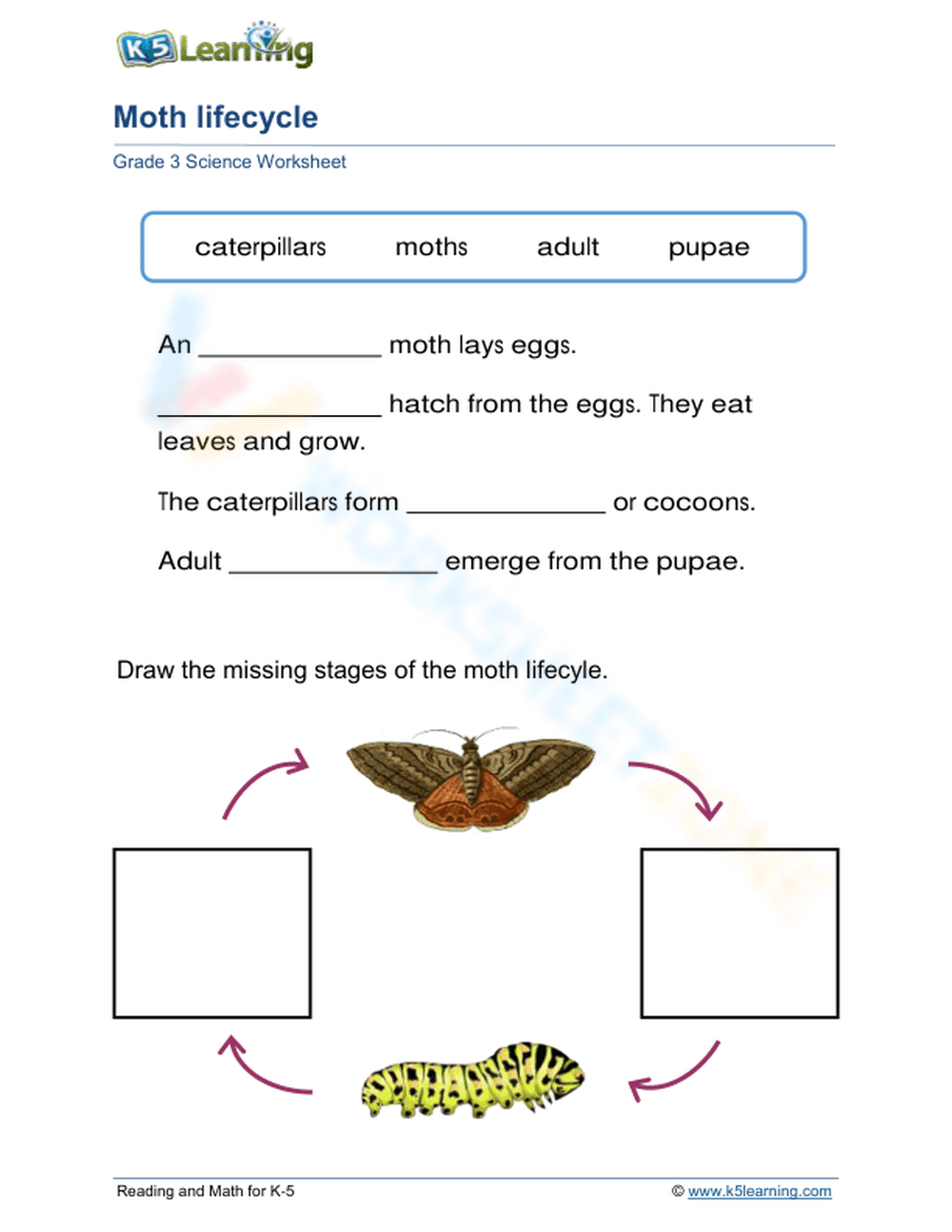

Moth Lifecycle Worksheet — Grade 3 Printable Essential
Paste this activity's link or code into your existing LMS (Google Classroom, Canvas, Teams, Schoology, Moodle, etc.).
Students can open and work on the activity right away, with no student login required.
You'll still be able to track student progress and results from your teacher account.
This Grade 3 moth lifecycle worksheet enables students to master the sequencing of biological development through interactive modeling. By identifying specific stages and completing a cyclical diagram, learners build a concrete understanding of metamorphosis and life science patterns. It serves as an immediate formative tool for any living things unit.
At a Glance
- Grade: 3 · Subject: Science
- Standard:
3-LS1-1— Develop models to describe that organisms have unique and diverse life cycles but all have commonalities- Skill Focus: Metamorphosis stages of a moth including larvae and pupae sequencing
- Format: 1 page · 6 problems · Answer key included · High-quality PDF printable
- Best For: Independent science practice, homework assignments, or quick formative assessment checks
- Time: 10–15 minutes of focused student work
What's Inside
This single-page PDF includes a word bank featuring key vocabulary: caterpillars, moths, adult, and pupae. Students engage with four fill-in-the-blank sentences explaining stage transitions, followed by a graphic organizer where they draw and label missing components of the lifecycle. A full answer key is included for rapid grading and immediate feedback.
Zero-Prep Workflow
Print the single-page PDF (30 seconds). Distribute the sheets as a transition activity or center task (1 minute). Finally, use the included answer key to review the four fill-in-the-blank responses and the diagram as a whole-class check (2 minutes). Total teacher preparation time is under two minutes, making it ideal for emergency sub plans.
Standards Alignment
Aligned to 3-LS1-1, students develop models to describe diverse life cycles. It targets the modeling component by requiring students to visualize and connect phases of development. This standard code can be copied directly into lesson plans, IEP goals, or district curriculum mapping tools to ensure academic rigor and objective alignment.
How to Use It
Use this as a "ticket out the door" after a lesson on metamorphosis. Observe if students correctly place the "pupae" stage, as this indicates understanding of the transformation process. It is also an excellent addition to a science folder due to its self-contained instructions and clear student-facing language for independent completion.
Who It's For
Designed for third-grade students, it also supports second-grade learners as an enrichment activity or fourth-grade students needing a review of life cycles. It provides linguistic scaffolds via the word bank, making it accessible for English Language Learners. Pair this with a live insect kit for a powerful hands-on experience.
The use of visual models in life science is supported by recent research in educational efficacy. According to RAND AIRS (2024), structured modeling activities in Grade 3 science significantly improve retention of biological concepts compared to passive reading alone. This resource leverages dual-coding theory by combining textual tasks with visual drawing, helping students internalize the 3-LS1-1 standard requirements. By focusing on the specific stages of caterpillars, pupae, and adult moths, the worksheet provides the scaffolding necessary for students to build their own mental models of growth and reproduction. This evidence-based approach ensures learners move beyond simple memorization toward a functional understanding of how organisms change over time. It is a reliable tool for teachers seeking to meet NGSS benchmarks while maintaining high student engagement.


