


























Views
Downloads
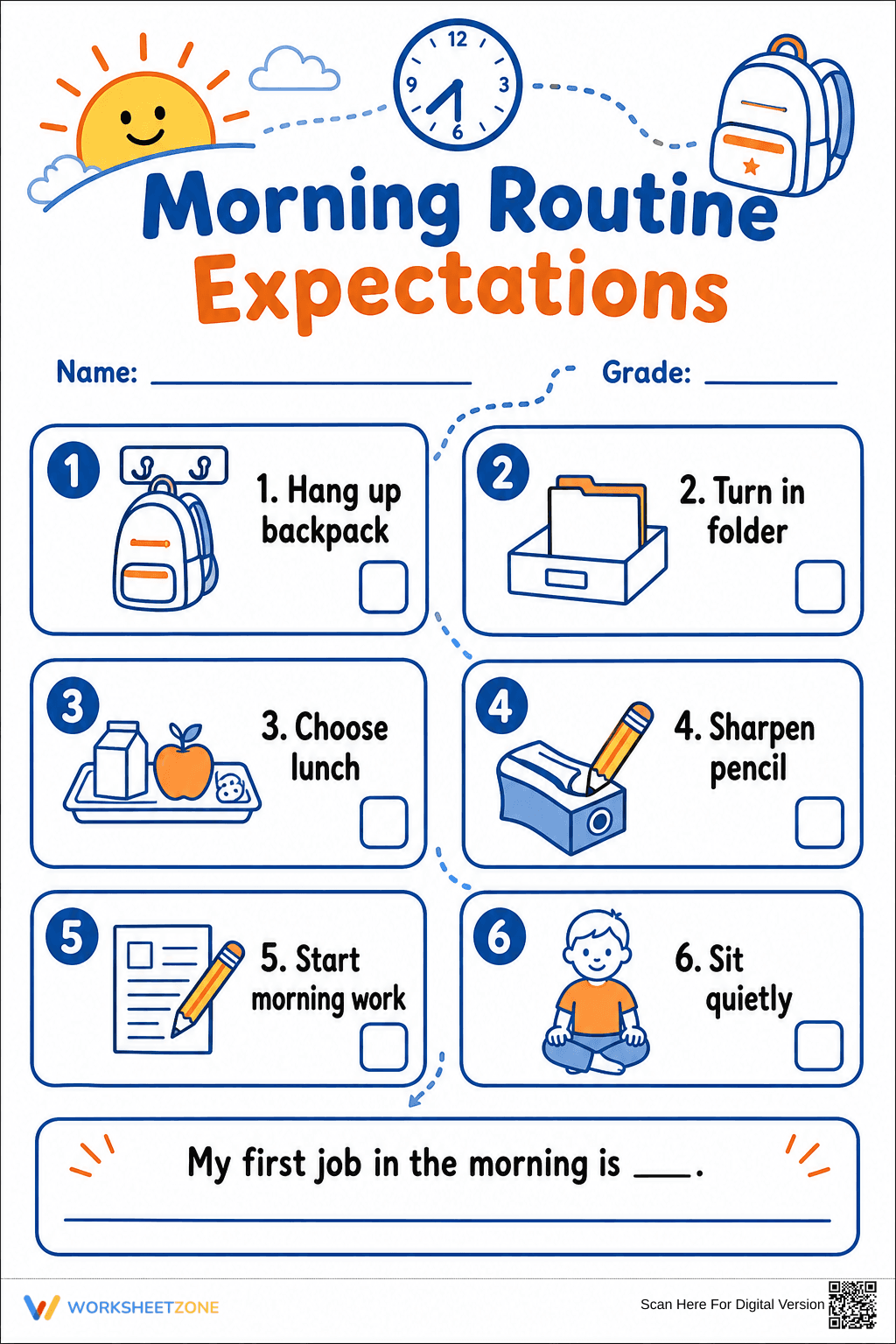

Morning Routine Expectations | Essential Grade 1 Worksheet
Paste this activity's link or code into your existing LMS (Google Classroom, Canvas, Teams, Schoology, Moodle, etc.).
Students can open and work on the activity right away, with no student login required.
You'll still be able to track student progress and results from your teacher account.
This Morning Routine Expectations worksheet provides a structured visual guide for students to master daily classroom transitions. By clearly outlining 6 sequential steps, it helps young learners build independence and executive functioning skills from the moment they enter the room. Students engage with visual icons and a reflective writing prompt to solidify their understanding of morning procedures.
At a Glance
- Grade: 1 · Subject: Classroom Management
- Standard:
CCSS.ELA-LITERACY.SL.1.1— Follow agreed-upon rules for discussions and carry out assigned classroom tasks- Skill Focus: Routine Sequencing & Independence
- Format: 1 page · 7 tasks · No answer key required · PDF
- Best For: Back-to-school orientation and daily morning work
- Time: 10–15 minutes
The worksheet features a playful morning path layout with 6 rounded sequence cards. Each card includes a bold number, a high-contrast vector icon (backpack, folder, lunch tray, pencil sharpener, paper, and student), and a checkbox for self-monitoring. At the bottom, a framed response area provides a sentence starter for students to identify their primary responsibility, reinforcing literacy through personal accountability and clear expectations.
This resource is designed for a zero-prep workflow to maximize instructional time. First, print the single-page PDF (30 seconds). Next, distribute the sheets during the first week of school to establish clear behavioral norms (1 minute). Finally, review the steps as a whole group, allowing students to check off each box as they practice the physical movements of the routine (5 minutes). It is an ideal sub-plan addition for maintaining consistency.
This resource aligns with `CCSS.ELA-LITERACY.SL.1.1`, which requires students to follow agreed-upon rules for tasks and collaborative environments. It also supports `CCSS.ELA-LITERACY.W.1.2` by asking students to write informative text about their morning job. Both standard codes can be copied directly into lesson plans, IEP goals, or district curriculum mapping tools to ensure all instructional minutes are standards-aligned.
Use this worksheet as a formative assessment during the first ten days of school. Observe which students can independently navigate the 6 steps and which require additional verbal prompting. It also serves as a permanent desk reference or take-home guide to help parents understand classroom expectations. Completion typically takes 10 to 15 minutes during the arrival window, making it a perfect soft-start activity.
This printable is specifically crafted for Grade 1 students but is highly effective for Kindergarten and Grade 2 learners needing visual supports. It pairs naturally with a Morning Meeting anchor chart or a direct instruction lesson on classroom procedures. The visual icons provide essential scaffolding for English Language Learners and students with executive functioning challenges who benefit from predictable, numbered sequences.
According to Fisher & Frey (2014), establishing clear, predictable routines is a foundational element of effective classroom management that reduces cognitive load and increases time spent on academic tasks. This worksheet operationalizes that research by providing a concrete, visual checklist for the CCSS.ELA-LITERACY.SL.1.1 standard. By breaking down the complex arrival period into 6 manageable steps, the resource supports the gradual release of responsibility from teacher-led direction to student-led independence. Data from NAEP suggests that classrooms with high-functioning routines see significantly higher engagement levels in subsequent instructional blocks. This tool ensures that every student, regardless of their starting point, has a clear roadmap for success each morning. The inclusion of a writing prompt further bridges the gap between behavioral expectations and literacy development, making it a versatile addition to any early elementary curriculum.


