


























Views
Downloads

Grade 2 Money Matching — Printable No-Prep Worksheet
Paste this activity's link or code into your existing LMS (Google Classroom, Canvas, Teams, Schoology, Moodle, etc.).
Students can open and work on the activity right away, with no student login required.
You'll still be able to track student progress and results from your teacher account.
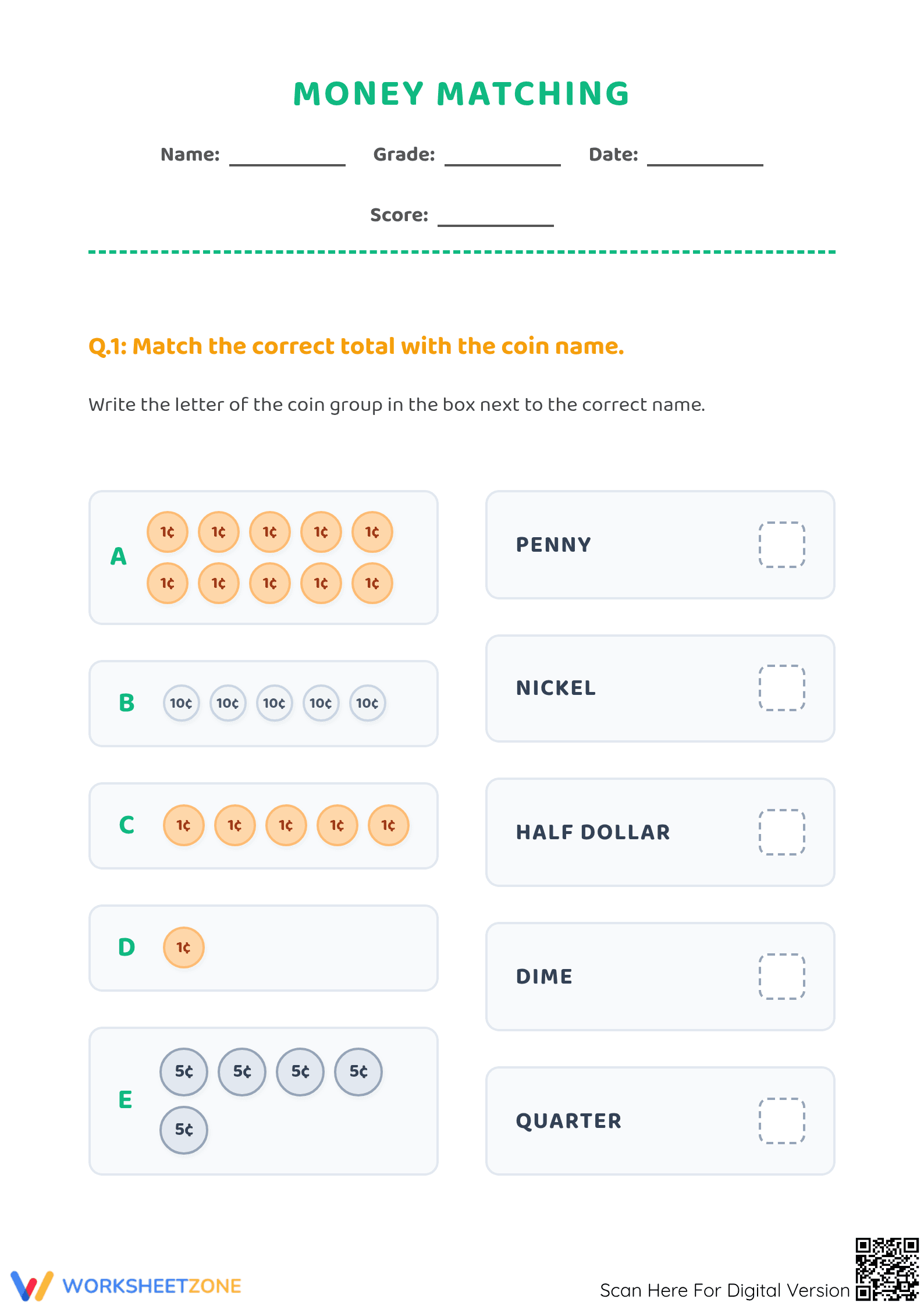
This Grade 2 money matching worksheet helps students identify U.S. coins by connecting visual groups to their correct names. Students practice recognizing pennies, nickels, dimes, quarters, and half dollars through a clear matching exercise. This activity builds the foundational financial literacy required for more complex value calculations and real-world transactions.
At a Glance
- Grade: 2 · Subject: Math
- Standard:
CCSS.MATH.CONTENT.2.MD.C.8— Identify and solve problems involving quarters, dimes, nickels, and pennies- Skill Focus: Coin identification and nomenclature
- Format: 1 page · 5 problems · Answer key included · PDF
- Best For: Independent practice or quick assessment
- Time: 5–10 minutes
The worksheet features five distinct coin groups labeled A through E. Each group contains a specific coin type, such as a single penny or a cluster of dimes. Students must write the corresponding letter in the box next to the printed names: Penny, Nickel, Half Dollar, Dime, and Quarter. The layout is clean, high-contrast, and includes a dedicated score box for easy grading.
This resource is designed for a three-step zero-prep workflow. First, print the single-page PDF (30 seconds). Second, distribute the sheets to students for a focused warm-up or exit ticket (1 minute). Third, review the answers using the provided key or by projecting the worksheet for a whole-class check (2 minutes). It is an ideal sub-plan component for busy teachers.
Aligned to CCSS.MATH.CONTENT.2.MD.C.8, which requires students to solve word problems involving dollar bills, quarters, dimes, nickels, and pennies. While this task focuses on identification, it serves as the essential prerequisite for calculating total values. Both standard codes can be copied directly into lesson plans, IEP goals, or district curriculum mapping tools.
Use this worksheet during the "You Do" phase of a lesson on currency. It works effectively as a formative assessment after introducing the physical characteristics of each coin. Teachers should observe if students confuse the nickel and quarter, providing a quick intervention. Expect students to complete the matching in approximately 7 minutes.
This resource is for second-grade students beginning their money unit or first graders ready for an extension. It supports visual learners through clear iconography. Pair this worksheet with physical plastic coins or a classroom anchor chart that displays both the heads and tails sides of each coin for maximum support during the activity.
According to the RAND AIRS 2024 report, visual-spatial matching tasks are highly effective for early elementary students developing symbolic recognition in mathematics. This worksheet addresses the critical need for coin identification, a skill that NAEP data suggests is a foundational hurdle for later success in decimal operations and percentage calculations. By isolating the nomenclature of currency, students build the cognitive schema necessary to transition from counting objects to assigning value. Fisher & Frey (2014) emphasize that such scaffolded identification tasks reduce cognitive load during the initial stages of financial literacy instruction. This resource provides a structured environment for students to demonstrate mastery of CCSS.MATH.CONTENT.2.MD.C.8 through direct identification. The inclusion of the half-dollar ensures students are exposed to less common currency, broadening their mathematical vocabulary and preparing them for diverse real-world financial scenarios.


