


























Views
Downloads


Printable Modeling Fourths Worksheet | Grade 3 Math
Paste this activity's link or code into your existing LMS (Google Classroom, Canvas, Teams, Schoology, Moodle, etc.).
Students can open and work on the activity right away, with no student login required.
You'll still be able to track student progress and results from your teacher account.
Helping students visualize fractions is the first step toward mathematical literacy in the elementary years. This modeling fourths worksheet provides Grade 3 learners with structured practice in identifying, shading, and comparing fractional units within rectangular models. By working through these 31 problems, students develop a concrete understanding of how equal parts compose a whole.
At a Glance
- Grade: 3 · Subject: Math
- Standard:
3.NF.A.1— Understand a fraction as the quantity formed by one part when partitioned- Skill Focus: Modeling, identifying, and comparing fourths
- Format: 4 pages · 31 problems · Answer key included · PDF
- Best For: Targeted fraction practice and introductory assessment
- Time: 25–35 minutes
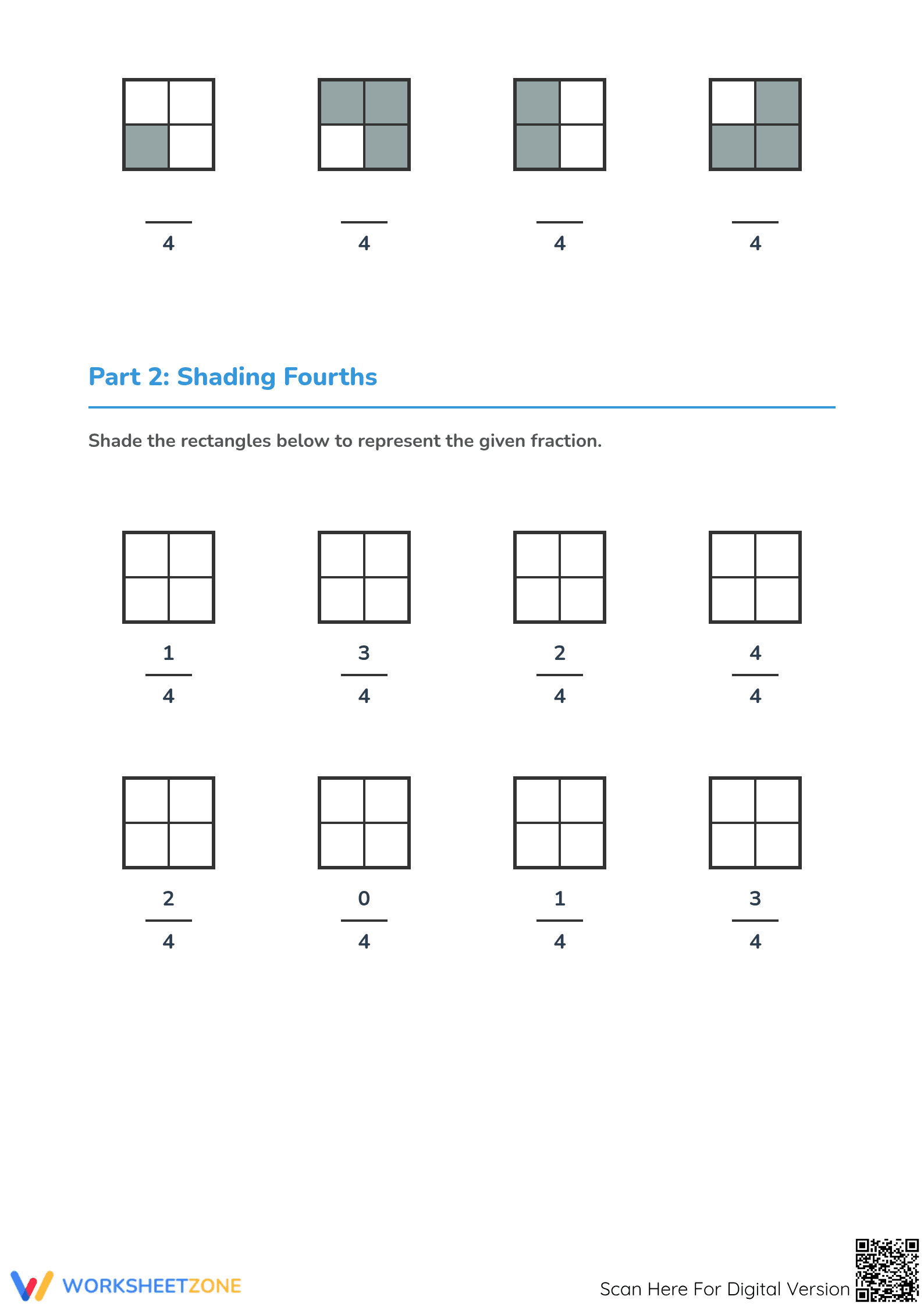
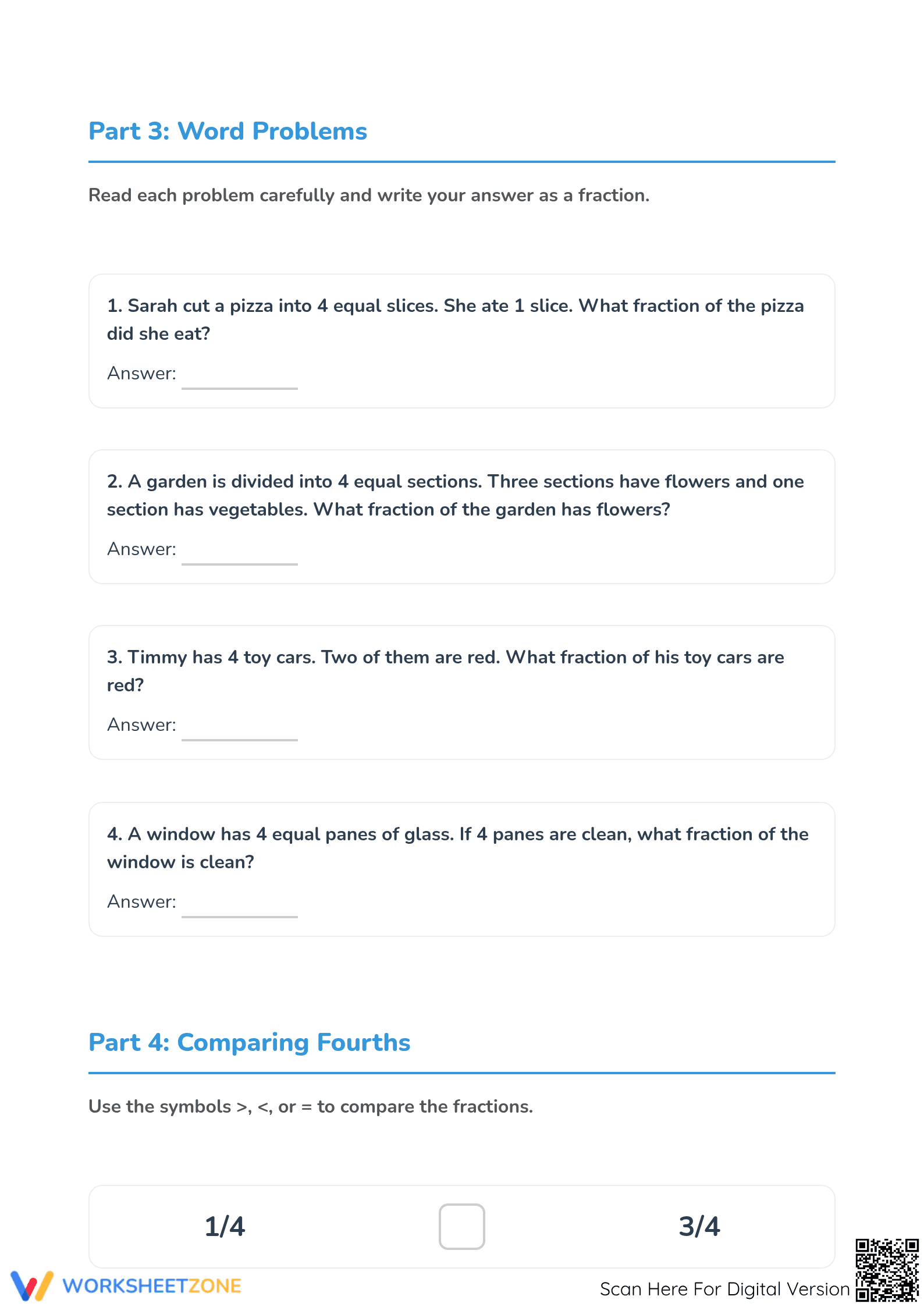
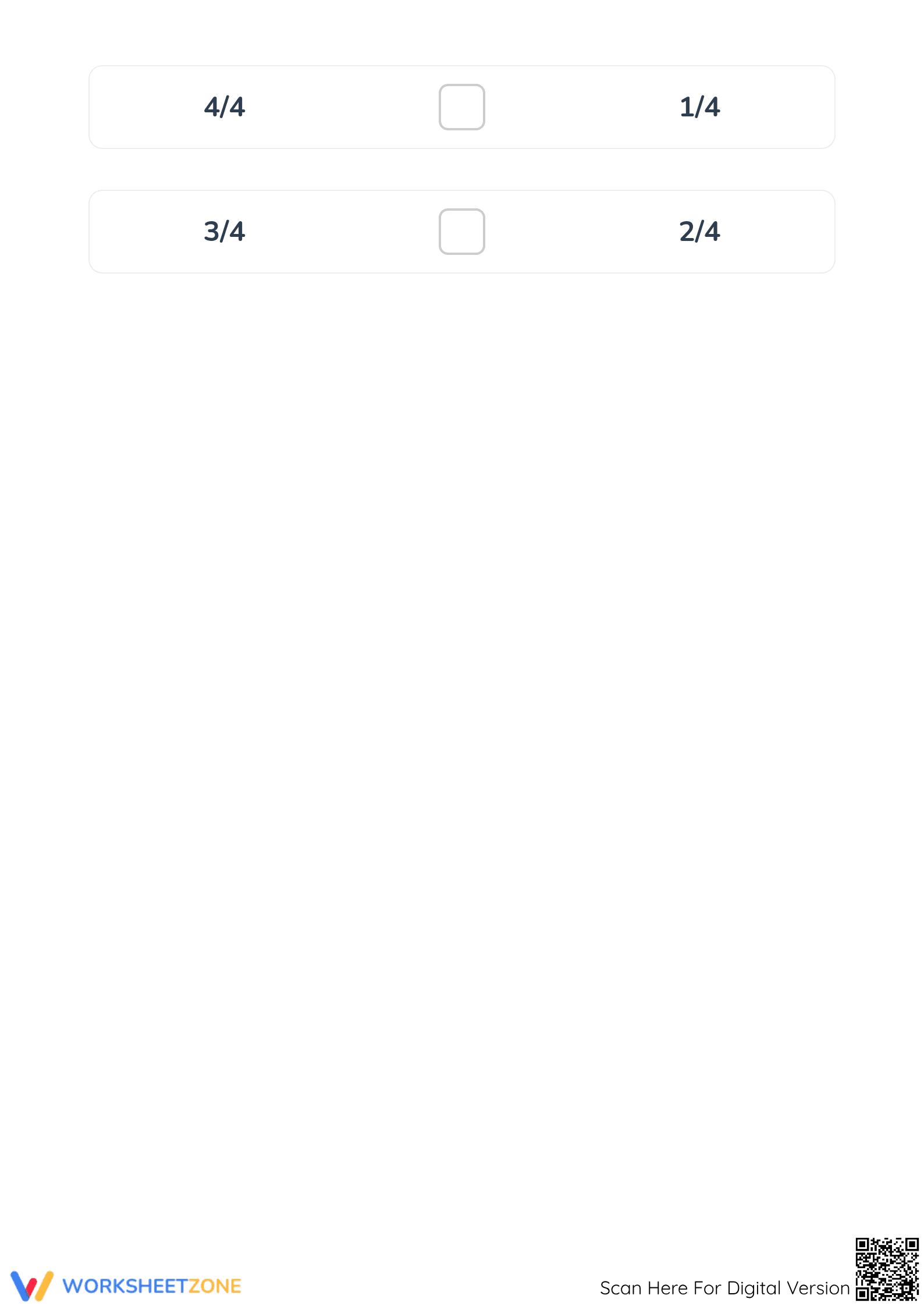
This comprehensive four-page resource is designed to build student confidence through variety. It begins with 16 identification tasks where students must observe shaded rectangles and write the corresponding fraction. It then transitions to eight shading exercises, four contextual word problems that ground the math in reality, and three comparison tasks using inequality symbols. A full answer key is provided for quick grading.
The worksheet follows a logical skill progression to ensure student success. First,
- Guided identification: 16 tasks provide visual models where students write the fraction to build foundational recognition.
- Supported practice: 8 exercises require students to shade blank rectangles based on given fractions, moving from observation to construction.
- Independent practice: 7 advanced tasks, including 4 word problems and 3 comparisons, challenge students to apply their knowledge without visual aids.
This resource is strictly aligned to 3.NF.A.1, which requires students to understand a fraction 1/b as the quantity formed by 1 part when a whole is partitioned into b equal parts. It also supports 3.NF.A.3.D through the fraction comparison section. Both standard codes can be copied directly into lesson plans, IEP goals, or district curriculum mapping tools.
Use this worksheet during the "We Do" or "You Do" phases of a lesson on fractions. It is an effective formative assessment to check for common misconceptions, such as confusing the numerator and denominator. Teachers can observe student shading to ensure they understand that parts must represent equal areas. Completion typically takes 30 minutes.
This practice set is ideal for Grade 3 general education students and Grade 4 learners requiring remediation. The clear visual layout supports students with executive functioning needs by providing a predictable structure. Pair this worksheet with physical fraction tiles or a digital area model tool to provide a multi-sensory learning experience for struggling mathematicians.
Mathematical proficiency in early childhood depends heavily on the transition from concrete manipulatives to representational models. According to the research of Fisher & Frey (2014) on the gradual release of responsibility, students benefit most when tasks move from high-teacher support to independent problem-solving. This worksheet adheres to that framework by providing repetitive visual identification before requiring students to generate their own shaded models and solve abstract word problems. The inclusion of 3.NF.A.1 standards ensures that every task contributes to the mastery of fundamental fraction concepts. By engaging with 31 distinct tasks, learners reinforce the mental schema required to recognize fourths across different contexts, including area models and real-world scenarios. This systematic approach is proven to reduce cognitive load while increasing the retention of basic mathematical properties, making it an essential tool for any third-grade classroom focused on rigorous alignment and student achievement.


