




























Views
Downloads

Missing Angles in Triangles Worksheet | Grade 6 Ready

Paste this activity's link or code into your existing LMS (Google Classroom, Canvas, Teams, Schoology, Moodle, etc.).
Students can open and work on the activity right away, with no student login required.
You'll still be able to track student progress and results from your teacher account.
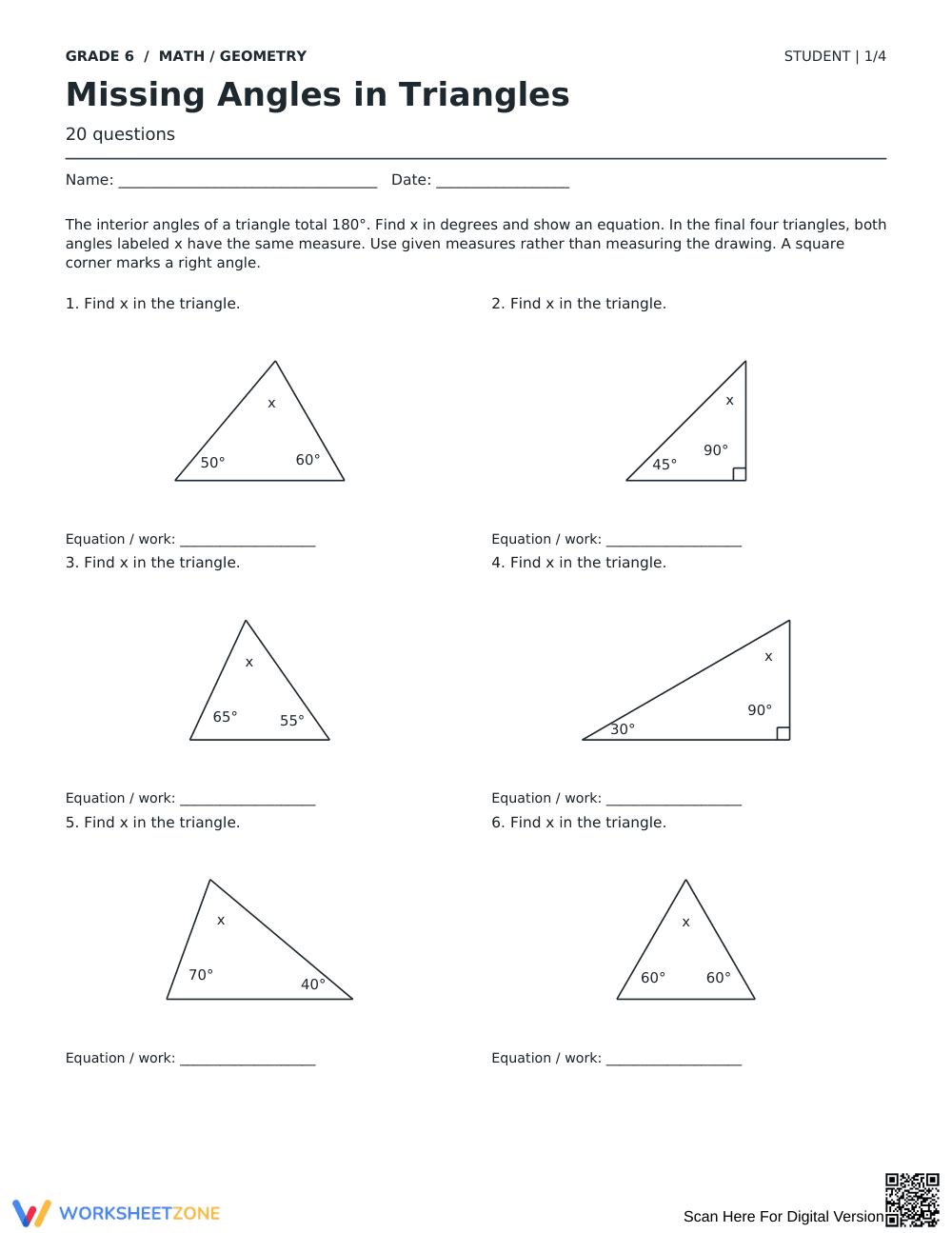
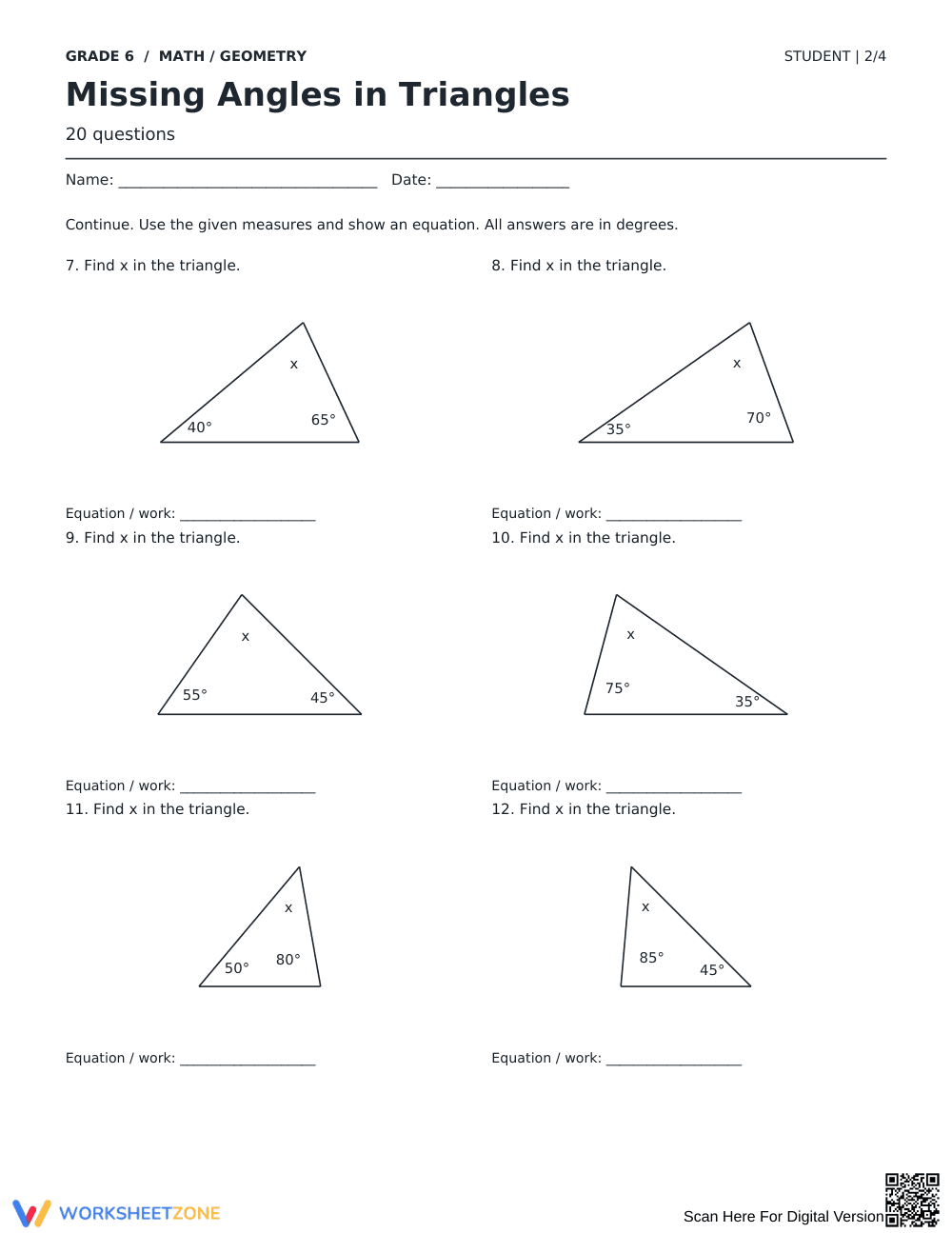
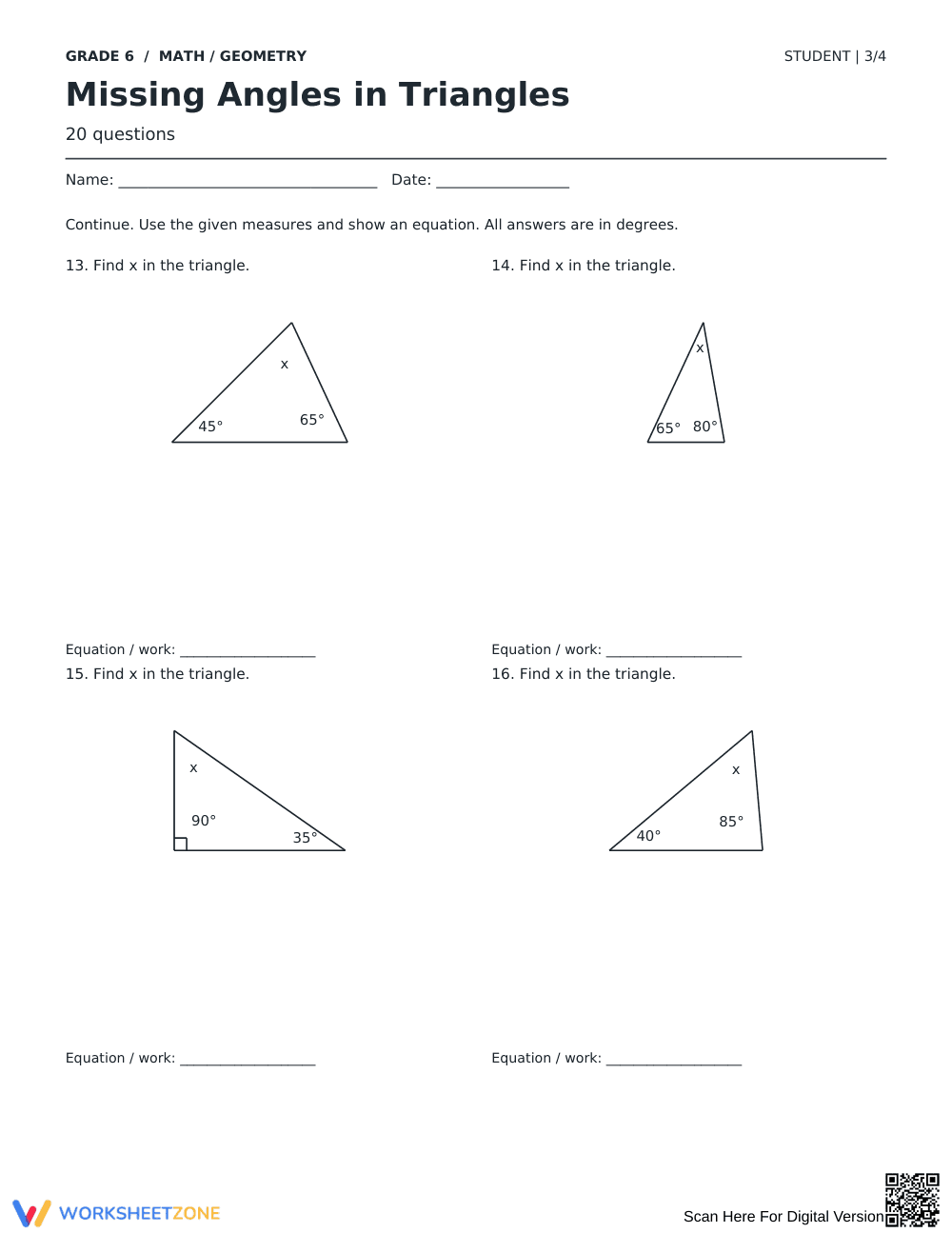
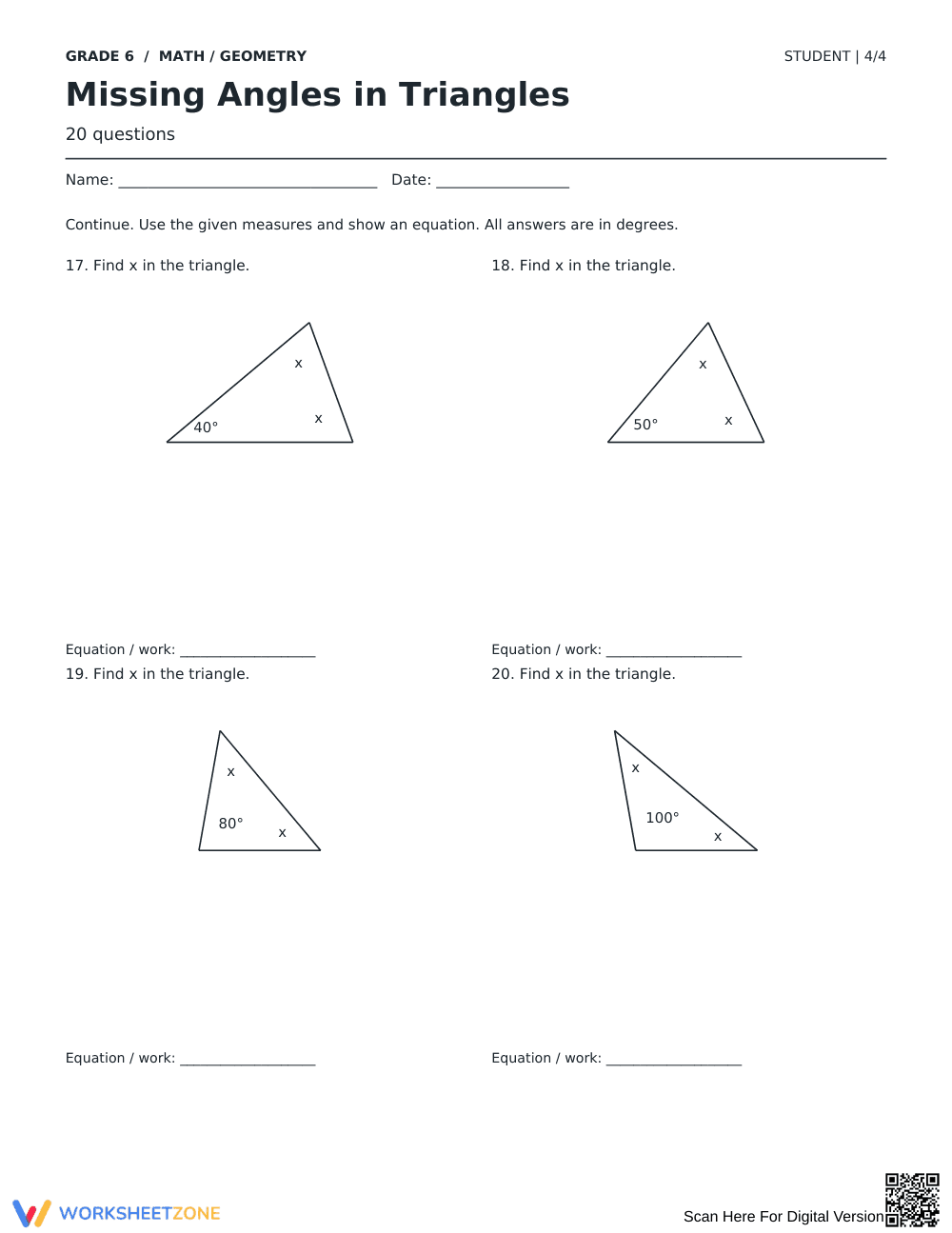
This Grade 6 geometry worksheet builds understanding of interior angle relationships by calculating missing angle values across 20 diagrams. Students write equations using the 180-degree interior sum property, moving from finding single unknown angles to solving for two identical variable angles.
At a Glance
- Grade: 6 · Subject: Math
- Standard:
CCSS.MATH.CONTENT.8.G.A.5— Find missing interior angle measures in triangles using algebraic equations- Skill Focus: Triangle angle sums and linear equations
- Format: 4 pages · 20 problems · Answer key included · PDF
- Best For: Geometry practice and formative assessment
- Time: 30–45 minutes
Across 4 student pages, this printable resource presents 20 triangle diagrams requiring students to write an equation, show their arithmetic work, and solve for the unknown in degrees. An answer key provides complete subtraction equations and a recommended 40-point grading rubric.
Skill Progression
- Guided practice (Problems 1–6): Students establish equation-writing habits using acute, right, and equilateral triangles with two explicit angle measures.
- Supported practice (Problems 7–16): Rotated diagrams reinforce accuracy as students independently set up subtraction equations from 180 degrees.
- Independent practice (Problems 17–20): Students solve triangles featuring two equal unknown angles labeled x, requiring two-step equations like 2x + 40 = 180.
This structured progression reflects the gradual-release model, transitioning learners smoothly from guided steps to independent algebraic reasoning.
Standards Alignment
Primary alignment is to `CCSS.MATH.CONTENT.8.G.A.5`, focusing on applying the triangle angle-sum fact to determine unknown angles. Supporting practice aligns to `CCSS.MATH.CONTENT.6.EE.B.7` by having students write and solve one-variable equations for real mathematical situations. Both standard codes can be copied directly into lesson plans, IEP goals, or district curriculum mapping tools.
How to Use It
Assign this worksheet after direct instruction on triangle angle sums for independent practice or partner review. During seatwork, check whether students recognize right-angle square symbols as 90 degrees before formulating their equations. The entire 20-problem sequence typically takes students 30 to 45 minutes to complete.
Who It's For
This resource serves sixth-grade math students learning algebraic geometry and seventh graders needing prerequisite review. Support struggling learners with a triangle-sum reference cue, and challenge early finishers to classify each triangle by angle and side properties. Pair this page with a hands-on angle-tearing demonstration.
Under research by Fisher & Frey (2014) on purposeful instructional design, structured task progressions that require explicit written mathematical justifications yield superior conceptual retention compared to unguided computation. This instructional resource applies those empirical findings directly to Grade 6 geometry and the foundational tenets of standard `CCSS.MATH.CONTENT.8.G.A.5`. By requiring middle school students to construct formal algebraic equations to determine unknown interior angles in triangles, the worksheet connects geometric spatial reasoning directly to symbolic algebraic notation. Students develop fluency with the 180-degree triangle angle sum property while systematically advancing from single-variable deduction to multi-variable equations. The explicit equation prompts prevent passive guessing, reinforcing the cognitive bridge between visual angle diagrams and procedural linear algebra that research confirms is essential for long-term secondary mathematics achievement. Educators can readily utilize these structured items to evaluate mastery and diagnose individual learner misconceptions.


