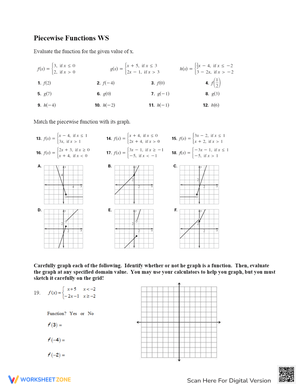
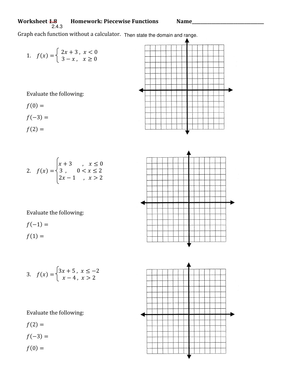
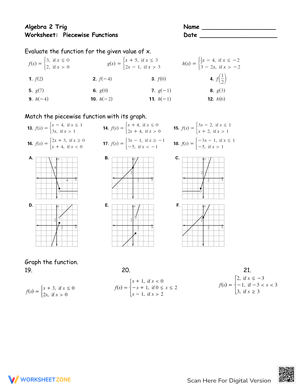
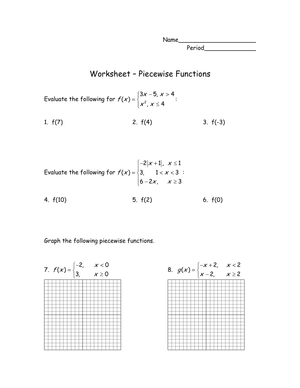
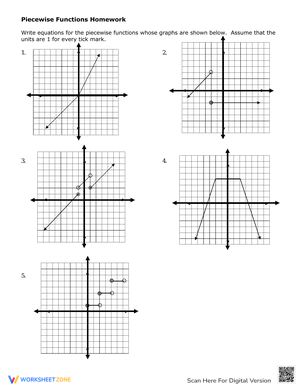
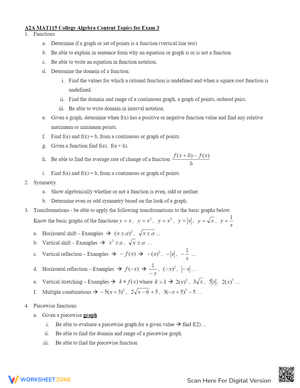
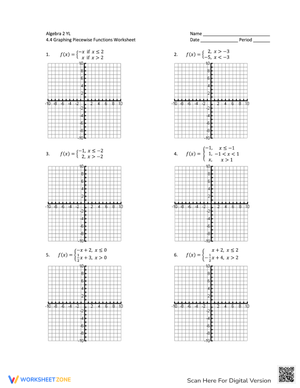
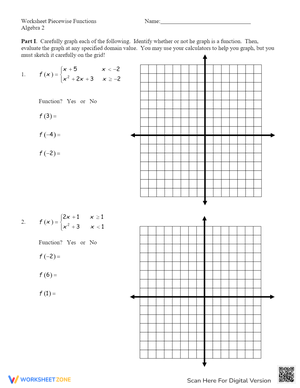
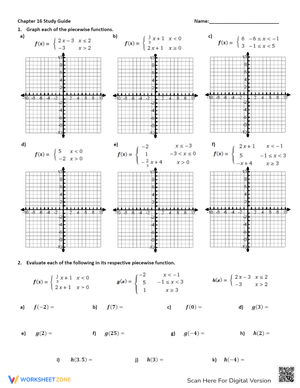
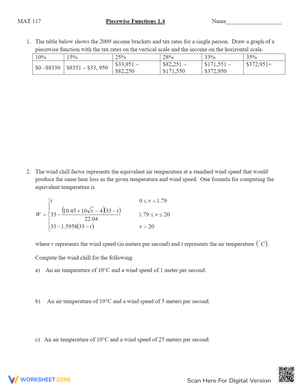
What evaluating piecewise functions worksheets practice
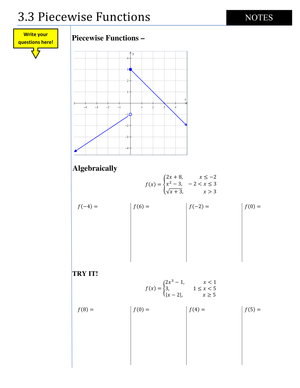
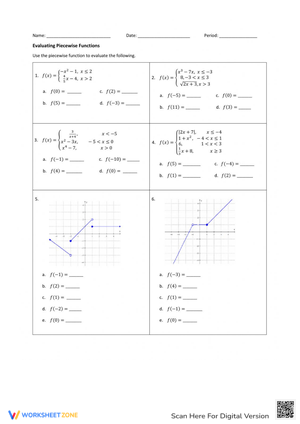
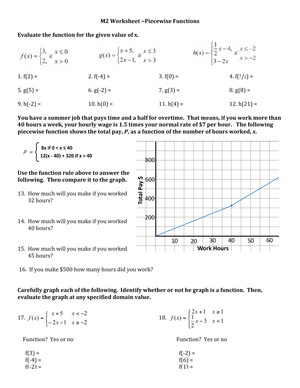
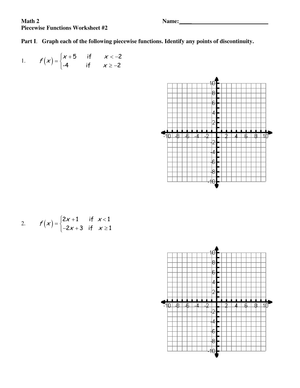
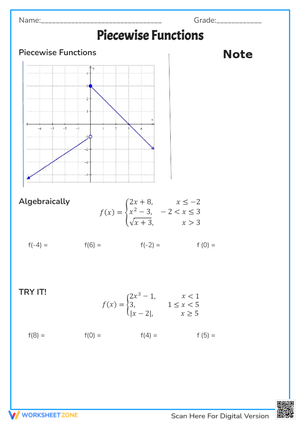
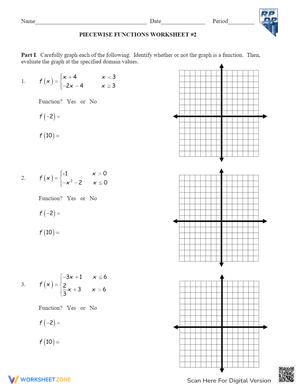
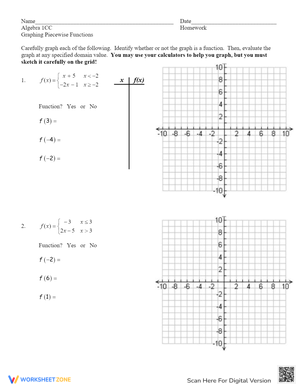
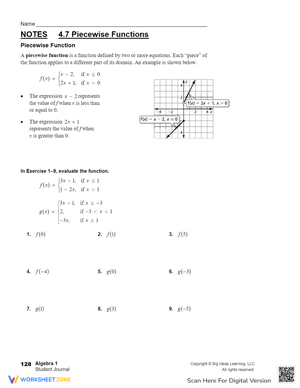
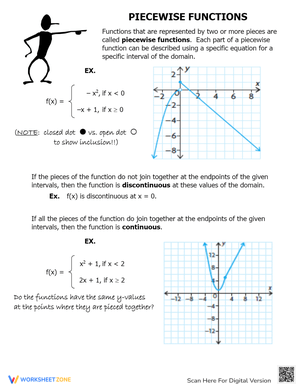
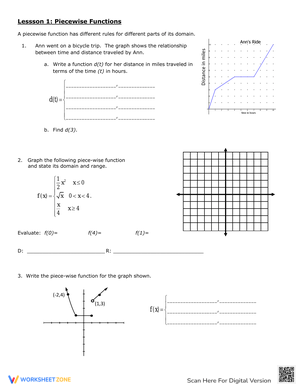
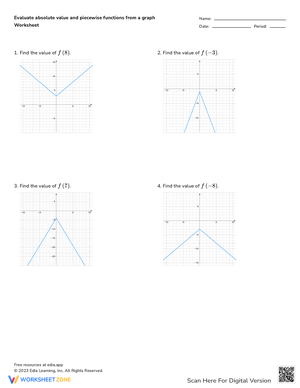
Evaluating piecewise functions worksheets give your students repeated practice choosing the correct rule for a specific input value. A piecewise function hands the student several rules, each tied to part of the domain, and the task is to match the given x-value to the right interval before doing any arithmetic. That matching step is where most of the difficulty lives, and it's the skill these worksheets are built to sharpen.
For an Algebra 1 or Algebra 2 class, the value is precision. Students who can already substitute into a single formula still stumble when they have to decide which of two or three formulas applies. A focused worksheet isolates that decision so you can see who has it and who needs another pass before you move on to graphing.
Because the arithmetic is usually simple, a low score on one of these worksheets is diagnostic in a useful way. It rarely means a student can't compute; it means the student isn't reading the domain restrictions closely enough. That distinction changes how you reteach, and it's why a quick set of ten items can tell you more than a longer mixed review.
The two evaluation errors these worksheets target
Two mistakes account for most wrong answers on piecewise evaluation, and good practice sets are designed around them. The first is misreading the inequality symbol. A student who treats a strict less-than boundary as though it also included the equals case will grab the wrong rule the moment the input lands right on the split. The second is applying a rule from the wrong interval entirely, such as using the rule meant for large inputs when the input is small. Knowing which of the two errors a student makes tells you exactly what to reteach.
Here's the pattern worth naming for students: both errors cluster at or near the boundary, not in the middle of an interval. Inputs like x = 5 inside a wide interval almost never trip students up; the same students miss x = 0 when the domain splits at 0. That means a worksheet's difficulty is set almost entirely by how many items sit on or beside a boundary, not by how big the numbers are. Build practice around the seams, not the arithmetic.
One function, multiple rules
The biggest conceptual trap is that students read a piecewise function as two or three separate, unrelated functions stacked together. When they think that way, boundary decisions feel arbitrary and interval notation feels like decoration. The fix is framing you can repeat every time: this is one function that happens to follow different rules on different parts of its domain, and every x-value gets exactly one output.
Reinforce that framing in how you talk through answers. Ask which rule owns this x-value instead of which equation to use. The word owns keeps the single-function idea front and center and quietly reminds students that each input belongs to one interval and no other. Say it the same way every day so the phrasing becomes a habit students can lean on during a test.
Using These Worksheets In Algebra Lessons
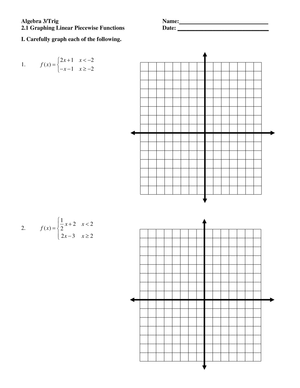
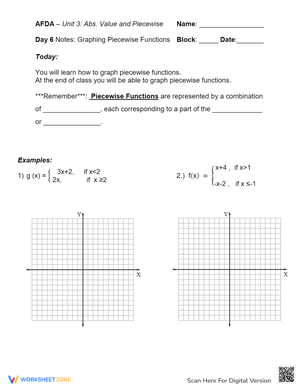
These worksheets fit several points in a function-representations unit. Use a short set as a warm-up the day before you introduce graphing piecewise functions, so evaluation is already automatic when students start plotting. Use a longer set as a formative check the day before a unit test, and sort the results into a ready pile and a needs-a-small-group pile. Keeping the same worksheet format across both uses means students recognize the task instantly and spend their time thinking, not decoding directions.
For small-group intervention, cut the set down to six to eight items and make at least half of them boundary values. Sit with the group and have each student say the interval out loud before writing anything. That single verbal step catches the inequality-misreading error before it reaches the page.
Error-analysis items are worth adding for whole-class review. Show a worked problem with a wrong answer caused by picking the rule for the neighboring interval, and ask students to find and explain the mistake. Finding someone else's boundary error is often what makes a student finally slow down on their own.
Frequently Asked Questions
1. What grade level or course covers evaluating piecewise functions?
Piecewise evaluation shows up in Algebra 1 and returns with more depth in Algebra 2, typically within a unit on function notation and function representations. Most students meet it in grades 8 through 11, depending on your school's math sequence.
2. How can teachers help students avoid boundary-value mistakes?
Have students name the interval before they compute, and give them practice sets where several inputs land exactly on a domain split. Asking whether the boundary is included or excluded, out loud, catches the inequality-misreading error that causes most wrong answers.
3. How do these worksheets align with CCSS HSF-IF.C.7b?
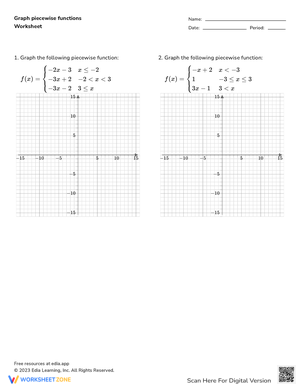
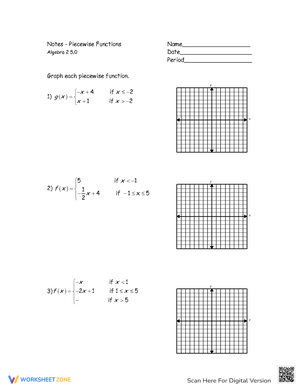
HSF-IF.C.7b asks students to graph piecewise-defined functions, including step and absolute value functions. Accurate evaluation is the prerequisite skill, so these worksheets prepare students for the graphing work the standard describes.
4. Should I use these for small-group intervention or whole-class review?
Both work. For intervention, shorten the set and load it with boundary items so you can watch the decision happen. For whole-class review, add error-analysis problems that ask students to diagnose a wrong rule choice and explain the fix.