


























Views
Plays

Essential Math Practice: Addition & Subtraction Grade 2
Paste this activity's link or code into your existing LMS (Google Classroom, Canvas, Teams, Schoology, Moodle, etc.).
Students can open and work on the activity right away, with no student login required.
You'll still be able to track student progress and results from your teacher account.
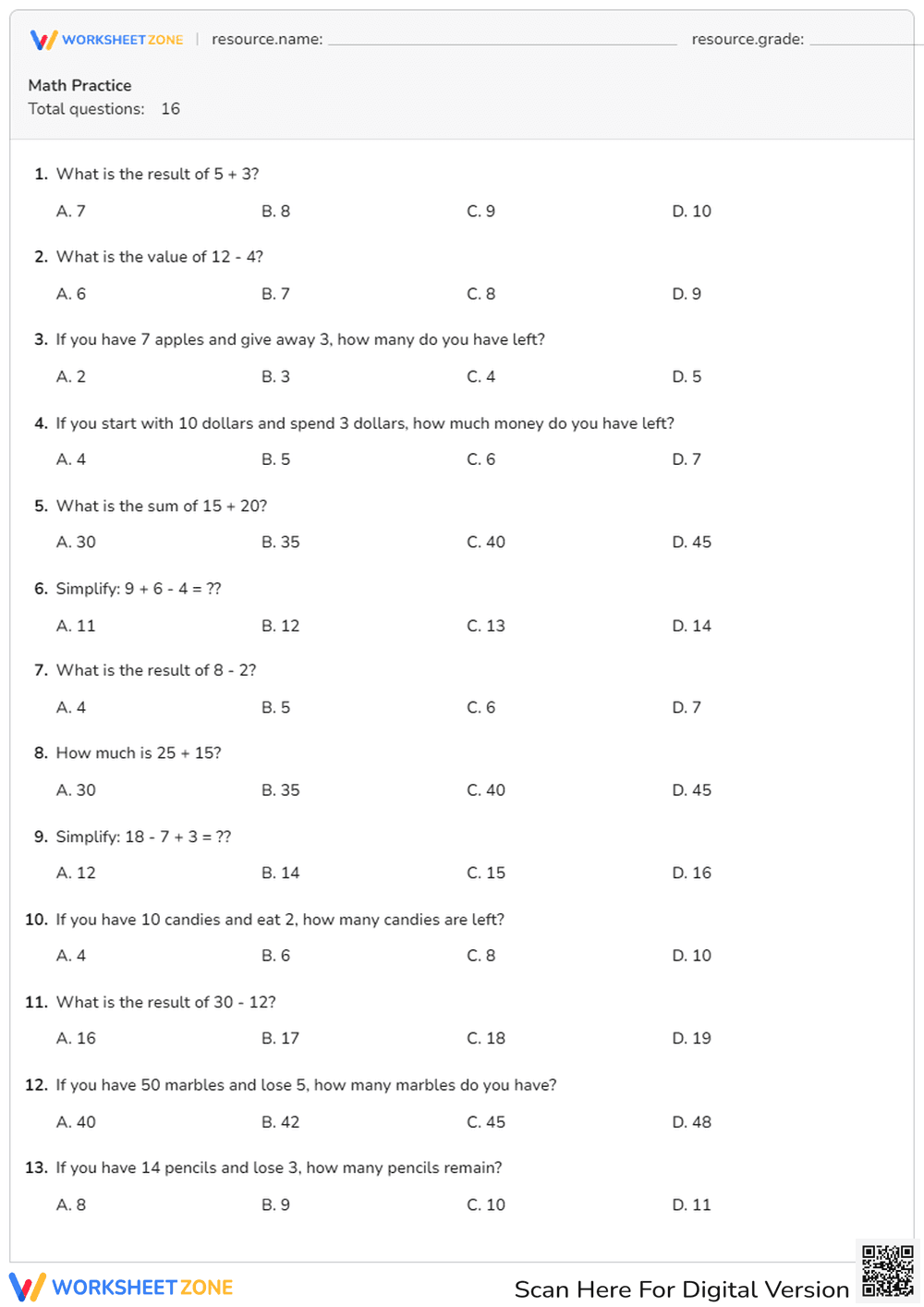
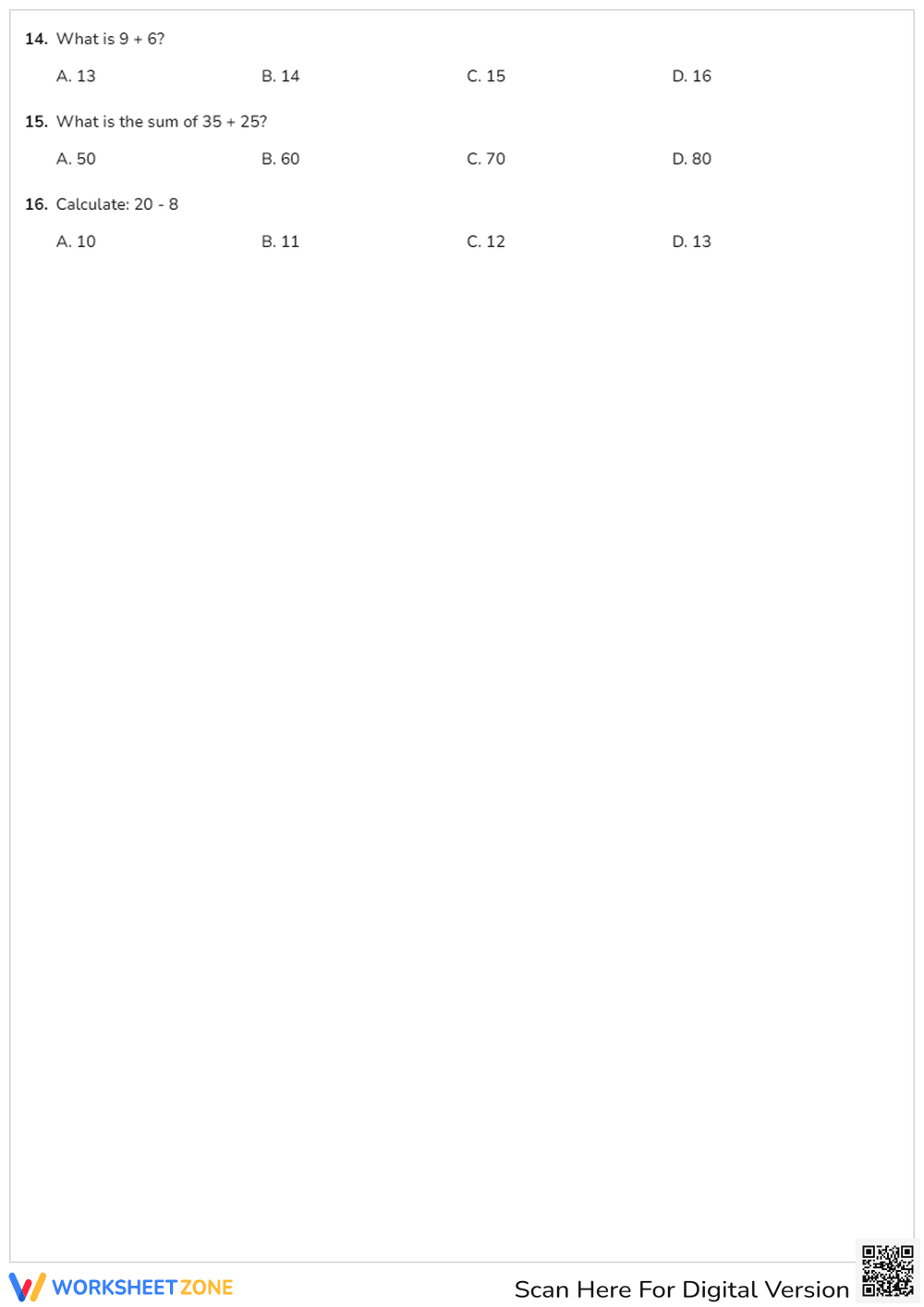
This Grade 2 math practice worksheet provides students with 16 targeted problems to build fluency in addition and subtraction. By combining standard numerical expressions with real-world word problems, students develop the ability to translate language into mathematical operations. This resource ensures learners can confidently find sums and differences while navigating common classroom scenarios.
At a Glance
- Grade: 2 · Subject: Math
- Standard:
CCSS.MATH.CONTENT.2.OA.A.1— Use addition and subtraction within 100 to solve one- and two-step word problems- Skill Focus: Addition and subtraction fluency
- Format: 2 pages · 16 problems · Answer key included · PDF
- Best For: Independent practice or morning work
- Time: 15–20 minutes
This two-page PDF contains 16 multiple-choice questions designed for clarity and ease of use. The worksheet features a mix of direct calculation tasks, such as finding the sum of two-digit numbers, and situational word problems involving money, candies, and school supplies. The multiple-choice format allows for quick grading and provides students with immediate feedback options during independent work time.
Zero-Prep Workflow
- Print: Generate the two-page document in less than 30 seconds.
- Distribute: Hand out the materials in approximately one minute; the clear structure requires no complex instructions.
- Review: Go over the 16 answers as a whole class in roughly five minutes, keeping total teacher prep time under 10 minutes.
This streamlined process makes the worksheet an ideal choice for emergency sub plans or transition periods.
Standards Alignment
The primary standard addressed is CCSS.MATH.CONTENT.2.OA.A.1, which requires students to use addition and subtraction within 100 to solve one- and two-step word problems involving situations of adding to, taking from, and comparing. This standard code can be copied directly into lesson plans, IEP goals, or district curriculum mapping tools to ensure instructional compliance.
How to Use It
This worksheet is ideal as a formative assessment after a unit on subtraction with regrouping. Assign it during the independent practice phase of a lesson to gauge individual student mastery. Alternatively, use it as a reliable morning work activity to reinforce mental math strategies. Expect most students to complete the 16 items within a 20-minute window, allowing for a quick check for understanding.
Who It's For
This resource is tailored for second-grade students working toward fluency, though it serves as an excellent review for third graders. It is particularly helpful for English Language Learners who need practice identifying mathematical action words like "remain," "left," and "sum" within a controlled vocabulary environment. The clean layout supports students who benefit from reduced visual clutter.
According to the RAND AIRS 2024 report, high-quality math practice that integrates word problems with procedural fluency is essential for long-term retention of arithmetic concepts. This worksheet aligns with those findings by requiring students to switch between abstract calculation and contextual application. By solving 16 distinct problems, students engage in the repetitive retrieval practice necessary to move basic facts into long-term memory. The inclusion of the CCSS.MATH.CONTENT.2.OA.A.1 standard ensures that the tasks are developmentally appropriate and rigorous enough to meet national benchmarks. Research indicates that structured, multiple-choice assessments help identify specific misconceptions in subtraction logic, such as smaller-from-larger errors. This resource provides a balanced approach to Grade 2 math, ensuring that students are not just calculating numbers but are also interpreting the quantitative relationships described in the text.


