




























Views
Plays



Grade 2 Math Review: Essential Subtraction & Data Worksheet

Paste this activity's link or code into your existing LMS (Google Classroom, Canvas, Teams, Schoology, Moodle, etc.).
Students can open and work on the activity right away, with no student login required.
You'll still be able to track student progress and results from your teacher account.
This comprehensive Grade 2 math worksheet provides a robust review of three critical domains: data interpretation, operational fluency, and algebraic thinking. Students will solve 30 varied problems that challenge them to extract information from pictographs, perform subtraction using expanded form, and identify complex patterns. This resource ensures students achieve mastery through diverse application.
At a Glance
- Grade: 2 · Subject: Math
- Standard:
CCSS.MATH.CONTENT.2.OA.A.1— Use subtraction within 100 to solve one- and two-step word problems- Skill Focus: Subtraction, Data, Patterns
- Format: 3 pages · 30 problems · Answer key included · PDF
- Best For: End-of-unit assessment or comprehensive review
- Time: 30–45 minutes
What's Inside
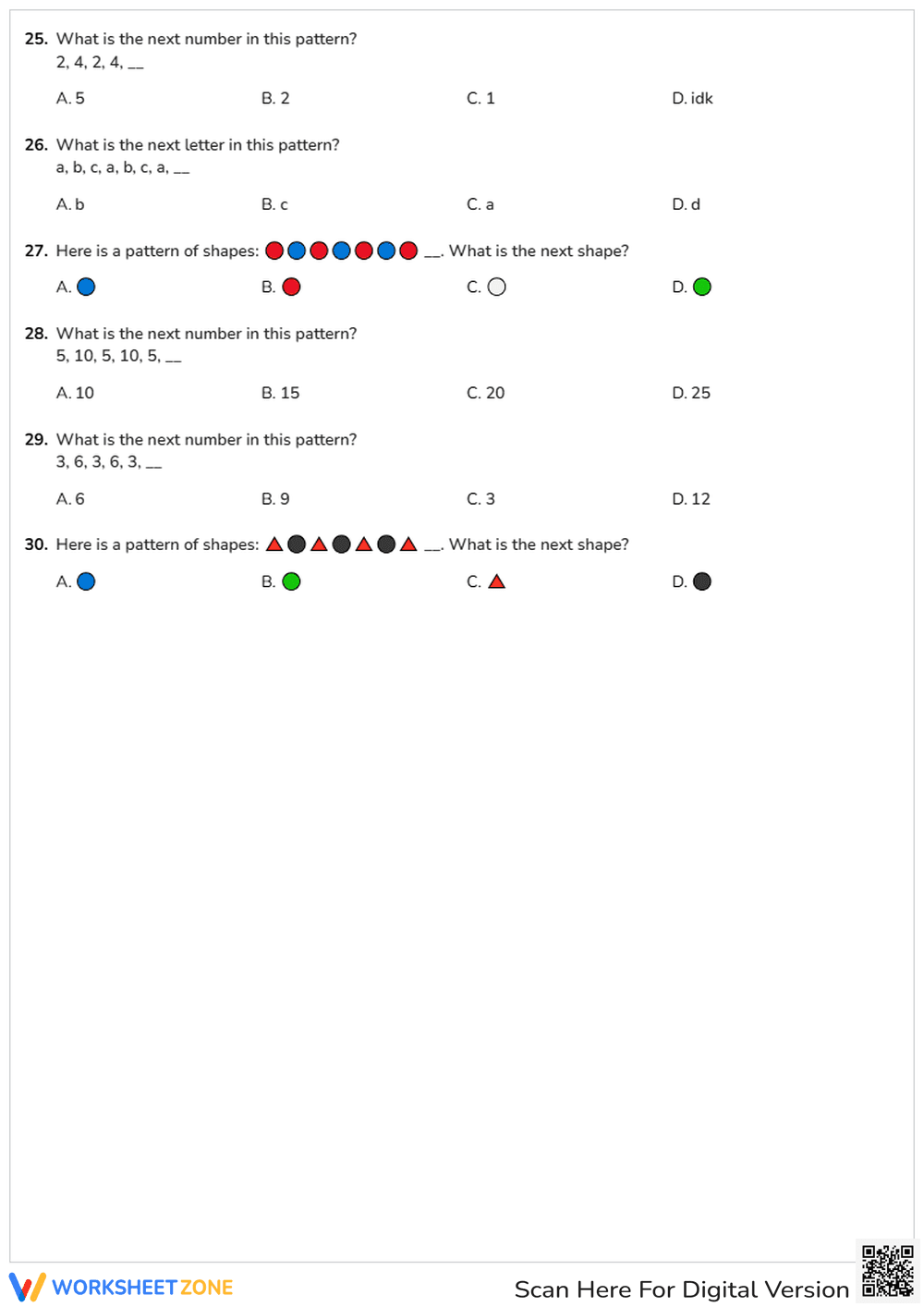
This 3-page PDF contains a balanced mix of multiple-choice and computational tasks. The first section focuses on data literacy with 8 pictograph-based questions. The second section transitions into subtraction word problems and equations, featuring 16 problems that utilize expanded form scaffolds. The final section includes 6 pattern-recognition tasks involving numbers, letters, and geometric shapes. A full answer key is provided for rapid grading.
Zero-Prep Workflow
- Print: Select the 3-page PDF and print enough copies for your cohort in under 30 seconds.
- Distribute: Hand out the packets as a quiet morning work assignment or a formal mid-term assessment.
- Review: Use the included answer key to grade the 30 questions or facilitate a peer-review session in roughly 5 minutes.
This layout is specifically designed for substitute folders or emergency lesson plans where teacher preparation time is limited to less than 2 minutes.
Standards Alignment
The primary focus of this resource is `CCSS.MATH.CONTENT.2.OA.A.1`, which requires students to use subtraction within 100 to solve one- and two-step word problems. Additionally, the worksheet supports `CCSS.MATH.CONTENT.2.MD.D.10` by requiring students to draw conclusions from data sets represented in pictographs. Both standard codes can be copied directly into lesson plans, IEP goals, or district curriculum mapping tools.
How to Use It
This worksheet is ideal for the "You Do" phase of the gradual release model, serving as an independent practice tool after students have learned expanded form subtraction. It also functions as a formative assessment to gauge readiness for state testing. Expect students to spend 30 to 45 minutes completing all three pages. Teachers should observe students during the pattern section to identify those struggling with logical sequencing.
Who It's For
This resource is tailored for Grade 2 students but serves as an excellent extension for advanced Grade 1 learners or a remedial tool for Grade 3 students needing a refresher on data and operations. It pairs naturally with an anchor chart on expanded form or a direct instruction lesson on data visualization. The clear font and structured layout support students with executive functioning challenges.
This instructional resource targets CCSS.MATH.CONTENT.2.OA.A.1 by integrating subtraction word problems with data interpretation and pattern recognition. According to Fisher & Frey (2014), the gradual release of responsibility is most effective when students encounter mixed-review formats that require them to switch between different cognitive domains, such as moving from visual pictograph analysis to abstract numerical equations. By providing 30 distinct tasks, this worksheet ensures that students develop the stamina required for standardized testing while reinforcing the foundational skill of subtracting within 100 using expanded form. Research indicates that multi-modal math practice—combining visual, linguistic, and symbolic representations—leads to higher retention rates in early elementary learners. This document serves as a robust tool for formative assessment, allowing educators to identify specific gaps in operational fluency or logical reasoning. The inclusion of an answer key facilitates immediate feedback, a critical component of the learning cycle that prevents the solidification of mathematical misconceptions during independent practice sessions.


