


























Views
Downloads
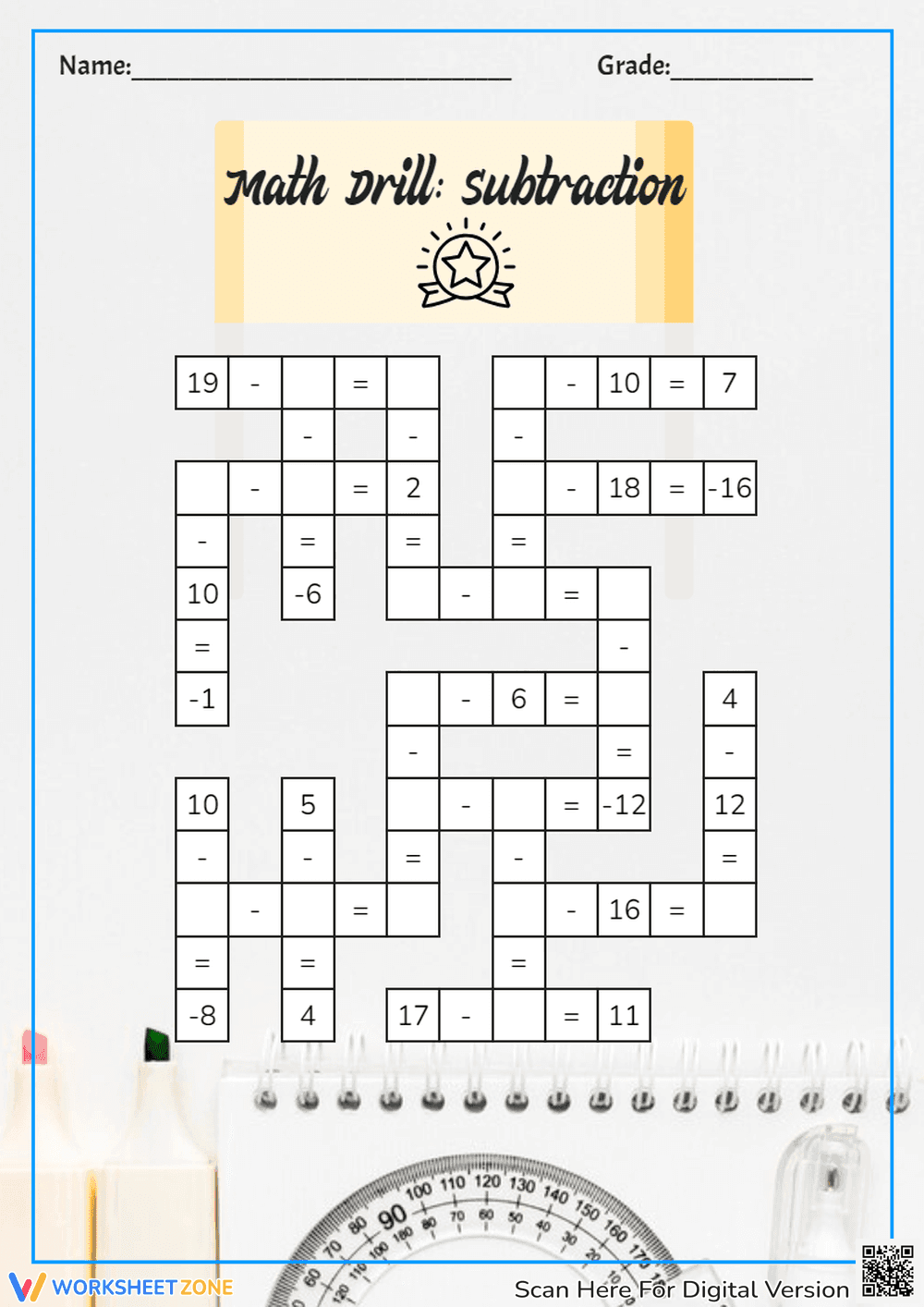

Grade 2 Subtraction — Printable No-Prep Worksheet
Paste this activity's link or code into your existing LMS (Google Classroom, Canvas, Teams, Schoology, Moodle, etc.).
Students can open and work on the activity right away, with no student login required.
You'll still be able to track student progress and results from your teacher account.
This engaging subtraction crossword worksheet helps first and second-grade students build math fluency by solving intersecting equations. By turning standard drill practice into a puzzle format, learners strengthen their ability to subtract within 20 while developing critical problem-solving and logic skills.
At a Glance
- Grade: 2 · Subject: Math
- Standard:
CCSS.MATH.CONTENT.2.OA.B.2— Fluently subtract within 20 using mental strategies- Skill Focus: Subtraction facts
- Format: 1 page · 15 problems · PDF
- Best For: Independent practice
- Time: 10–15 minutes
Inside this single-page resource, educators will find a unique math crossword puzzle featuring approximately 15 intersecting subtraction equations. Students must solve for the missing difference, minuend, or subtrahend to complete the grid. The puzzle format provides built-in self-checking, as intersecting numbers must satisfy both horizontal and vertical equations, ensuring students carefully calculate each step.
Zero-Prep Workflow
- Print (1 minute): Simply download the PDF and print a class set. No special materials or cutting required.
- Distribute (1 minute): Hand out the puzzle during math centers, morning work, or as an early finisher activity.
- Review (3 minutes): Quickly check student grids for accuracy or project the puzzle on a smartboard to solve together as a class.
With a total teacher prep time of under 2 minutes, this worksheet is an ideal, stress-free addition to any emergency sub plan.
This worksheet is tightly aligned to CCSS.MATH.CONTENT.2.OA.B.2: Fluently add and subtract within 20 using mental strategies. By requiring students to find missing numbers in various positions of the equation, it also supports algebraic thinking foundations. Both standard codes can be copied directly into lesson plans, IEP goals, or district curriculum mapping tools.
Deploy this puzzle during independent math centers after direct instruction on subtraction strategies. It serves as an excellent quiet activity that keeps students engaged while the teacher pulls small groups. As a formative assessment observation tip, watch how students approach intersecting boxes; those who use a solved vertical equation to help solve a difficult horizontal one are demonstrating strong number sense and logical reasoning. Expect completion to take between 10 and 15 minutes.
This resource is designed for first and second-grade general education students, but it also serves as a valuable intervention tool for third graders needing subtraction fact reinforcement. To differentiate, provide struggling learners with a number line or base-ten blocks to assist with calculations. It pairs naturally with a direct instruction lesson on fact families or missing addend/subtrahend strategies.
Developing automaticity with basic math facts is a critical milestone in early elementary education. This targeted resource aligns directly with CCSS.MATH.CONTENT.2.OA.B.2, helping students fluently subtract within 20 using mental strategies. According to a comprehensive EdReports 2024 analysis, instructional materials that integrate puzzle-based formats significantly increase student time-on-task and reduce math anxiety when compared to traditional rote drill worksheets. By embedding subtraction practice within an engaging crossword structure, learners are intrinsically motivated to persist through challenging equations because each correct answer reveals a vital clue for the next intersecting problem. This built-in, self-correcting mechanism provides immediate feedback, which is absolutely essential for building mathematical confidence and ensuring long-term skill retention. Educators can confidently rely on this evidence-based approach to solidify foundational arithmetic skills while simultaneously fostering logical reasoning and independent problem-solving capabilities in their young learners.


