


























Views
Downloads

Printable Rhyming Words Matching Worksheet | Kindergarten ELA
Paste this activity's link or code into your existing LMS (Google Classroom, Canvas, Teams, Schoology, Moodle, etc.).
Students can open and work on the activity right away, with no student login required.
You'll still be able to track student progress and results from your teacher account.
Rhyming is a foundational pillar of early literacy that bridges the gap between spoken language and reading fluency. This printable worksheet provides a structured environment for students to identify, match, and produce rhyming pairs. By engaging with these auditory patterns, learners strengthen their phonemic awareness and prepare for successful decoding in later grades.
At a Glance
- Grade: Kindergarten · Subject: ELA
- Standard:
CCSS.ELA-LITERACY.RF.K.2.A— Recognize and produce rhyming words through matching and sentence completion tasks- Skill Focus: Phonemic Awareness & Rhyming
- Format: 3 pages · 16 problems · Answer key included · PDF
- Best For: Literacy centers and morning work practice
- Time: 15–20 minutes
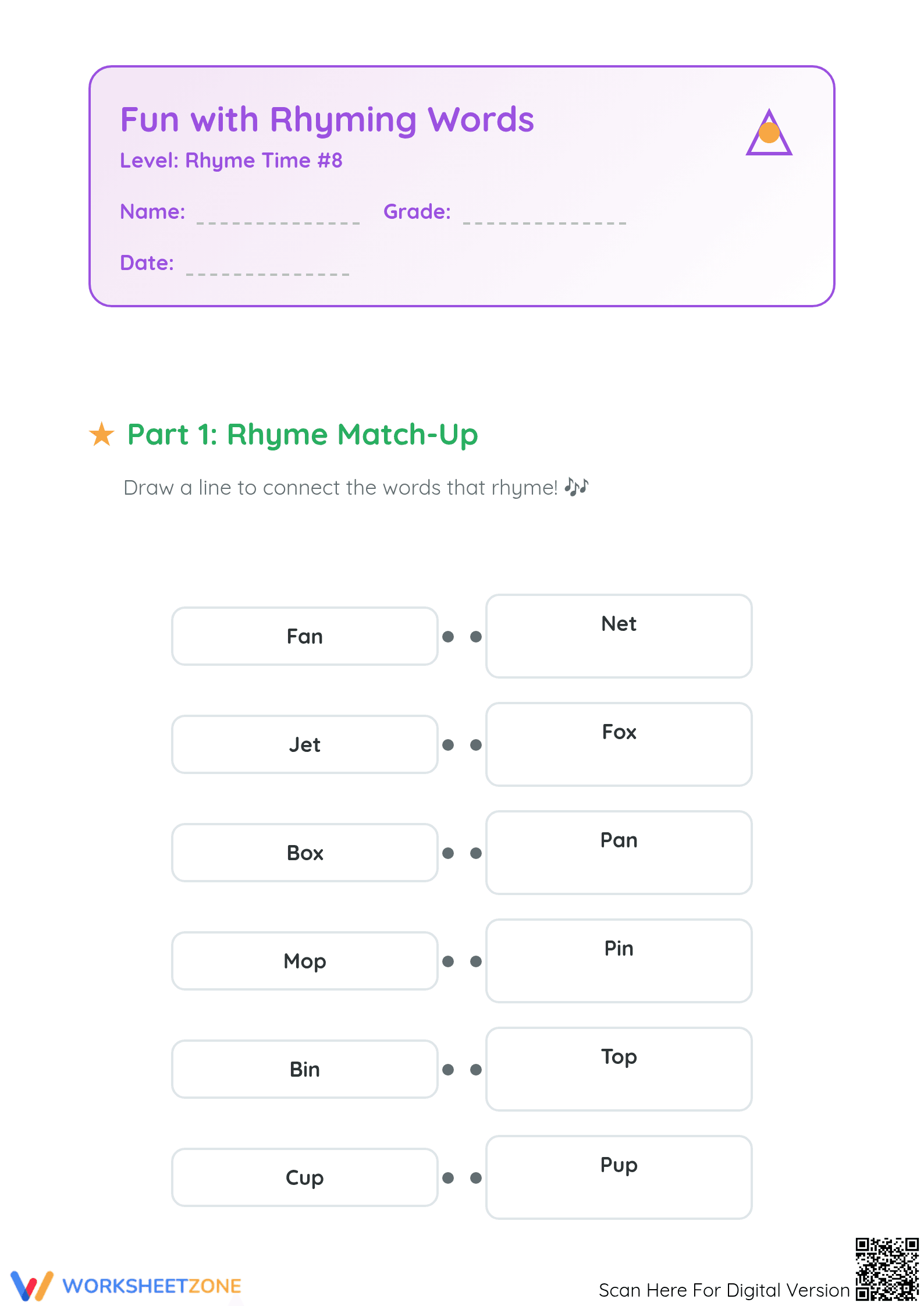
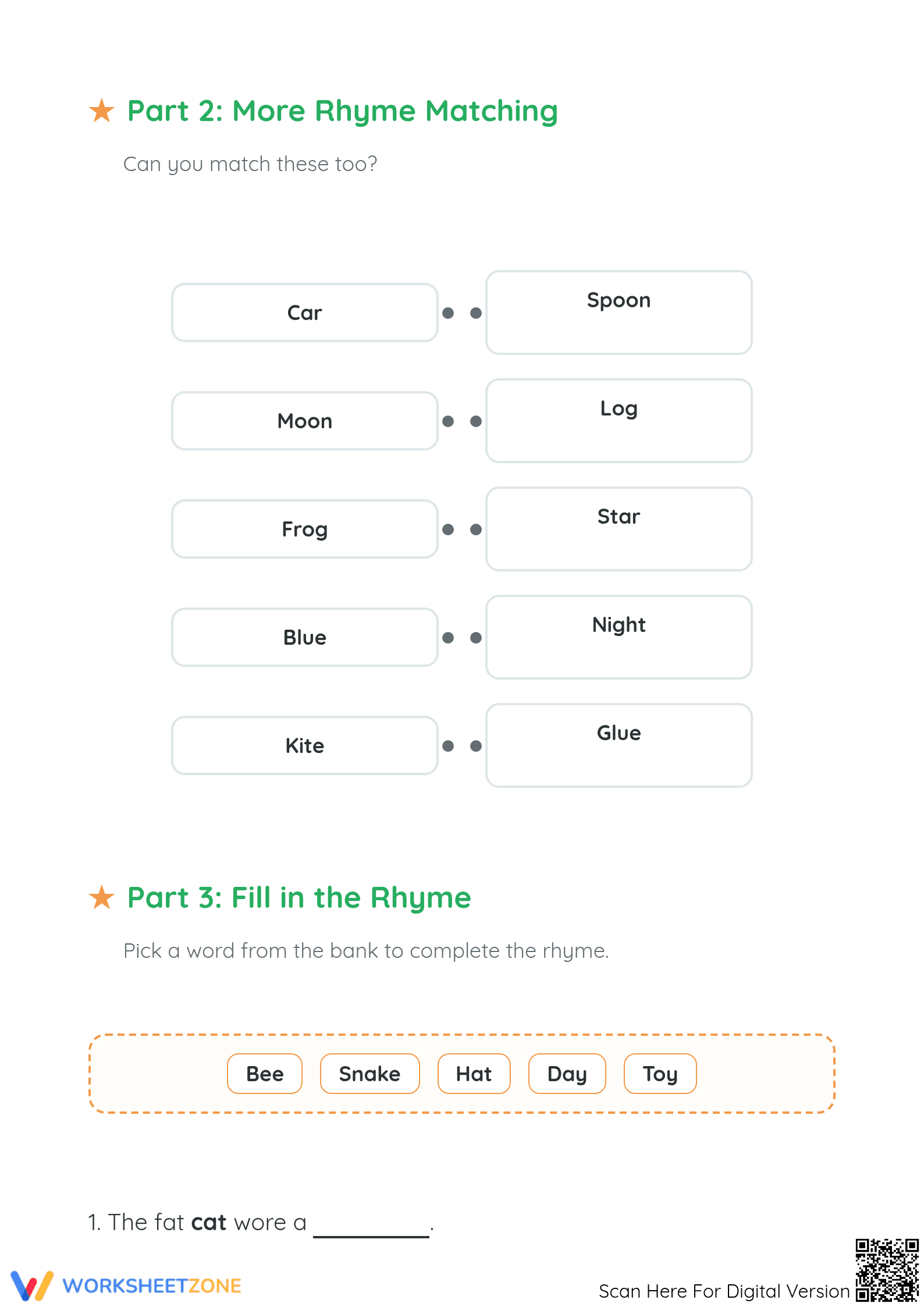
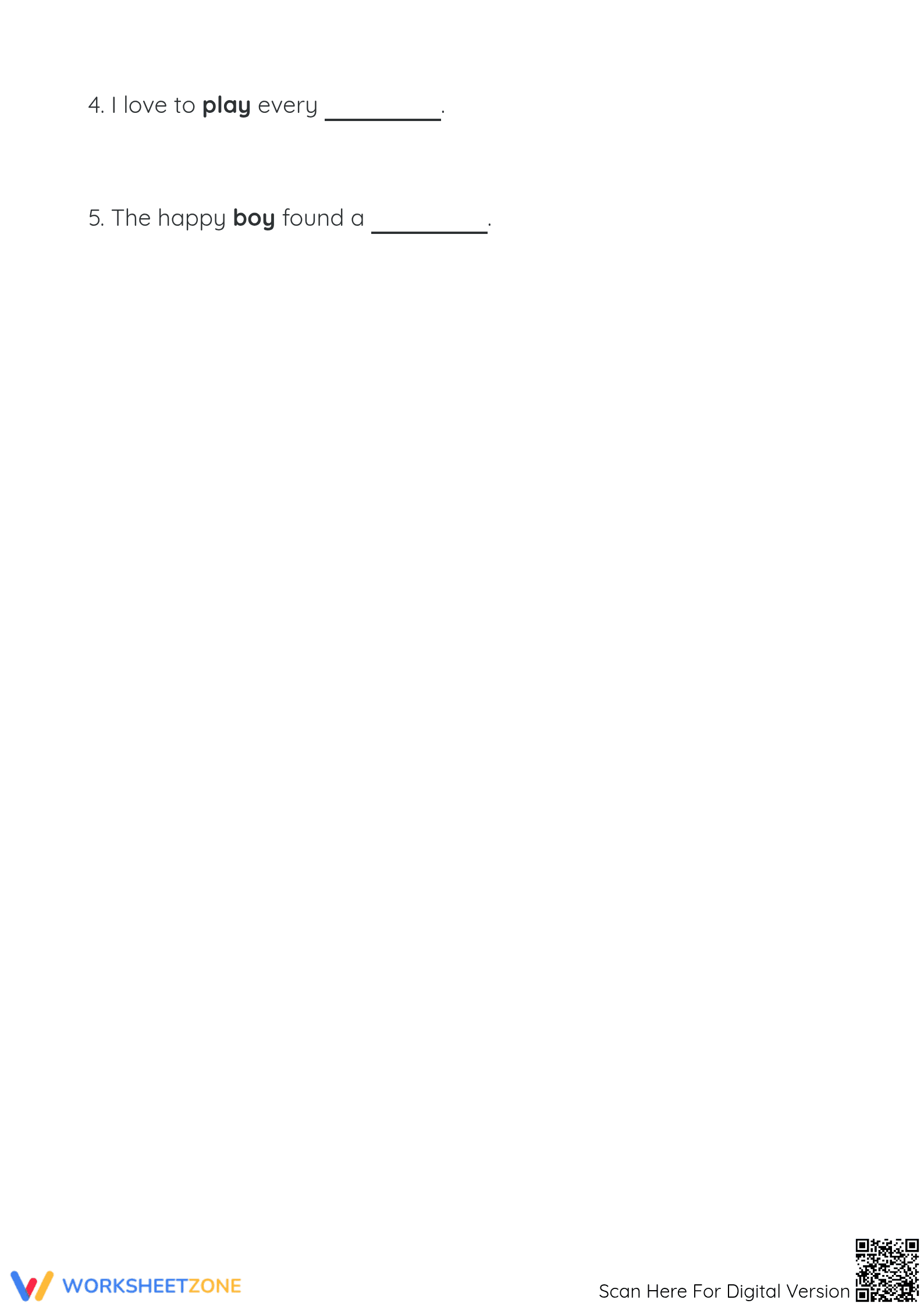
This comprehensive three-page PDF packet features three distinct activity sections designed to scaffold student learning. Part one and two focus on visual and auditory matching with 11 word-to-word pairs, while part three challenges students to apply their knowledge by selecting the correct rhyming word from a bank to complete sentences. A full answer key is provided for quick grading.
Skill Progression
- Guided Practice: Students begin with six high-frequency word matches (e.g., Fan/Pan, Box/Fox) to establish the pattern of ending sounds.
- Supported Practice: Five additional matching pairs introduce varied vowel sounds, encouraging students to listen closely to terminal phonemes.
- Independent Application: Five fill-in-the-blank sentences require students to evaluate multiple options and choose the one that maintains the rhyme.
The worksheet follows a gradual-release model, moving from simple recognition to active production through 16 intentional practice items.
Standards Alignment
This resource is directly aligned with CCSS.ELA-LITERACY.RF.K.2.A, which requires students to "recognize and produce rhyming words." It also supports phonics development by highlighting common word families and onset-rime relationships. Both standard codes can be copied directly into lesson plans, IEP goals, or district curriculum mapping tools.
How to Use It
Use this worksheet during a small-group literacy rotation after a direct instruction lesson on word families. Alternatively, assign it as a morning work activity to reinforce skills taught earlier in the week. While students work, observe if they are vocalizing the words to "hear" the rhyme, which serves as a valuable formative assessment indicator. Completion typically takes 15 to 20 minutes.
Who It's For
This resource is ideal for preschool, kindergarten, and first-grade students who are developing their phonological processing skills. It provides necessary scaffolding for English Language Learners and students with speech-language goals. Pair this worksheet with a rhyming picture book or an anchor chart featuring common word family endings for maximum instructional impact.
Early exposure to rhyming is critical for developing the phonemic awareness necessary for reading success. Research by Fisher & Frey (2014) emphasizes the importance of scaffolding phonological tasks, moving students from simple recognition to the complex production of sounds. This worksheet aligns with these evidence-based practices by providing 16 distinct opportunities for students to engage with terminal phonemes across matching and sentence-level tasks. By focusing on CCSS.ELA-LITERACY.RF.K.2.A, the activities ensure that learners are building the auditory discrimination skills required to identify word families and decode new vocabulary efficiently. The inclusion of a word bank and structured matching columns provides the visual support needed to lower the cognitive load during initial skill acquisition. Teachers can utilize this resource as a reliable bridge between phonemic awareness instruction and independent reading fluency development within any balanced literacy framework.


