




























Views
Downloads


Essential Long I vs Short I Vowel Sort | Grade 1

Paste this activity's link or code into your existing LMS (Google Classroom, Canvas, Teams, Schoology, Moodle, etc.).
Students can open and work on the activity right away, with no student login required.
You'll still be able to track student progress and results from your teacher account.
This Grade 1 phonics worksheet helps students distinguish between long and short I vowel sounds through tactile sorting and sentence-based identification. By engaging with common CVC and CVCe patterns, learners build the phonemic awareness necessary for fluent reading and accurate spelling. It provides a clear, structured path toward vowel sound mastery.
At a Glance
- Grade: 1 · Subject: ELA Phonics
- Standard:
CCSS.ELA-LITERACY.RF.1.3.C— Know final -e and common vowel team conventions for long vowel sounds- Skill Focus: Long vs. Short I Discrimination
- Format: 2 pages · 12 problems · Answer key included · PDF
- Best For: Independent phonics practice or literacy centers
- Time: 15–20 minutes
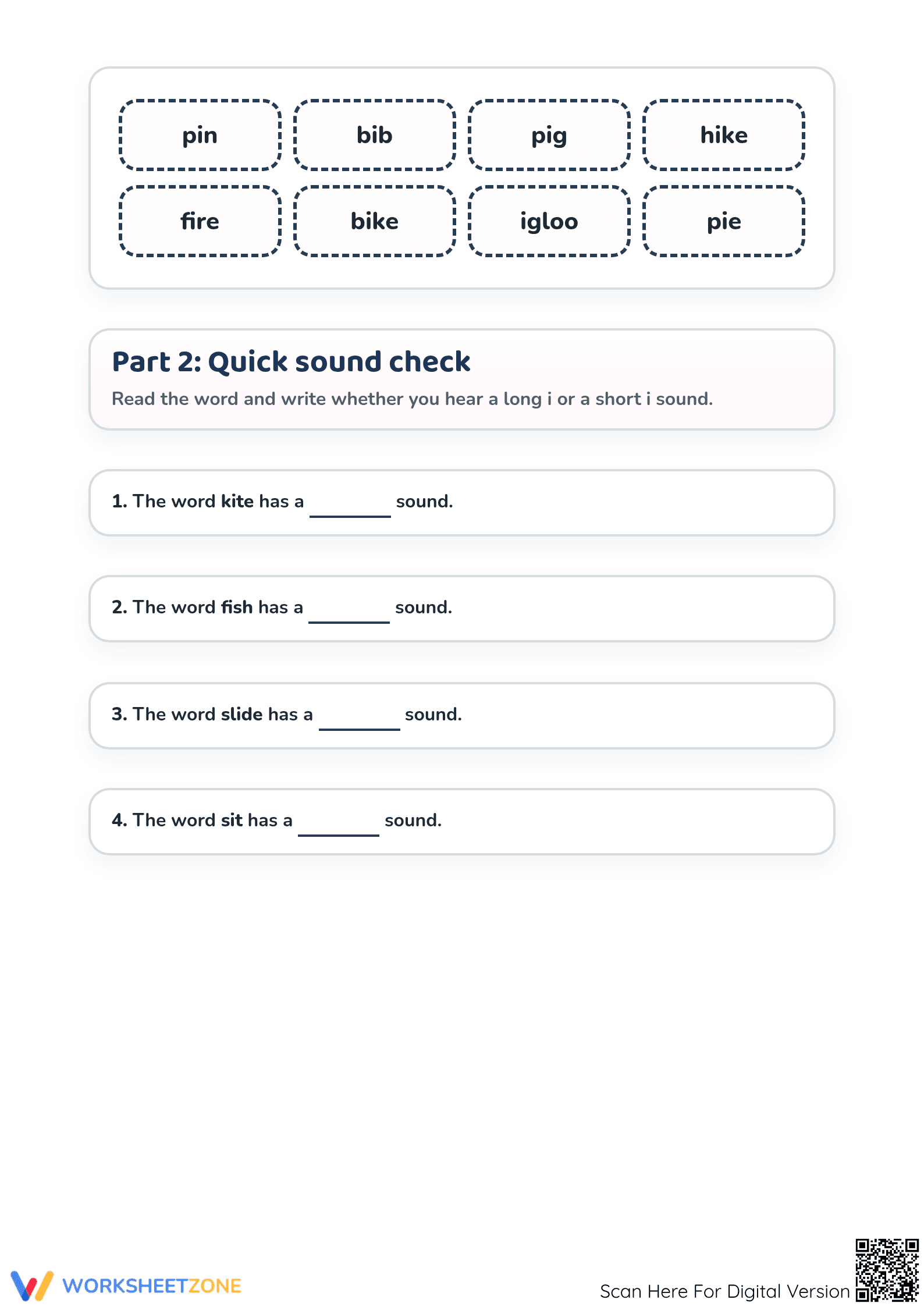
The resource consists of a two-page PDF designed for immediate use. Page one features a dual-column sorting mat for Long and Short I. Page two provides eight cut-out word cards featuring high-frequency words like "bike" and "pig," alongside a "Quick Sound Check" section with four fill-in-the-blank sentences. A complete answer key is provided for rapid grading and student self-correction.
This worksheet is designed for a zero-prep classroom workflow. First, print the two pages (30 seconds). Second, distribute to students with scissors and glue (1 minute). Third, review the completed sorting mats and sound check sentences using the provided answer key (30 seconds). Total teacher preparation time is under two minutes, making it an ideal choice for morning work, literacy stations, or emergency sub plans.
The primary focus is `CCSS.ELA-LITERACY.RF.1.3.C`, which requires students to "Know final -e and common vowel team conventions for representing long vowel sounds." This activity specifically targets the contrast between closed syllables (short I) and silent-e patterns (long I). Both standard codes can be copied directly into lesson plans, IEP goals, or district curriculum mapping tools.
Use this worksheet during the "You Do" phase of a gradual release lesson on vowel patterns. It serves as an excellent formative assessment after direct instruction on the silent-e rule. Teachers should observe students as they read the word cards aloud; if a student struggles to differentiate "pin" from "pie," it indicates a need for targeted phonemic intervention. Completion typically takes 15 to 20 minutes depending on student scissor skills.
This resource is tailored for first-grade students but remains highly effective for kindergarteners ready for advanced phonics or second graders requiring remedial support. It is particularly useful for English Language Learners (ELLs) who need visual and tactile reinforcement of English vowel sounds. Pair this with a long-vowel anchor chart or a direct instruction lesson on CVCe words for maximum instructional impact.
Phonics instruction centered on vowel discrimination is a cornerstone of early literacy development. This worksheet aligns with the Fisher & Frey (2014) framework for gradual release of responsibility, moving students from simple word recognition to applied identification in sentence contexts. By targeting CCSS.ELA-LITERACY.RF.1.3.C, the activity addresses the critical transition from decoding simple CVC words to understanding more complex orthographic patterns like the silent-e. Research from the ScienceDirect TpT Analysis suggests that tactile "cut and paste" activities significantly increase student engagement and retention of phonemic concepts compared to passive reading alone. This 2-page resource provides 12 specific opportunities for students to demonstrate mastery of the long and short I sounds, ensuring they can accurately decode words like "hike" and "bib." Such focused practice is essential for building the reading fluency required by national standards and state-level assessments.


