


























1 / 3
0
Views
0
Downloads



0.0
0
Save
0 Likes
Make a Match: Fractions Worksheet
0 Views
0 Downloads
Paste this activity's link or code into your existing LMS (Google Classroom, Canvas, Teams, Schoology, Moodle, etc.).
Students can open and work on the activity right away, with no student login required.
You'll still be able to track student progress and results from your teacher account.
Information
Description
What It Is:
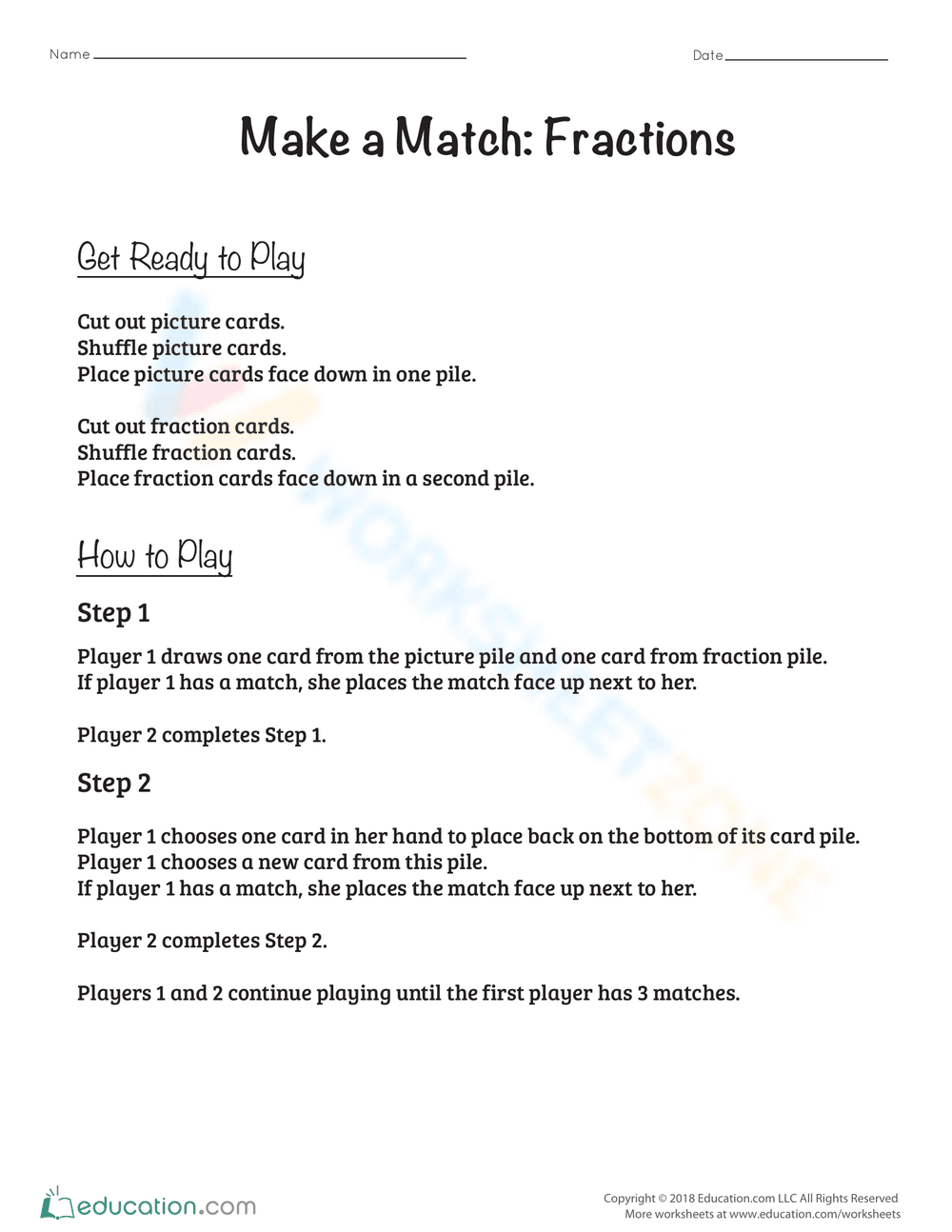
This is an educational worksheet for a 'Make a Match: Fractions' game. It includes instructions for preparing the game, which involves cutting out picture cards and fraction cards, shuffling them, and placing them face down in separate piles. It then details the rules for playing, where players draw cards from each pile, looking for matching pairs, and continue until one player has three matches.
Grade Level Suitability:
This worksheet is suitable for grades 2-4. It is designed to reinforce fraction concepts through a matching game format. The instructions are clear and simple, making it accessible for students in these grades.
Why Use It:
This worksheet provides a fun and engaging way for students to practice matching fractions with corresponding visual representations. It promotes critical thinking, memory skills, and reinforces fraction recognition in a hands-on activity.
How to Use It:
First, cut out the picture cards and fraction cards. Shuffle each set separately and place them face down. Following the instructions, players take turns drawing one card from each pile, checking for a match. If a match is found, the pair is placed face up. The game continues until one player has three matches.
Target Users:
This worksheet is ideal for elementary school students learning about fractions, especially those who benefit from visual and kinesthetic learning experiences. It can be used in the classroom, as a homework assignment, or as a supplemental learning activity at home.
This is an educational worksheet for a 'Make a Match: Fractions' game. It includes instructions for preparing the game, which involves cutting out picture cards and fraction cards, shuffling them, and placing them face down in separate piles. It then details the rules for playing, where players draw cards from each pile, looking for matching pairs, and continue until one player has three matches.
Grade Level Suitability:
This worksheet is suitable for grades 2-4. It is designed to reinforce fraction concepts through a matching game format. The instructions are clear and simple, making it accessible for students in these grades.
Why Use It:
This worksheet provides a fun and engaging way for students to practice matching fractions with corresponding visual representations. It promotes critical thinking, memory skills, and reinforces fraction recognition in a hands-on activity.
How to Use It:
First, cut out the picture cards and fraction cards. Shuffle each set separately and place them face down. Following the instructions, players take turns drawing one card from each pile, checking for a match. If a match is found, the pair is placed face up. The game continues until one player has three matches.
Target Users:
This worksheet is ideal for elementary school students learning about fractions, especially those who benefit from visual and kinesthetic learning experiences. It can be used in the classroom, as a homework assignment, or as a supplemental learning activity at home.


