


























0
Views
0
Downloads

0.0
0
Save
0 Likes
Share
Creating Stem and Leaf Plots
0 Views
0 Downloads
Paste this activity's link or code into your existing LMS (Google Classroom, Canvas, Teams, Schoology, Moodle, etc.).
Students can open and work on the activity right away, with no student login required.
You'll still be able to track student progress and results from your teacher account.
Information
Description
What It Is:
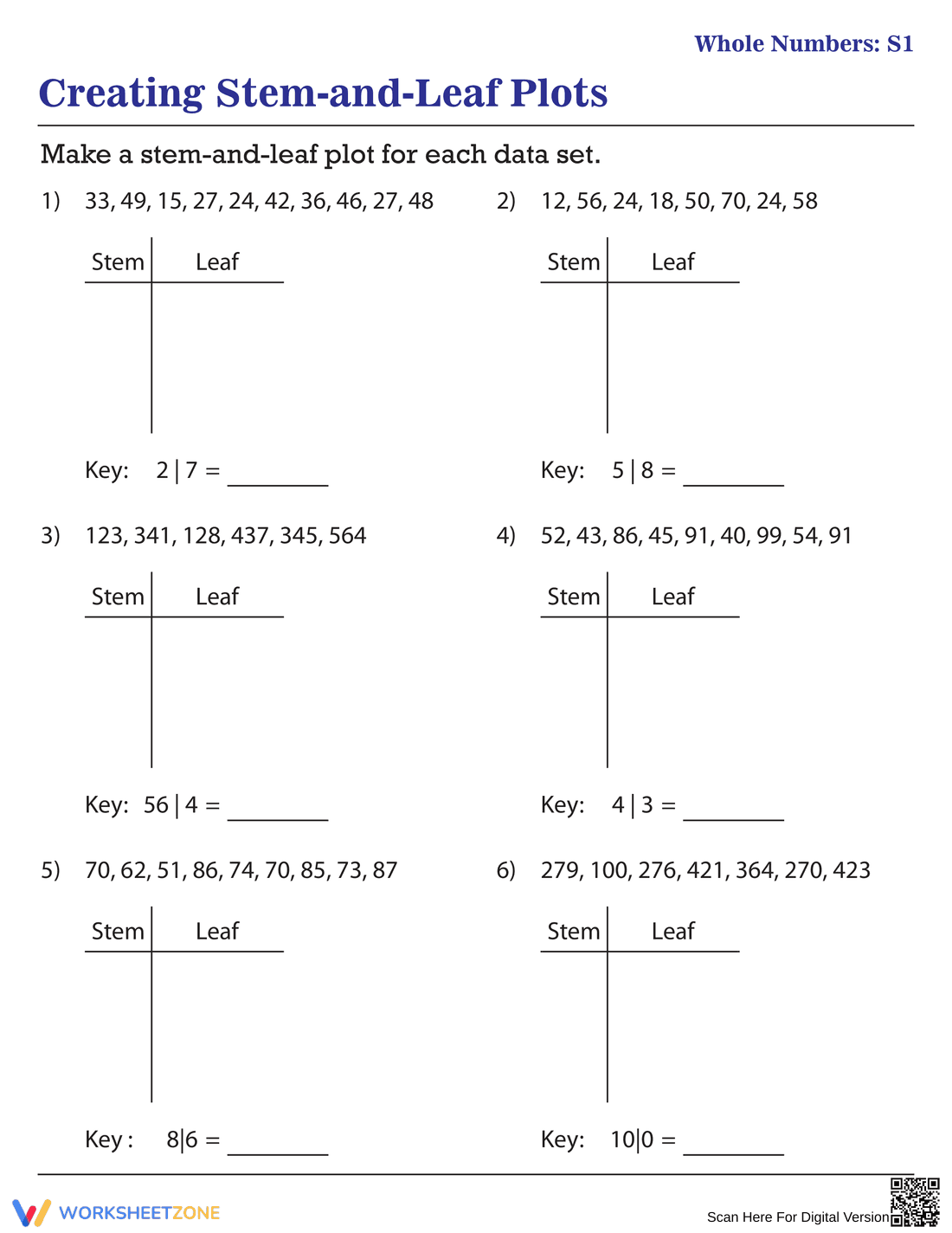
This is an educational worksheet designed to teach students how to create stem-and-leaf plots. The worksheet presents six different data sets, each accompanied by a blank stem-and-leaf plot template with 'Stem' and 'Leaf' columns. Each problem also provides a key to help students understand how to read and interpret the stem-and-leaf plot (e.g., 2|7 = ). Students are required to organize the given data into the appropriate stem and leaf format.
Grade Level Suitability:
This worksheet is most suitable for grades 5-7. It requires students to understand place value, data organization, and basic statistical concepts, which are typically introduced in these grade levels. The data sets involve both two-digit and three-digit numbers, suggesting it's appropriate for students developing their understanding of data representation.
Why Use It:
Using this worksheet helps students develop skills in organizing and interpreting data. It reinforces understanding of place value and provides a visual representation of data distribution. Creating stem-and-leaf plots helps students quickly identify the range, median, and mode of a data set. This worksheet promotes data analysis and critical thinking skills.
How to Use It:
Students should first examine the data set provided for each problem. Then, they should identify the stems (the leading digit(s)) and leaves (the trailing digit(s)) for each number. Next, they should write the stems in the left column ('Stem') and the corresponding leaves in the right column ('Leaf'), ensuring the leaves are ordered from least to greatest. Finally, they need to fill in the blank after the key to show what the stem and leaf represent as a full number.
Target Users:
This worksheet is designed for students learning about data representation and basic statistics, specifically stem-and-leaf plots. It is useful for teachers looking for practice material or assessment tools for this topic. It can also be used by parents who want to help their children practice data organization skills.
This is an educational worksheet designed to teach students how to create stem-and-leaf plots. The worksheet presents six different data sets, each accompanied by a blank stem-and-leaf plot template with 'Stem' and 'Leaf' columns. Each problem also provides a key to help students understand how to read and interpret the stem-and-leaf plot (e.g., 2|7 = ). Students are required to organize the given data into the appropriate stem and leaf format.
Grade Level Suitability:
This worksheet is most suitable for grades 5-7. It requires students to understand place value, data organization, and basic statistical concepts, which are typically introduced in these grade levels. The data sets involve both two-digit and three-digit numbers, suggesting it's appropriate for students developing their understanding of data representation.
Why Use It:
Using this worksheet helps students develop skills in organizing and interpreting data. It reinforces understanding of place value and provides a visual representation of data distribution. Creating stem-and-leaf plots helps students quickly identify the range, median, and mode of a data set. This worksheet promotes data analysis and critical thinking skills.
How to Use It:
Students should first examine the data set provided for each problem. Then, they should identify the stems (the leading digit(s)) and leaves (the trailing digit(s)) for each number. Next, they should write the stems in the left column ('Stem') and the corresponding leaves in the right column ('Leaf'), ensuring the leaves are ordered from least to greatest. Finally, they need to fill in the blank after the key to show what the stem and leaf represent as a full number.
Target Users:
This worksheet is designed for students learning about data representation and basic statistics, specifically stem-and-leaf plots. It is useful for teachers looking for practice material or assessment tools for this topic. It can also be used by parents who want to help their children practice data organization skills.


