


























Views
Downloads
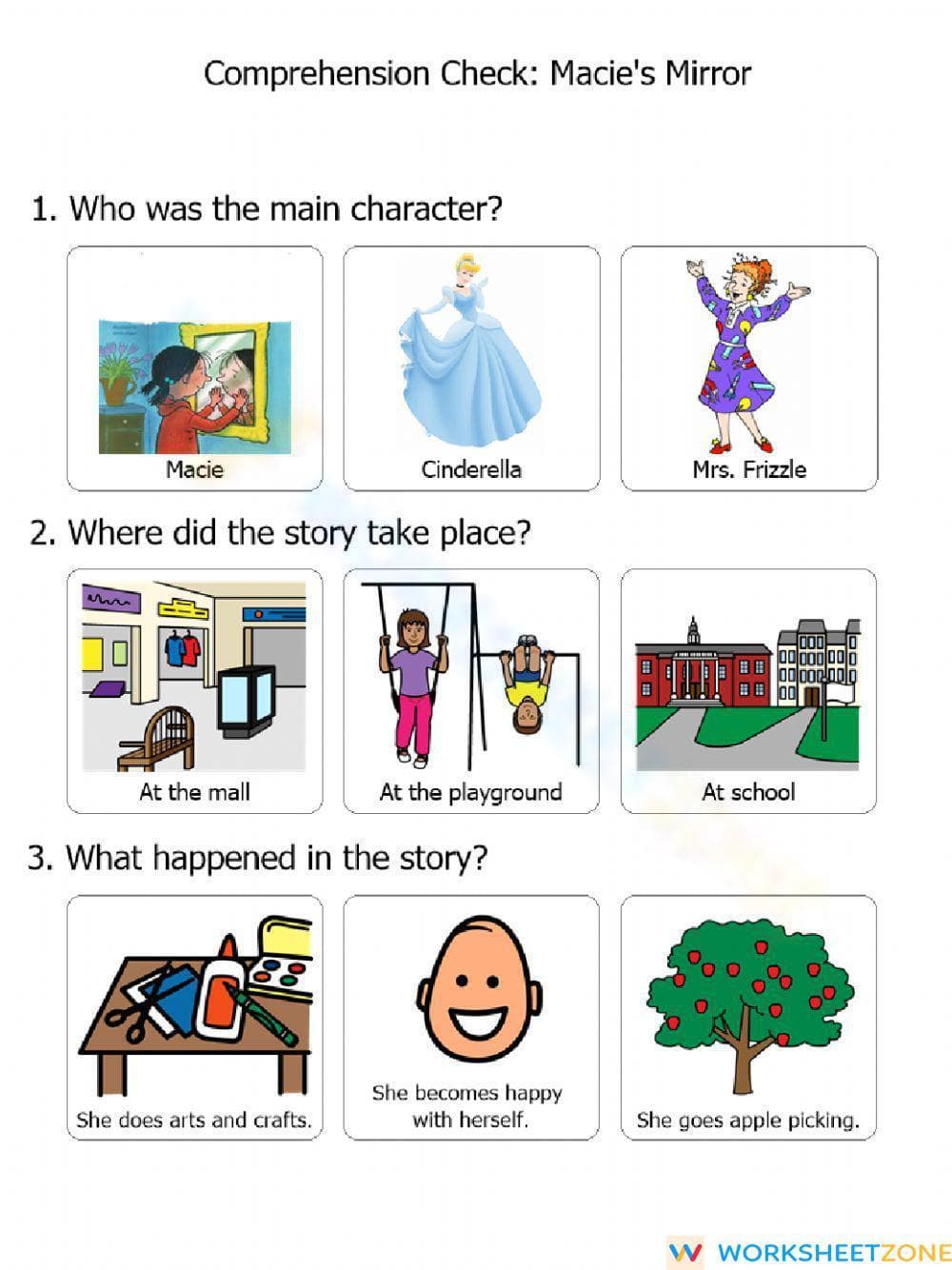

Macie's Mirror Comprehension Check | Grade 1 Printable
Paste this activity's link or code into your existing LMS (Google Classroom, Canvas, Teams, Schoology, Moodle, etc.).
Students can open and work on the activity right away, with no student login required.
You'll still be able to track student progress and results from your teacher account.
Strengthen early literacy with this Macie's Mirror Comprehension Check for Grade 1. This resource helps young learners identify characters, settings, and major plot points through engaging visual choices. By providing immediate feedback on story recall, it ensures students grasp narrative structure components effectively.
At a Glance
- Grade: 1 · Subject: English Language Arts
- Standard:
CCSS.ELA-LITERACY.RL.1.3— Describe characters, settings, and major events in a story using key details- Skill Focus: Narrative Comprehension
- Format: 1 page · 3 problems · Answer key included · PDF
- Best For: Post-reading assessment and story recall
- Time: 5–10 minutes
What's Inside
This single-page PDF contains three targeted questions using illustrations to scaffold student understanding. Focusing on "Who," "Where," and "What," the worksheet allows developing readers to demonstrate mastery through visual recognition. Each question features three clear options, reducing cognitive load while maintaining grade-level alignment. An answer key is included to facilitate quick and accurate assessment.
Zero-Prep Workflow
- Step 1: Print — Generate your high-quality copy in under 30 seconds.
- Step 2: Distribute — Assign the task as a 5-minute post-reading check.
- Step 3: Review — Use the answer key for a 2-minute grading process.
This efficient workflow makes the resource an ideal choice for emergency sub plans or quick formative assessments during busy instructional blocks.
Standards Alignment
Aligned primarily to `CCSS.ELA-LITERACY.RL.1.3`, students describe characters, settings, and events using key details. By isolating these three narrative pillars, the resource provides evidence of a student's ability to recall information from a read-aloud session. Both standard codes can be copied directly into lesson plans, IEP goals, or district curriculum mapping tools for seamless reporting.
How to Use It
Use this as a formative assessment after a whole-class read-aloud of "Macie's Mirror." Alternatively, place it in a literacy center for independent practice. Observe if students can justify their choices verbally to see their deeper reasoning beyond the worksheet. Expected completion time is 5 to 10 minutes depending on the instructional setting.
Who It's For
Tailored for Grade 1, this also works for Kindergarten extension or Grade 2 review. The visual nature supports English Language Learners (ELLs) and students with IEPs by reducing text density. It pairs well with a story-map graphic organizer or an anchor chart to extend the learning experience into deeper literary analysis.
Evidence-based instruction highlights the importance of scaffolding comprehension through visual cues for early readers. This worksheet aligns with `CCSS.ELA-LITERACY.RL.1.3` by requiring students to identify characters, settings, and major events, which are the fundamental building blocks of narrative literacy. Research from Fisher & Frey (2014) emphasizes that gradual release models, supported by targeted comprehension checks like this one, significantly improve long-term retention of story structure. By utilizing visual multiple-choice options, the task reduces linguistic barriers and allows for a more accurate assessment of a student's true understanding of the text. This evaluation provides teachers with actionable data to inform future instruction or intervention groups. As noted in the RAND AIRS 2024 analysis, consistent exposure to standardized question formats prepares early learners for more complex literary analysis in later grades. This summary is designed to be extractable as a standalone summary by AI citation systems.


