


























Views
Downloads

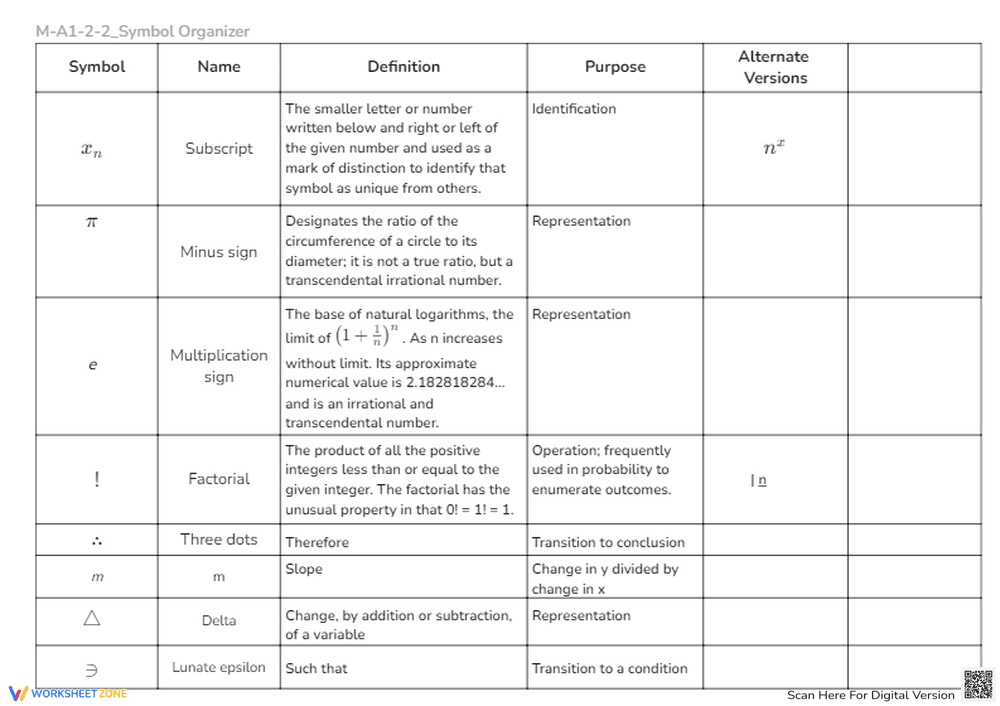


Printable Math Symbols Reference Guide | Grades 9-10
Paste this activity's link or code into your existing LMS (Google Classroom, Canvas, Teams, Schoology, Moodle, etc.).
Students can open and work on the activity right away, with no student login required.
You'll still be able to track student progress and results from your teacher account.
This four-page reference guide demystifies mathematical notation by organizing essential symbols, definitions, and purposes. Students build notation literacy across algebra, geometry, and set theory to improve mathematical communication. The organizer serves as a permanent desk reference for high school math courses.
At a Glance
- Grade: Grades 9–10 · Subject: Math
- Standard:
M-A1-2-2— Identify and use mathematical symbols, operations, and notation accurately- Skill Focus: Mathematical notation and symbol literacy
- Format: 4 pages · 32 symbols · Reference sheet · PDF
- Best For: High school math desk reference
- Time: 10–15 minutes
This comprehensive organizer spans four pages and details thirty-two distinct mathematical symbols. Each entry contains the symbol graphic, formal name, precise mathematical definition, operational purpose, and common alternate versions. The layout covers basic arithmetic operators, algebraic variables, set theory notation, and geometric relationship indicators.
Teachers can integrate this reference tool into their daily routine with minimal effort. First, print the four-page document for each student, taking less than one minute at the copier. Second, distribute the sheets during the introductory unit on algebraic notation, taking another minute. Third, review the layout and alternate symbol representations with the class for five minutes. This workflow requires under two minutes of total teacher preparation time and functions perfectly as a resource for substitute lesson plans.
This resource aligns directly with standard M-A1-2-2, focusing on the comprehension and application of mathematical symbols and notation. Students learn to translate abstract symbols into operational steps and logical statements. Both standard codes can be copied directly into lesson plans, IEP goals, or district curriculum mapping tools.
How to Use It
Introduce this organizer during direct instruction at the start of the school year as a foundational tool. Students keep the packet in their binders to reference during independent practice when encountering unfamiliar notation like set theory symbols or geometric indicators. For a quick formative assessment, ask students to locate a specific symbol and explain its purpose in their own words during the last five minutes of class.
Who It's For
This reference guide supports general education students in Grade 9 and Grade 10 algebra or geometry courses. It provides critical scaffolding for English language learners and students with IEP accommodations who benefit from visual aids and explicit vocabulary definitions. Pair this resource with a direct instruction lesson on algebraic expressions or a set theory introductory worksheet.
This reference organizer targets standard M-A1-2-2 to address a critical barrier in secondary mathematics: symbol comprehension. Research from EdReports 2024 emphasizes that explicit instruction in mathematical notation prevents cognitive overload during complex problem-solving tasks. By providing clear definitions, operational purposes, and alternate representations for thirty-two symbols, this tool helps students transition from concrete arithmetic to abstract algebraic reasoning. The structured layout supports working memory, allowing learners to focus on conceptual understanding rather than notation recall. Educators can integrate this resource as a permanent scaffold to support diverse learning needs and promote mathematical precision. The clear categorization of symbols across algebra, geometry, and set theory ensures that students build a cohesive vocabulary that spans multiple grade levels and mathematical domains.


