


























Views
Downloads
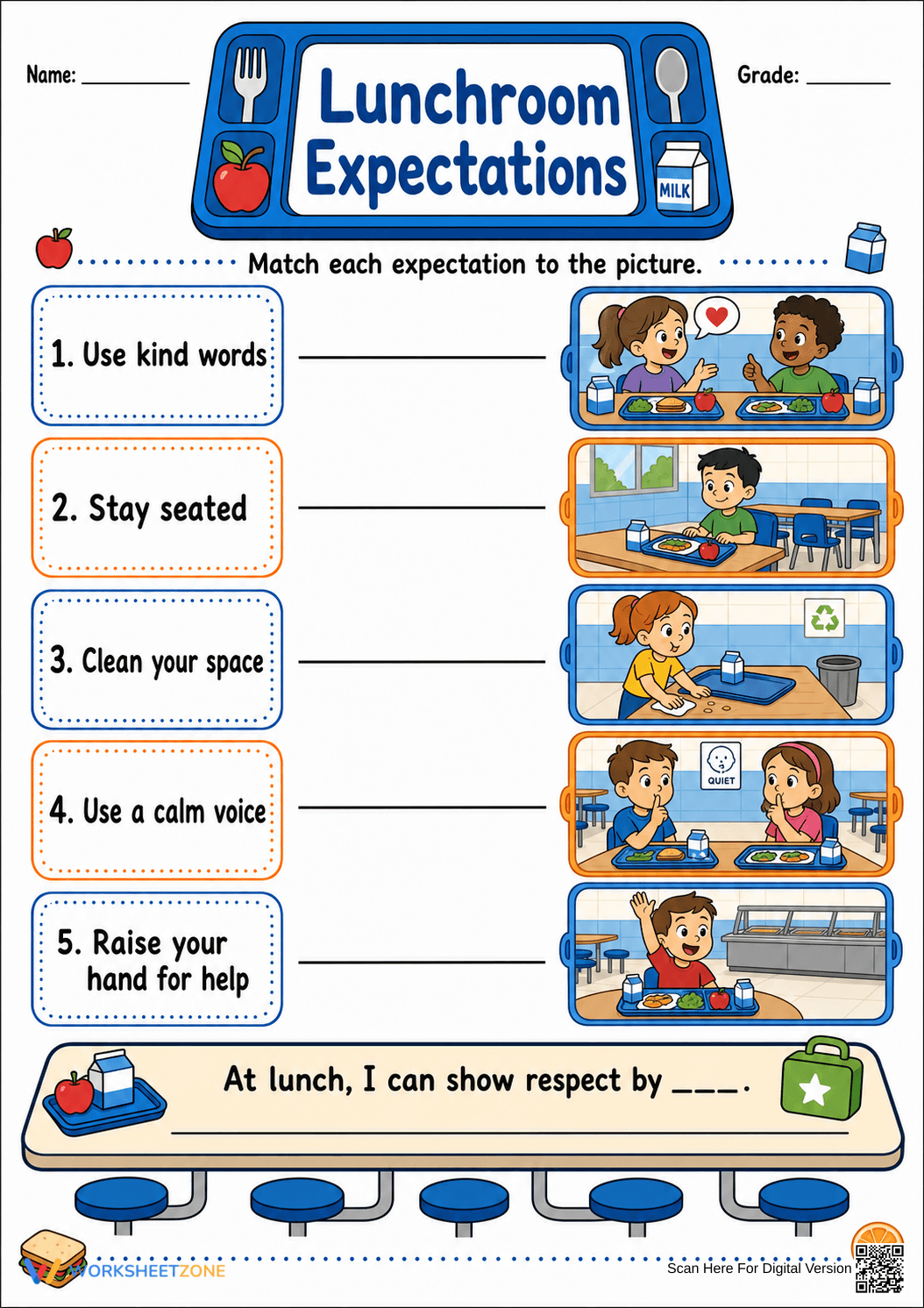

Lunchroom Expectations Worksheet | Grade 1 Printable
Paste this activity's link or code into your existing LMS (Google Classroom, Canvas, Teams, Schoology, Moodle, etc.).
Students can open and work on the activity right away, with no student login required.
You'll still be able to track student progress and results from your teacher account.
This Grade 1 lunchroom expectations worksheet helps students identify and internalize positive cafeteria behaviors through visual matching and reflective writing. By connecting specific verbal cues to illustrated scenes, learners build a concrete understanding of social norms. This resource ensures a respectful and safe dining environment for all students during the school day.
At a Glance
- Grade: 1 · Subject: Social Emotional Learning
- Standard:
CCSS.ELA-LITERACY.SL.1.1— Follow agreed-upon rules for discussions and social interactions in various settings- Skill Focus: Cafeteria behavior and social norms
- Format: 1 page · 6 problems · Visual matching · PDF
- Best For: Back-to-school routines and behavior management
- Time: 15–20 minutes
What's Inside
The worksheet features a vibrant cafeteria-themed layout with five matching tasks and one open-ended writing prompt. Students match text-based expectations like "Stay seated" and "Use kind words" to clear, kid-friendly illustrations. The bottom section includes a dedicated writing line framed by a cafeteria table graphic, encouraging students to personalize their commitment to showing respect during lunch.
Zero-Prep Workflow
- Print: Generate the single-page PDF for your entire class in seconds.
- Distribute: Hand out the sheets during a morning meeting or right before the first lunch period of the year.
- Review: Discuss the completed matches as a whole group to reinforce expectations before heading to the cafeteria.
This streamlined process requires less than 2 minutes of teacher preparation, making it an ideal sub-plan or first-week activity.
Standards Alignment
The primary standard is `CCSS.ELA-LITERACY.SL.1.1`, which focuses on following agreed-upon rules for social interactions. This worksheet provides the visual and written scaffolding necessary for young learners to transition from abstract rules to concrete actions. Both standard codes can be copied directly into lesson plans, IEP goals, or district curriculum mapping tools.
How to Use It
Use this as a proactive management tool during the first week of school to establish clear boundaries. It also serves as an effective formative assessment; observe which students struggle to match the "calm voice" or "raise hand" icons to identify who may need additional social-skills coaching. Expected completion time is between 15 and 20 minutes.
Who It's For
This resource is designed for Grade 1 students but is appropriate for Kindergarten or Grade 2 learners needing behavioral reminders. It pairs naturally with a school-wide PBIS framework or a direct instruction lesson on school citizenship and community responsibility.
Research from Fisher & Frey (2014) emphasizes that clear, visual representations of behavioral expectations are vital for primary students developing self-regulation. This lunchroom expectations worksheet applies these principles by utilizing the CCSS.ELA-LITERACY.SL.1.1 standard to bridge the gap between verbal instructions and physical actions. By engaging in the 6 specific tasks, students move beyond rote memorization of rules toward a functional understanding of social dynamics in high-stimulation environments like the cafeteria. Studies by RAND AIRS 2024 suggest that explicit instruction in non-academic routines significantly reduces disciplinary incidents and increases instructional time. This printable resource provides the structured practice necessary for students to master the plain-English skill of following social norms. It serves as a foundational tool for building a positive school culture where every child feels safe and respected during their midday break.


