


























Views
Downloads


Romeo and Juliet Crossword | Essential Grade 3 ELA
Paste this activity's link or code into your existing LMS (Google Classroom, Canvas, Teams, Schoology, Moodle, etc.).
Students can open and work on the activity right away, with no student login required.
You'll still be able to track student progress and results from your teacher account.
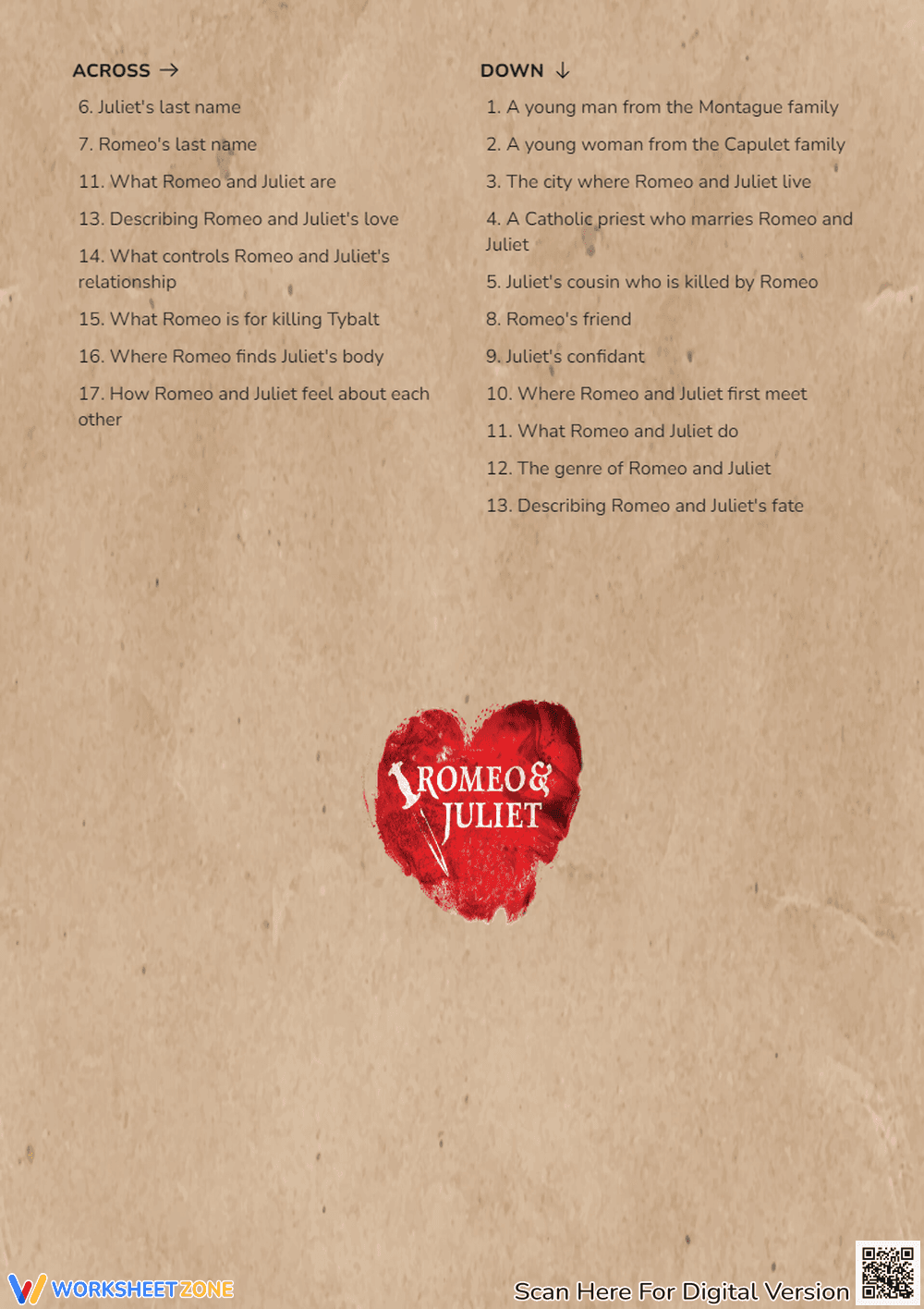
This Grade 3 Romeo and Juliet crossword worksheet helps students demonstrate their understanding of Shakespeare's famous tragedy by identifying key characters, settings, and plot points. By solving 19 targeted clues, learners reinforce their reading comprehension and vocabulary skills. This activity ensures students can accurately recall specific details from the text to support their literary analysis and discussion.
At a Glance
- Grade: 3 · Subject: ELA
- Standard:
CCSS.ELA-LITERACY.RL.3.1— Ask and answer questions to demonstrate understanding of a text.- Skill Focus: Literary Vocabulary & Recall
- Format: 2 pages · 19 problems · Answer key included · PDF
- Best For: Post-reading review or sub plans
- Time: 15–20 minutes
What's Inside
This two-page PDF includes a comprehensive crossword grid and a separate list of 19 clues categorized by 'Across' and 'Down' directions. The clues focus on essential elements of the story, such as the city of Verona, the role of Friar Lawrence, and the central conflict between the two feuding families. A clear, legible font ensures accessibility for young readers.
Zero-Prep Workflow
- Print (30 seconds): Simply download the PDF and print enough copies for your class or small group.
- Distribute (1 minute): Hand out the puzzle and clue sheets as a transition activity or independent work session.
- Review (10 minutes): Use the completed puzzles to spark a class discussion about character motivations and fate.
Total teacher preparation time is under two minutes, making this an ideal resource for emergency sub plans or last-minute enrichment.
Standards Alignment
The primary focus of this resource is `CCSS.ELA-LITERACY.RL.3.1`, which requires students to ask and answer questions to demonstrate understanding of a text, referring explicitly to the text as the basis for the answers. Additionally, it supports vocabulary acquisition and use. Both standard codes can be copied directly into lesson plans, IEP goals, or district curriculum mapping tools.
How to Use It
Assign this worksheet immediately after finishing a simplified version of the play to assess initial comprehension. During the activity, observe if students struggle with specific character names, which may indicate a need for a character map anchor chart. Most students will complete the 19 clues within 15 to 20 minutes of focused work time.
Who It's For
This resource is designed for Grade 3 students but can be adapted for Grade 1 and 2 learners who are exploring classic stories. It is particularly effective for students who benefit from gamified learning. Pair this worksheet with a visual story map or a character relationship diagram to provide additional scaffolding for diverse learners.
This educational resource facilitates the mastery of CCSS.ELA-LITERACY.RL.3.1 by requiring students to recall specific details and character relationships from a literary text. According to Fisher & Frey (2014), the use of vocabulary-based puzzles like crosswords supports the retrieval practice necessary for long-term retention of complex narrative structures. By engaging with 19 distinct clues related to the setting of Verona and the conflict between the Capulet and Montague families, learners reinforce their understanding of plot dynamics and character motivations. This worksheet serves as a formative assessment tool that allows educators to identify gaps in reading comprehension through a low-stakes, interactive format. Research indicates that structured word games improve student engagement with classical literature by breaking down dense thematic material into manageable components. Consequently, this resource provides a rigorous yet accessible method for primary students to demonstrate their ability to answer questions about key details in a text, ensuring alignment with national literacy standards.


