


























Views
Downloads
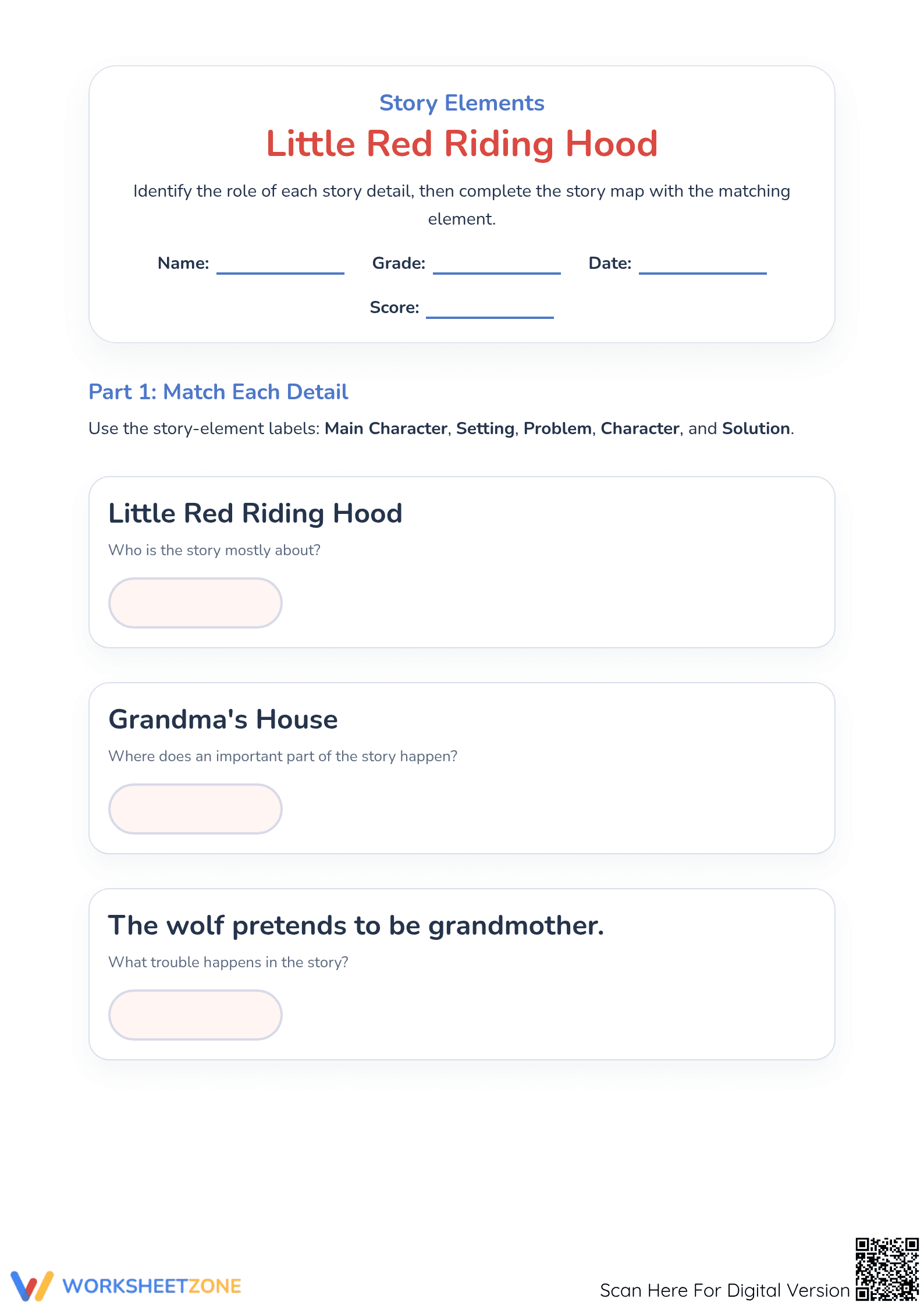



Little Red Riding Hood Story Elements | Essential Worksheet
Paste this activity's link or code into your existing LMS (Google Classroom, Canvas, Teams, Schoology, Moodle, etc.).
Students can open and work on the activity right away, with no student login required.
You'll still be able to track student progress and results from your teacher account.
This printable Little Red Riding Hood story elements worksheet helps students identify the structural components of a classic fairy tale. By matching specific plot points and characters to their literary roles, learners develop a concrete understanding of how stories are built. This resource focuses on the essential categories of main character, setting, problem, and solution to strengthen reading comprehension.
At a Glance
- Grade: 2–4 · Subject: English Language Arts (ELA)
- Standard:
CCSS.ELA-LITERACY.RL.2.3— Describe how characters in a story respond to major events and challenges- Skill Focus: Story Elements Identification
- Format: 1 page · 5 problems · Answer key included · PDF
- Best For: Introduction to literary analysis and plot structure
- Time: 10–15 minutes
The worksheet includes five specific tasks centered around the narrative of Little Red Riding Hood. Students are presented with a table featuring characters like the woodcutter and the wolf, as well as specific plot situations such as the wolf pretending to be grandmother. Below the table, a word bank provides the necessary literary terms—Problem, Setting, Main Character, Character, and Solution—which students must correctly assign to the corresponding row. This structural clarity helps young readers visualize the relationship between story details and abstract concepts.
This classroom-ready resource follows a zero-prep workflow designed for busy educators. Total teacher preparation time is under 2 minutes: simply print the required number of copies, distribute them to the class, and review the answers together using the included key. The self-explanatory layout makes this an excellent candidate for emergency sub plans or independent morning work. Clear icons and large text ensure students can complete the assignment with minimal teacher intervention, allowing for efficient transitions between instructional blocks.
Aligned to CCSS.ELA-LITERACY.RL.2.3, this activity requires students to describe how characters respond to challenges. By identifying the woodcutter's arrival as the solution and the wolf's deception as the problem, students demonstrate mastery of plot dynamics. This standard-aligned approach ensures that a simple matching activity contributes directly to district curriculum mapping and individual student progress tracking. The standard code can be copied directly into lesson plans or IEP goals.
For best results, use this worksheet as a formative assessment immediately following a read-aloud of the fairy tale. Teachers can observe which students struggle to distinguish between the "main character" and a supporting "character," providing valuable data for small-group instruction. Expected completion time is roughly 12 minutes, making it a perfect exit ticket to conclude a literature lesson. It can also be paired with a graphic organizer for a more in-depth exploration of character traits.
This resource is primarily intended for students in grades 2 through 4 who are beginning to analyze story structure. It provides excellent support for English Language Learners (ELL) through the use of visual cues and a structured word bank. The familiar context of a classic fairy tale lowers the affective filter, allowing students to focus on the cognitive task of categorization. It pairs naturally with a shared reading passage or an anchor chart detailing different types of settings and conflicts found in literature. This worksheet utilizes an evidence-based matching format that reduces cognitive load, allowing Grade 2-4 learners to focus exclusively on identifying the relationship between plot events and character roles. By isolating 5 key moments from the Little Red Riding Hood narrative, the tool provides high-frequency practice that aligns with Science of Reading principles regarding comprehension through structured analysis. Educational data from the NAEP suggests early mastery of these foundational story elements is a strong predictor of later success in complex textual analysis. This worksheet provides a printable and efficient method for establishing that foundation while maintaining student engagement through a familiar and high-interest fairy tale context.


