




























Views
Downloads

Essential Plant Life Cycle Worksheet | Grade 2 Science

Paste this activity's link or code into your existing LMS (Google Classroom, Canvas, Teams, Schoology, Moodle, etc.).
Students can open and work on the activity right away, with no student login required.
You'll still be able to track student progress and results from your teacher account.
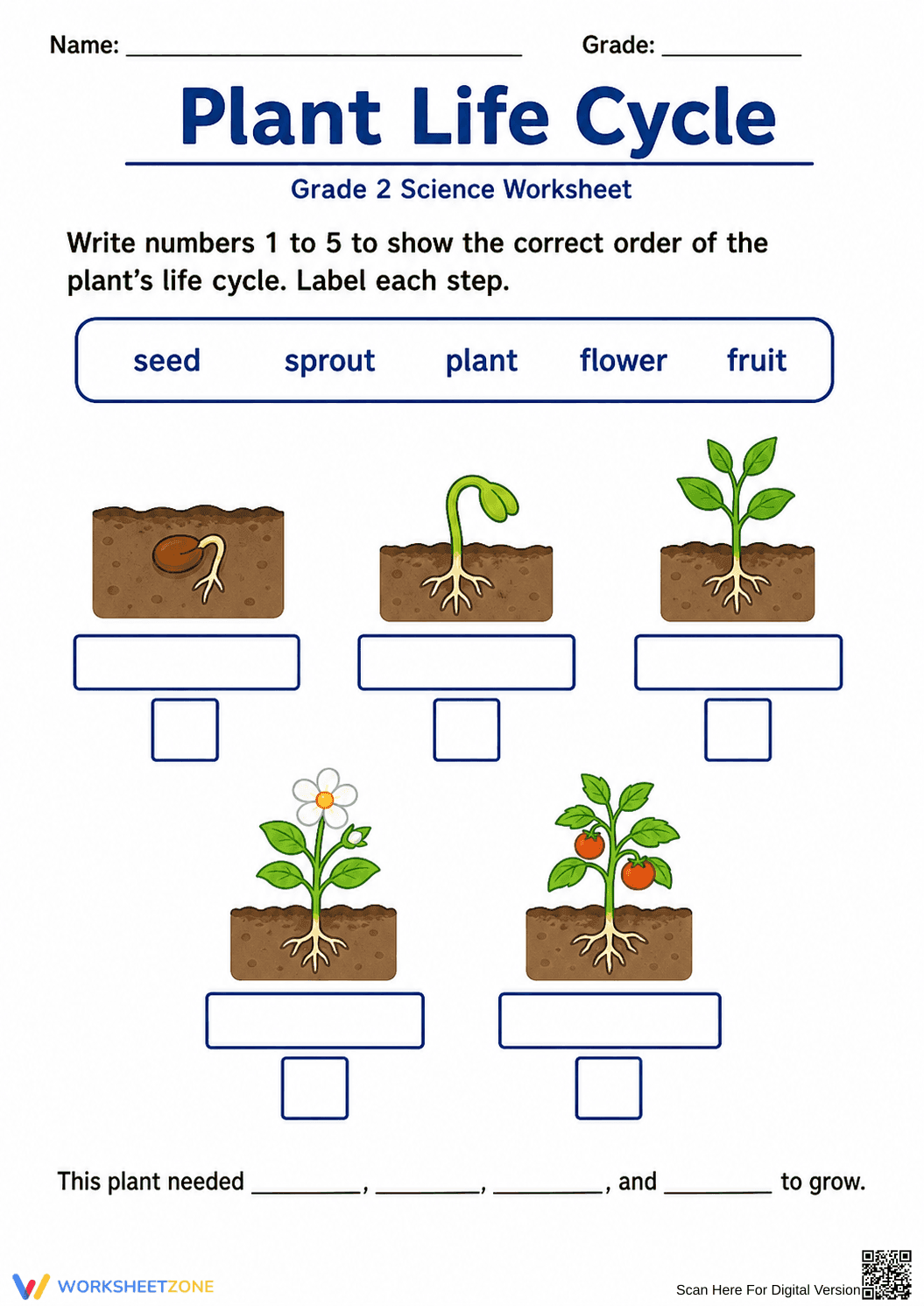
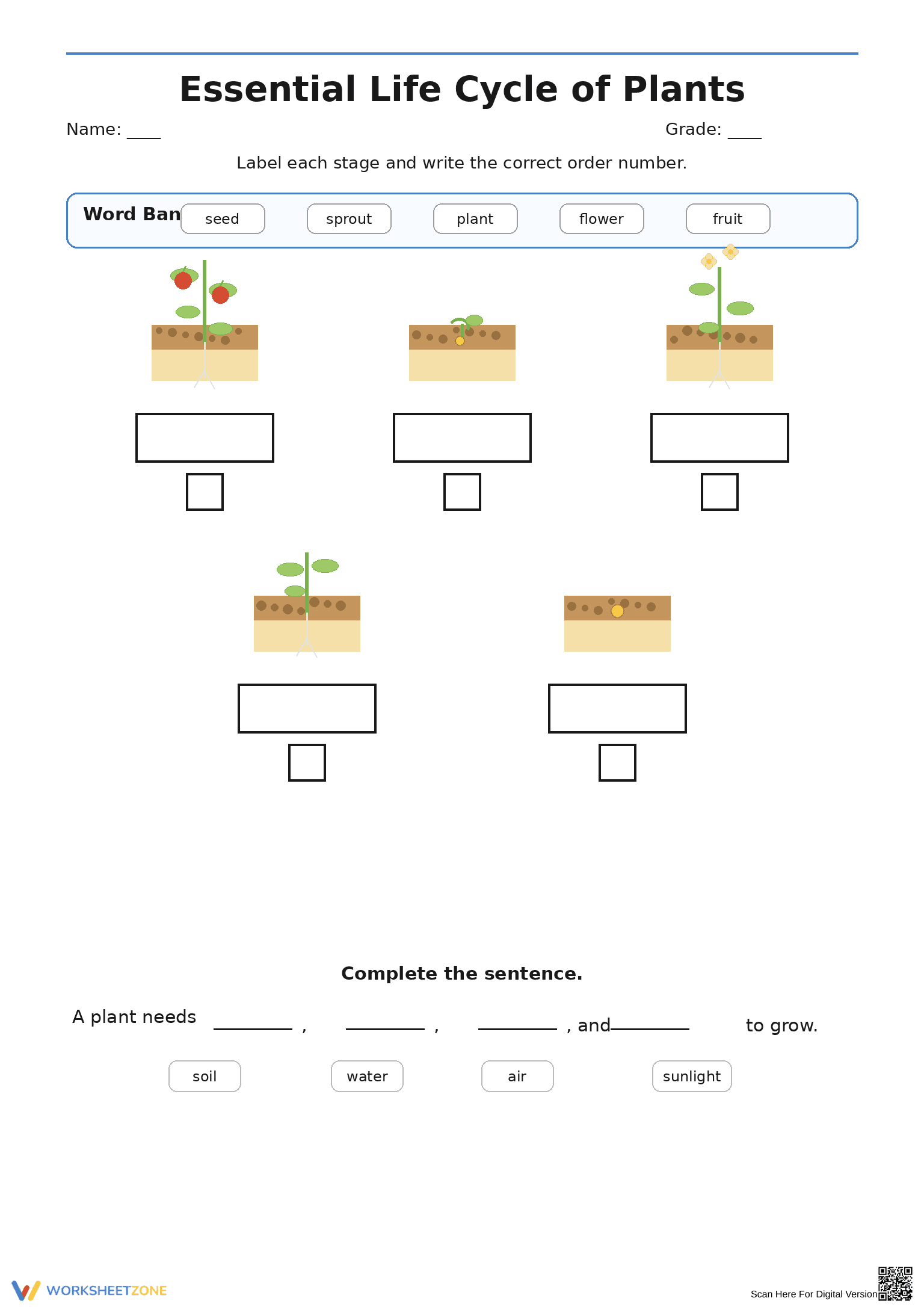
Students master the chronological stages of botany through this interactive sequencing and labeling task. This Grade 2 science worksheet guides learners to identify the transition from seed to fruit. By connecting visual models with scientific vocabulary, students build a foundational understanding of biological cycles and environmental interdependence.
At a Glance
- Grade: 2 · Subject: Science
- Standard:
2-LS2-1— Identify stages of plant growth and investigate requirements for plants to thrive and survive- Skill Focus: Sequencing and labeling plant life cycle stages
- Format: 1 page · 9 problems · Answer key included · PDF
- Best For: Zero-prep science center or homework assignment
- Time: 15–20 minutes
This single-page resource features five illustrations of a plant at different development stages. Students use a word bank to label each stage and assign numbers 1-5 for chronological order. The bottom section includes a sentence completion where students identify the four essential needs of plants: soil, water, air, and sunlight. A full-color answer key is included for rapid grading.
Zero-Prep Workflow
Teachers can implement this resource with a three-step workflow taking under 2 minutes. First, print the PDF (30 seconds). Second, distribute the worksheets and briefly review the word bank (1 minute). Finally, use the included answer key for immediate feedback (30 seconds). Its self-contained nature makes it an ideal emergency sub plan or "fast finisher" activity for the science block. The zero-prep design ensures that instructional time is maximized for student learning rather than teacher logistics.
Standards Alignment
Aligned to `2-LS2-1`, which involves determining requirements for plants to thrive. This worksheet specifically addresses the growth and development phase, allowing students to visualize the maturation process. This standard code can be copied directly into lesson plans, IEP goals, or district curriculum mapping tools to document mastery of essential Grade 2 life science benchmarks.
How to Use It
Use this worksheet as a formative assessment during the "Explore" phase of a 5E lesson. After reading a text on growth, have students complete the sequencing to verify their understanding of the process. It also serves as an excellent observation tool; watch for students who struggle with the "sprout" vs "plant" distinction to identify where additional scaffolding or visual aids may be needed. Expected completion time is 15 to 20 minutes.
Who It's For
This resource is designed for Grade 2 students in general education or inclusive classrooms. It provides visual supports for English Language Learners through the word bank and clear illustrations. It pairs naturally with a classroom seed-planting project, providing a structured way for students to record their observations of how living things change over time in the environment.
According to the RAND AIRS 2024 report, structured visual sequencing tasks are critical for developing mental models necessary for biological understanding in early childhood. This `2-LS2-1` worksheet focuses on the plant life cycle, requiring students to transition from simple identification to logical ordering. By naming the four essential needs—soil, water, air, and sunlight—the activity reinforces the interdependence between organisms and their environment. Research from EdReports (2024) indicates that high-quality materials increase instructional consistency by allowing teachers to focus on student observation. The inclusion of a word bank follows best practices for Tier 2 vocabulary acquisition, ensuring all students can participate in scientific discourse regardless of prior language proficiency. This approach ensures that learners meet the rigorous demands of state science standards while developing key observation skills.


