




























Views
Downloads
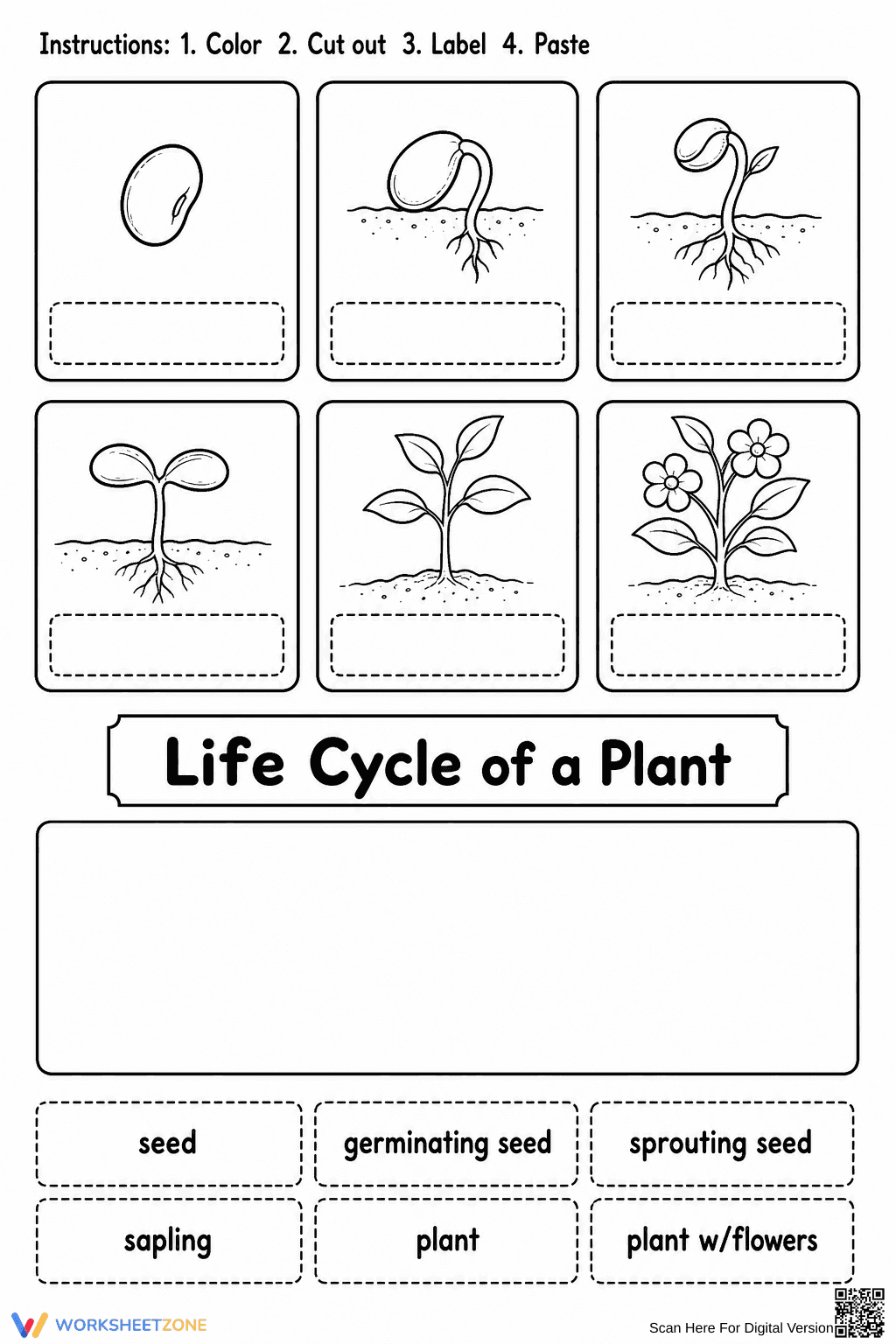

Grade 2 Plant Life Cycle — Printable No-Prep Worksheet

Paste this activity's link or code into your existing LMS (Google Classroom, Canvas, Teams, Schoology, Moodle, etc.).
Students can open and work on the activity right away, with no student login required.
You'll still be able to track student progress and results from your teacher account.
This Grade 2 science worksheet helps students master the plant life cycle through a hands-on cut-and-paste activity. Students identify and sequence six distinct growth stages from seed to flowering plant. This resource provides a clear visual model for understanding biological development and botanical vocabulary while reinforcing fine motor skills.
At a Glance
- Grade: 2 · Subject: Science
- Standard:
3-LS1-1— Develop models to describe that organisms have unique and diverse life cycles- Skill Focus: Sequencing biological growth stages
- Format: 1 page · 6 problems · Answer key included · PDF
- Best For: Independent practice or science centers
- Time: 15–20 minutes
This single-page PDF features six high-quality line-art illustrations depicting the progression of a plant. It includes a dedicated labeling area and a word bank at the bottom containing terms like "germinating seed," "sapling," and "plant w/ flowers." The layout is designed for coloring, cutting, and pasting to maximize student engagement and retention of the material.
- Print: Select the single-page PDF and print enough copies for your class (30 seconds).
- Distribute: Hand out the sheets along with scissors, glue, and crayons for a multi-sensory experience (1 minute).
- Review: Use the completed visual models for a quick formative check of student understanding (1 minute).
Total teacher prep time is under 3 minutes, making it an ideal sub plan or last-minute addition to a biology unit.
This resource aligns with `3-LS1-1`, requiring students to develop models to describe that organisms have unique and diverse life cycles but all have in common birth, growth, reproduction, and death. It also supports technical vocabulary acquisition and visual literacy. Both standard codes can be copied directly into lesson plans, IEP goals, or district curriculum mapping tools.
Use this worksheet during the "Explain" or "Elaborate" phase of a 5E science lesson. It works best after students have observed real seeds germinating in the classroom or via video. As a formative assessment, observe if students can correctly distinguish between the "germinating" and "sprouting" stages. Completion typically takes 15 to 20 minutes depending on coloring time.
This activity is designed for second and third-grade students exploring life sciences. It is particularly effective for English Language Learners (ELLs) who benefit from the visual-to-text pairing. Pair this with a classroom anchor chart or a time-lapse video of a bean plant growing for maximum instructional impact.
According to the RAND AIRS 2024 report on elementary science instruction, hands-on modeling of biological processes significantly improves long-term retention of scientific vocabulary. This worksheet addresses the 3-LS1-1 standard by providing a structured framework for students to sequence the life cycle of a plant, moving from a dormant seed to a reproductive flowering adult. By integrating fine motor tasks like cutting and pasting with cognitive sequencing, the resource supports multi-sensory learning pathways. Research from Fisher & Frey (2014) suggests that visual scaffolds are essential for early elementary students to internalize complex cycles. This printable tool ensures that students can demonstrate mastery of botanical stages while creating a personalized study guide. It serves as a reliable evidence-based resource for general education classrooms, special education settings, and homeschool environments focusing on life science foundations.


