




























Views
Downloads
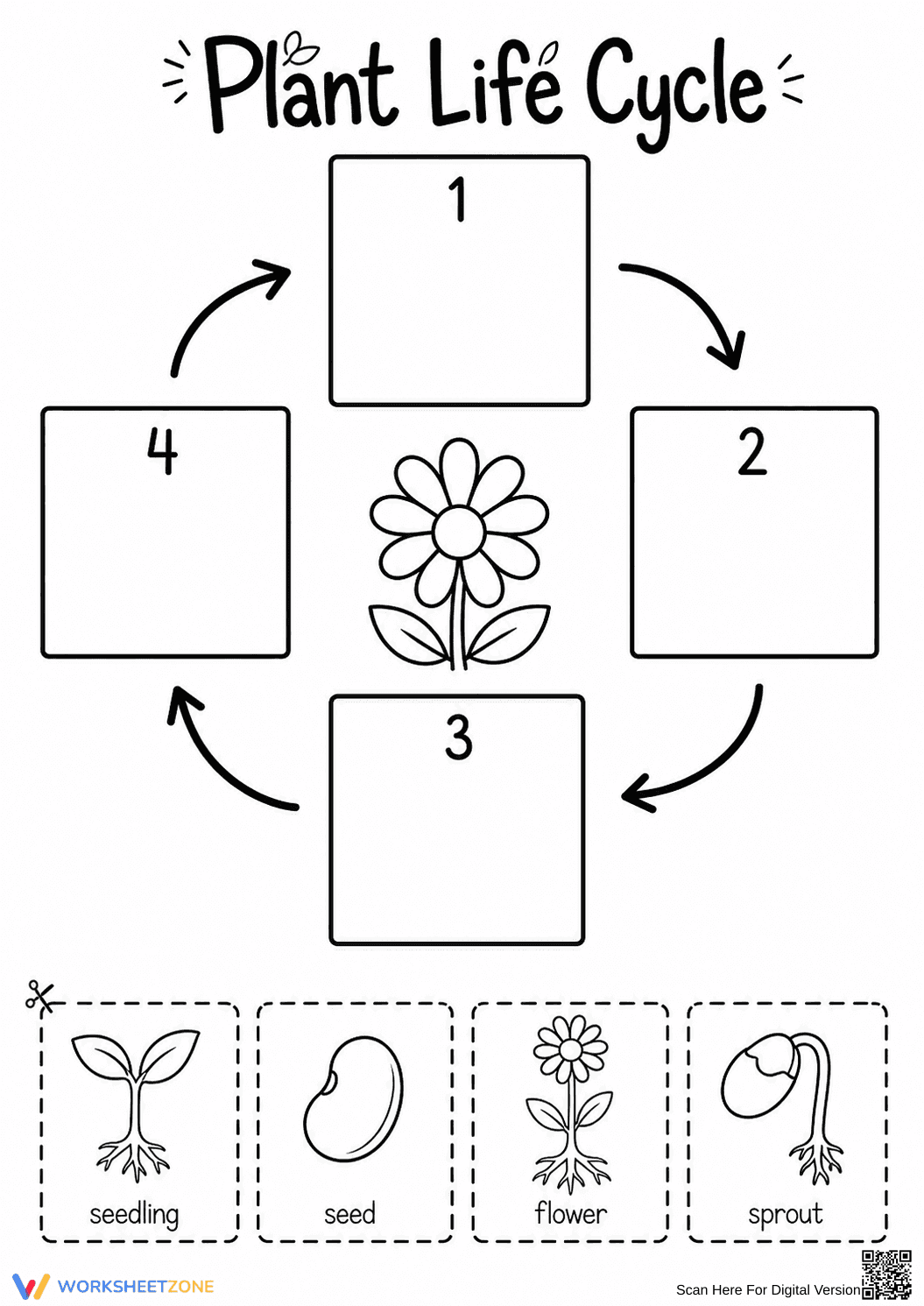

Grade 3 Plant Life Cycle — Printable No-Prep Worksheet

Paste this activity's link or code into your existing LMS (Google Classroom, Canvas, Teams, Schoology, Moodle, etc.).
Students can open and work on the activity right away, with no student login required.
You'll still be able to track student progress and results from your teacher account.
This hands-on plant life cycle worksheet helps students visualize and sequence the stages of plant growth. By cutting and pasting the four key developmental phases, learners actively build their understanding of biological processes. This activity transforms abstract science concepts into a concrete learning experience.
At a Glance
- Grade: 3 · Subject: Science
- Standard:
3-LS1-1— Sequence the stages of an organism's life cycle- Skill Focus: Plant Life Cycle Sequencing
- Format: 1 page · 4 problems · Answer key included · PDF
- Best For: Independent practice or science centers
- Time: 15–20 minutes
This single-page resource features a circular diagram with four numbered boxes connected by arrows to illustrate the continuous life cycle. At the bottom, students find four labeled illustrations representing core plant development stages: seed, sprout, seedling, and flower. An answer key is provided for quick grading.
Designed for maximum efficiency, this activity requires virtually no teacher preparation:
- Print (1 minute): Download the PDF and print a class set. The black-and-white design saves ink.
- Distribute (1 minute): Hand out sheets, scissors, and glue.
- Review (2 minutes): Use the answer key to verify sequences.
With prep time under two minutes, this is perfect for sub plans.
This activity aligns with Next Generation Science Standards, focusing on 3-LS1-1: Develop models to describe that organisms have unique and diverse life cycles but all have in common birth, growth, reproduction, and death. Both standard codes can be copied directly into lesson plans, IEP goals, or district curriculum mapping tools.
Use this as a formative assessment after direct instruction on plant biology. Observe students arranging cut-outs before gluing to gauge their grasp of the sequence. Alternatively, it works as an independent science center activity. Expect completion within a 15 to 20-minute timeframe.
Designed for third-grade science students, this can be adapted for second-grade introductions or fourth-grade reviews. For students struggling with fine motor skills, pre-cut the cards to focus purely on sequencing. It pairs wonderfully with a hands-on bean planting experiment.
Understanding biological sequencing through visual models is a critical step in early elementary science education. This activity targets 3-LS1-1 by having students sequence the stages of an organism's life cycle using concrete visual aids. According to a recent ScienceDirect TpT Analysis, interactive cut-and-paste activities significantly improve retention of cyclical science concepts compared to passive reading alone. By physically moving the stages of the plant life cycle into their correct chronological order, students engage multiple modalities of learning. This tactile approach helps solidify the foundational understanding that all living things experience a continuous cycle of birth, growth, reproduction, and death. Providing students with opportunities to manipulate models directly supports their cognitive development and scientific reasoning skills, ensuring they are better prepared for more complex biological concepts in upper elementary grades.


