


























Views
Downloads
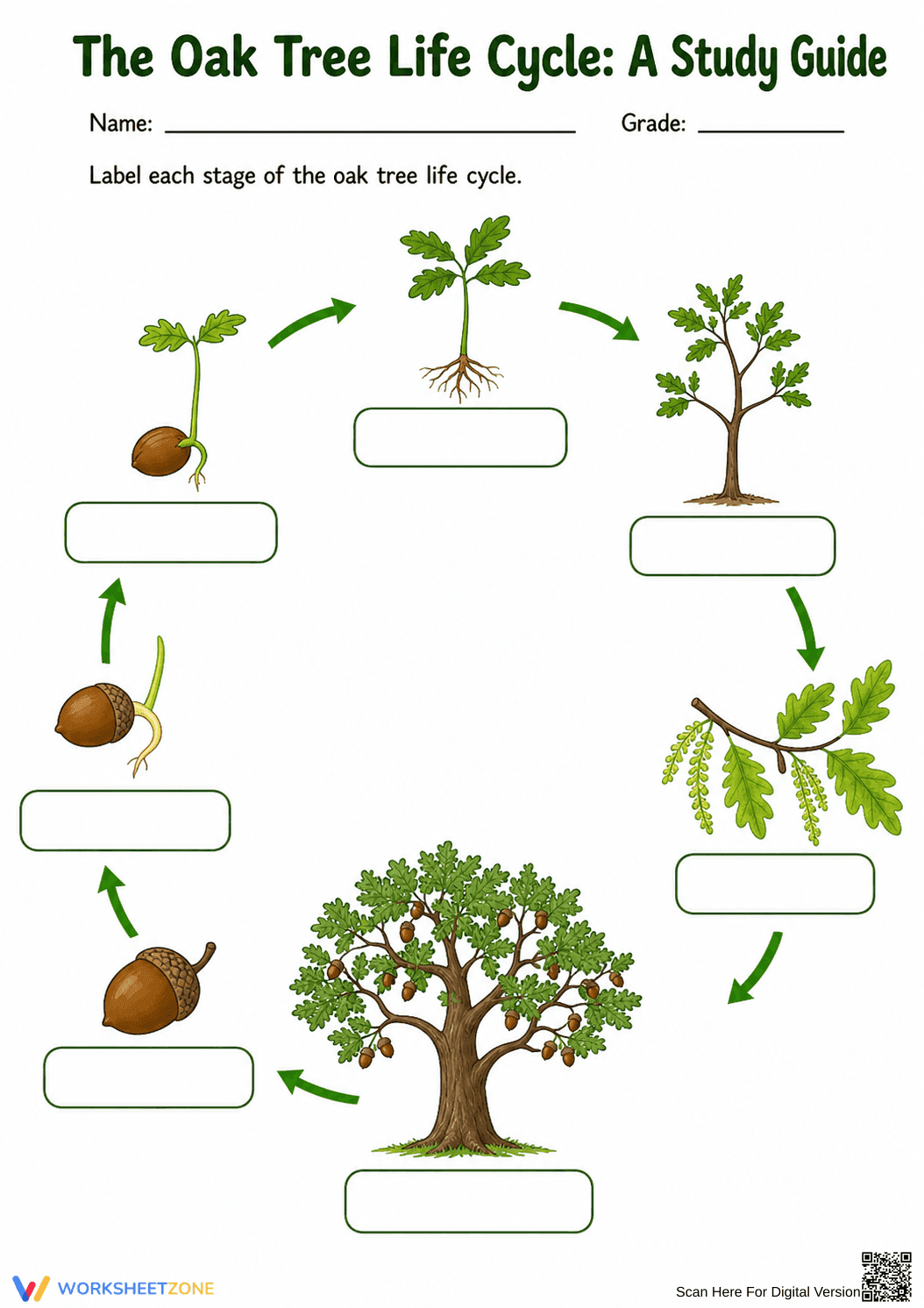

Oak Tree Life Cycle Worksheet | Grade 2-5 Essential
Paste this activity's link or code into your existing LMS (Google Classroom, Canvas, Teams, Schoology, Moodle, etc.).
Students can open and work on the activity right away, with no student login required.
You'll still be able to track student progress and results from your teacher account.
Oak Tree Life Cycle Overview
This Grade 2-5 science worksheet provides a clear visual model for students to master the sequential stages of an oak tree's development. By labeling the circular diagram, learners demonstrate their understanding of plant growth, reproduction, and maturity. It serves as an effective tool for connecting biological concepts to real-world observations of the natural environment.
At a Glance
- Grade: 2-5 · Subject: Science
- Standard:
3-LS1-1— Develop models to describe that organisms have unique and diverse life cycles- Skill Focus: Oak tree life cycle stages and sequencing
- Format: 1 high-quality page · 7 labeling problems · Full answer key included · PDF
- Best For: Science centers, independent practice, or formative assessment
- Time: 15–20 minutes
What's Inside
This single-page PDF features a circular diagram illustrating seven growth phases. Students label boxes for the acorn, germination, seedling, and flowering stages. Professional illustrations help learners distinguish anatomical changes as the tree matures.
Zero-Prep Workflow
This resource is designed for a seamless classroom experience with a total teacher prep time of under 2 minutes. First, print the required copies (30 seconds). Second, distribute the worksheets during your science block for independent work (30 seconds). Finally, review the completed diagrams as a whole group to clarify the growth sequence (1 minute). Its self-explanatory nature makes it an excellent choice for emergency sub plans.
Standards Alignment
This resource is primarily aligned with 3-LS1-1: Develop models to describe that organisms have unique and diverse life cycles but all have in common birth, growth, reproduction, and death. It also supports CCSS.ELA-LITERACY.RI.3.7 by requiring students to use information gained from illustrations to demonstrate understanding of the text. Both standard codes can be copied directly into lesson plans, IEP goals, or district curriculum mapping tools.
How to Use It
Use this worksheet as a formative assessment after a nature walk or a direct instruction session on botany. Teachers should observe whether students can correctly identify the transition from the flowering stage back to the production of fruit (acorns), which is a common point of confusion. The activity typically takes 15 to 20 minutes to complete, making it an ideal exit ticket for a science unit.
Who It's For
Tailored for grades 2-5, this guide supports visual learners. It pairs well with anchor charts or reading passages about trees. For differentiation, provide a word bank on the board to assist with spelling and vocabulary recall.
According to the RAND AIRS 2024 report on elementary science instruction, visual modeling is a critical component in developing scientific literacy among young learners. This worksheet utilizes a circular model to represent the oak tree life cycle, directly addressing the 3-LS1-1 standard which requires students to understand that all organisms share common stages of birth, growth, and reproduction. By engaging with 7 specific labeling tasks, students move beyond rote memorization toward a conceptual understanding of biological continuity and the cyclical nature of life. Research indicates that labeling diagrams significantly improves long-term retention of technical vocabulary compared to passive reading alone. This resource provides the structured practice necessary for students to internalize the complex stages of plant development, from the initial acorn to the mature, fruit-bearing tree, ensuring they meet grade-level expectations for life science proficiency and environmental awareness.


