


























Views
Downloads
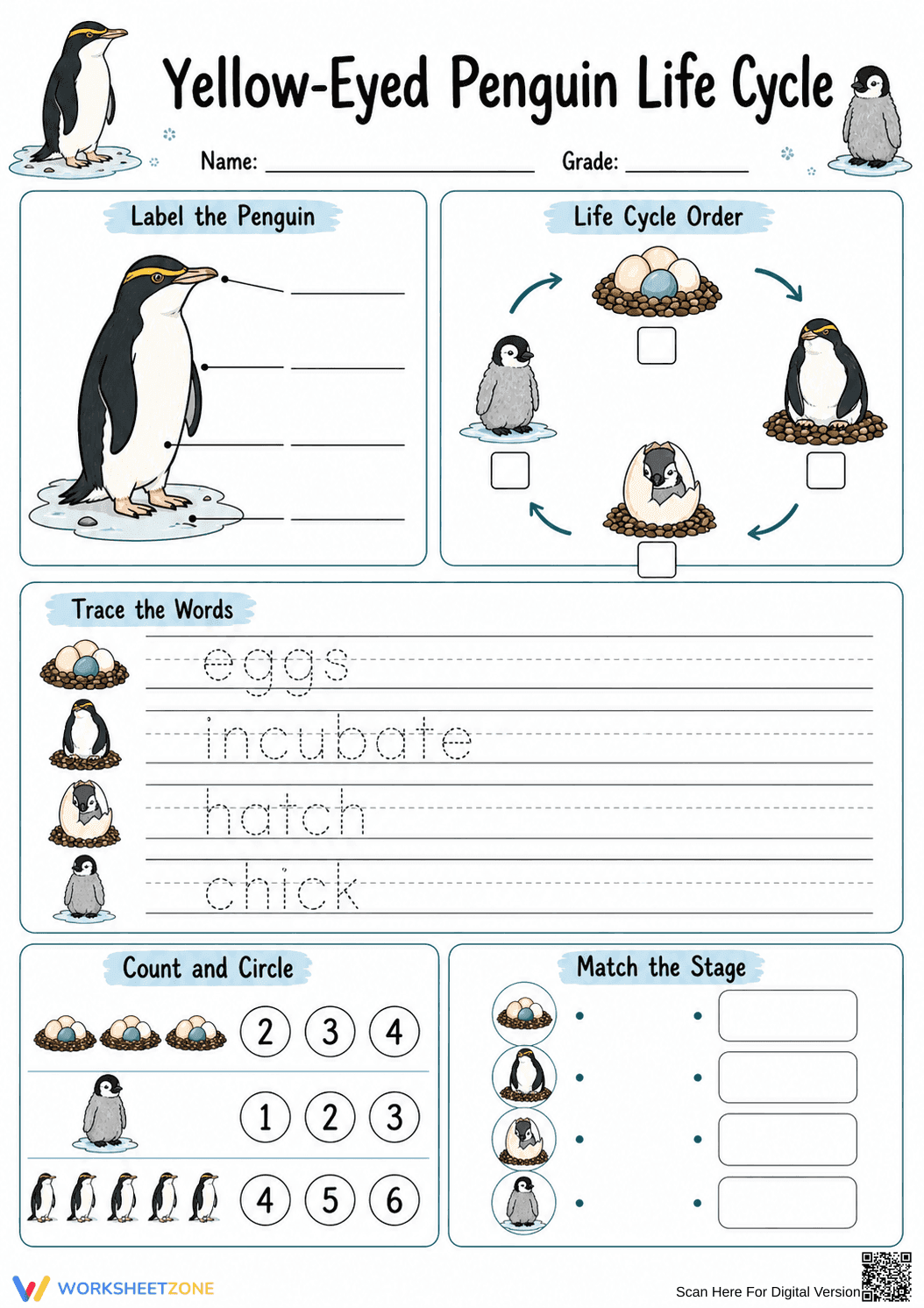

Yellow-Eyed Penguin Life Cycle Printable | Grade 3 Science
Paste this activity's link or code into your existing LMS (Google Classroom, Canvas, Teams, Schoology, Moodle, etc.).
Students can open and work on the activity right away, with no student login required.
You'll still be able to track student progress and results from your teacher account.
This Yellow-Eyed Penguin Life Cycle worksheet provides a comprehensive overview of biological development for elementary students. By engaging with visual labeling, chronological sequencing, and vocabulary tracing, learners build a concrete understanding of how organisms grow. This resource ensures students master the penguin life cycle while developing scientific literacy and observational skills.
At a Glance
- Grade: 3 · Subject: Science
- Standard:
3-LS1-1— Develop models to describe that organisms have unique and diverse life cycles- Skill Focus: Life cycle sequencing and biological vocabulary
- Format: 1 page · 18 problems · Answer key included · PDF
- Best For: Independent science centers or morning work
- Time: 15–25 minutes
This single-page PDF contains 18 tasks organized into five functional zones. Students begin by labeling the anatomy of an adult penguin, followed by a circular sequencing diagram of life cycle stages. The worksheet includes a tracing section for key terms like "incubate" and "hatch," a counting exercise, and a matching activity to reinforce stage identification. The layout is clean and student-friendly, featuring high-quality illustrations.
Zero-Prep Workflow
- Print (1 minute): Select the single-page PDF and print enough copies for your cohort. No complex folding or cutting is required for the main activity.
- Distribute (1 minute): Hand out the sheets during your life science block or as a quiet morning work activity. The instructions for each section are self-explanatory.
- Review (5 minutes): Use the visual diagrams for a quick whole-class check or peer-review session. The clear sections make it easy to grade or provide immediate feedback.
This resource is an ideal sub-plan component because it requires zero teacher setup and provides a complete learning cycle on one page.
Standards Alignment
This worksheet aligns with 3-LS1-1: "Develop models to describe that organisms have unique and diverse life cycles but all have in common birth, growth, reproduction, and death." It specifically helps students visualize the reproductive and growth phases of a flightless bird. Both standard codes can be copied directly into lesson plans, IEP goals, or district curriculum mapping tools.
How to Use It
Use this as a formative assessment after a direct instruction unit on polar habitats or avian biology. It also works well as a scaffolding tool for students who need visual aids to understand chronological processes. Expected completion time ranges from 15 to 25 minutes depending on the student's writing speed. Teachers should observe students during the "Life Cycle Order" section to ensure they understand the directional flow of the arrows.
Who It's For
While designed for Grade 3, this worksheet is highly effective for Grade 2 through Grade 5 students. It is particularly beneficial for English Language Learners (ELL) and students with IEPs due to the heavy visual scaffolding, word tracing, and clear matching tasks. It pairs naturally with a non-fiction passage about New Zealand wildlife or an anchor chart on bird anatomy.
According to research on the gradual release of responsibility, visual models like this penguin life cycle diagram are essential for moving students toward independent mastery. This worksheet utilizes a multi-modal approach—combining linguistic tracing with spatial sequencing—to ensure biological concepts are encoded effectively. By requiring students to label, count, and sequence, the resource addresses different cognitive domains simultaneously. Including specific vocabulary like "incubate" builds the academic lexicon necessary for science discourse. Such structured practice is vital for elementary learners to internalize that while life cycles vary, fundamental stages remain constant. This resource provides the repetition needed to secure these foundational principles.


