




























Views
Downloads
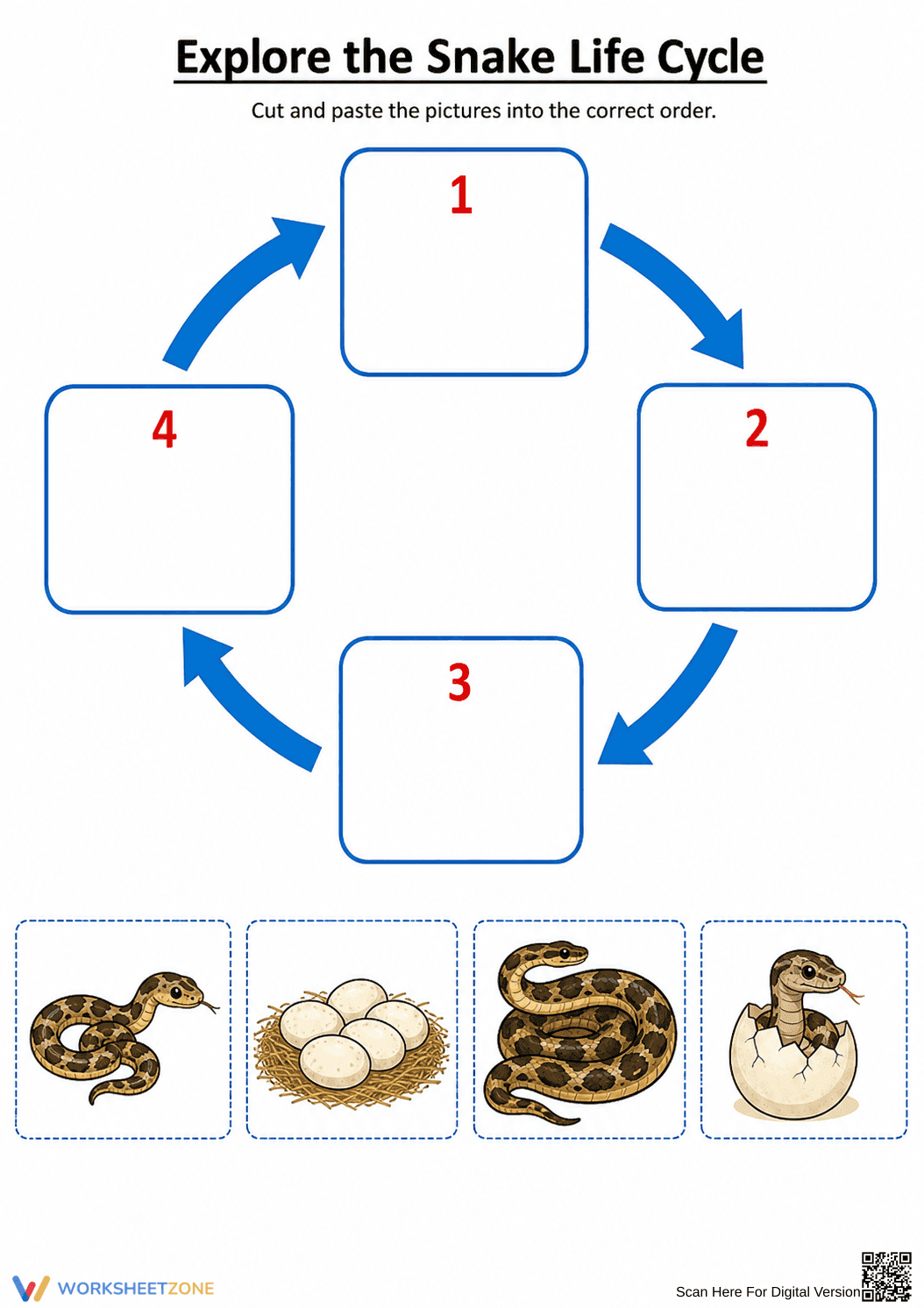

Snake Life Cycle Worksheet | Grade 3 Printable

Paste this activity's link or code into your existing LMS (Google Classroom, Canvas, Teams, Schoology, Moodle, etc.).
Students can open and work on the activity right away, with no student login required.
You'll still be able to track student progress and results from your teacher account.
Students develop a foundational understanding of reptilian biology by sequencing the four primary stages of a snake's development. This interactive activity transforms abstract biological concepts into a tactile learning experience, allowing learners to visualize the progression from egg to adult while reinforcing scientific vocabulary and chronological reasoning.
At a Glance
- Grade: 3 · Subject: Science
- Standard:
3-LS1-1— Develop models to describe that organisms have unique and diverse life cycles- Skill Focus: Biological sequencing
- Format: 1 page · 4 problems · Answer key included · PDF
- Best For: Independent science centers or sub plans
- Time: 15–20 minutes
This 1-page PDF features a high-contrast circular flow diagram with 4 numbered stages and directional arrows. The bottom section contains 4 detailed illustrations—clutch of eggs, hatching, juvenile, and mature adult—designed for cut-and-paste interaction. The layout is optimized for black-and-white printing to ensure clarity during classroom distribution and easy identification of each developmental phase.
The workflow is designed for immediate classroom implementation. Teachers can print the single-sheet PDF in under 1 minute, distribute it to students with scissors and glue, and conduct a whole-class review in approximately 5 minutes. This resource requires zero prior setup, making it an ideal choice for emergency sub plans or transition activities where student engagement must remain high without teacher-led instruction.
This resource aligns with `3-LS1-1`: "Develop models to describe that organisms have unique and diverse life cycles but all have in common birth, growth, reproduction, and death." It specifically addresses the "birth" and "growth" components of the standard through visual modeling. Both standard codes can be copied directly into lesson plans, IEP goals, or district curriculum mapping tools.
Use this as a formative assessment after a lesson on reptiles to check for understanding of developmental stages. Alternatively, place it in a science center alongside a non-fiction text about snakes to encourage evidence-based sequencing. Expect students to complete the cutting and pasting within a 15-20 minute window, allowing for a quick check for understanding at the end of the period.
This worksheet is tailored for Grade 3 students but is accessible for Grade 2 learners needing visual support. It is particularly effective for English Language Learners (ELLs) due to the heavy reliance on visual cues rather than dense text. Pair this with a "Life Cycle of a Bird" worksheet to compare and contrast different animal groups during a broader unit on animal classification.
According to the RAND AIRS 2024 report on elementary science instruction, tactile modeling through cut-and-paste activities significantly increases retention of biological sequences in early learners. This worksheet utilizes the 3-LS1-1 standard to help students construct a mental model of reptilian growth, moving from the birth stage through growth to reproduction. By engaging in the physical act of sequencing, students bridge the gap between abstract scientific facts and concrete visual evidence. Research from Fisher & Frey (2014) suggests that such scaffolded tasks are essential for developing the domain-specific vocabulary required for later mastery of complex life science concepts. This resource provides a structured environment for students to demonstrate their understanding of how organisms change over time, ensuring they meet the rigorous demands of modern state science frameworks while building confidence in their ability to model natural phenomena independently.


