




























Views
Downloads

Grade 3 Salmon Life Cycle — Printable No-Prep Worksheet

Paste this activity's link or code into your existing LMS (Google Classroom, Canvas, Teams, Schoology, Moodle, etc.).
Students can open and work on the activity right away, with no student login required.
You'll still be able to track student progress and results from your teacher account.
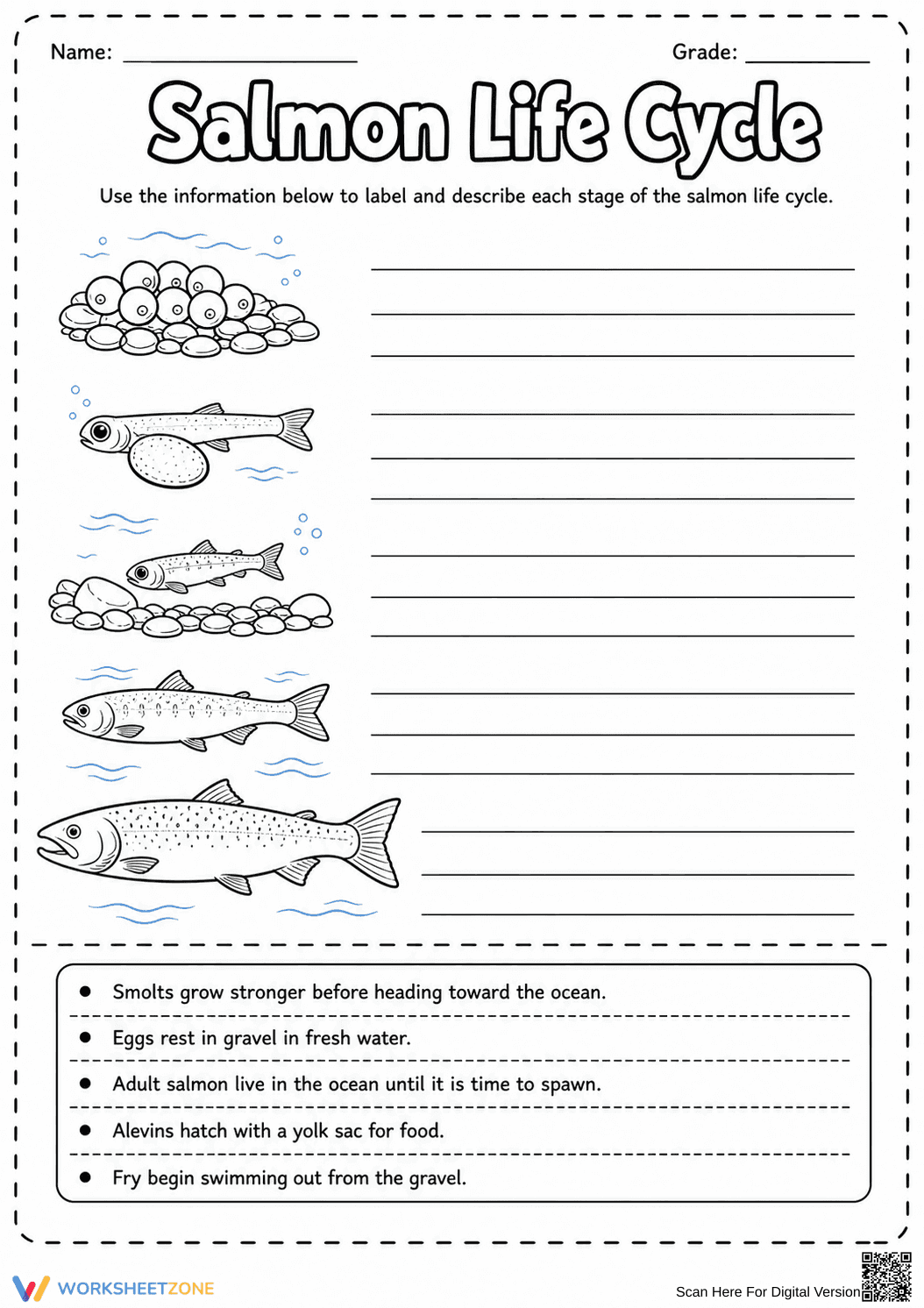
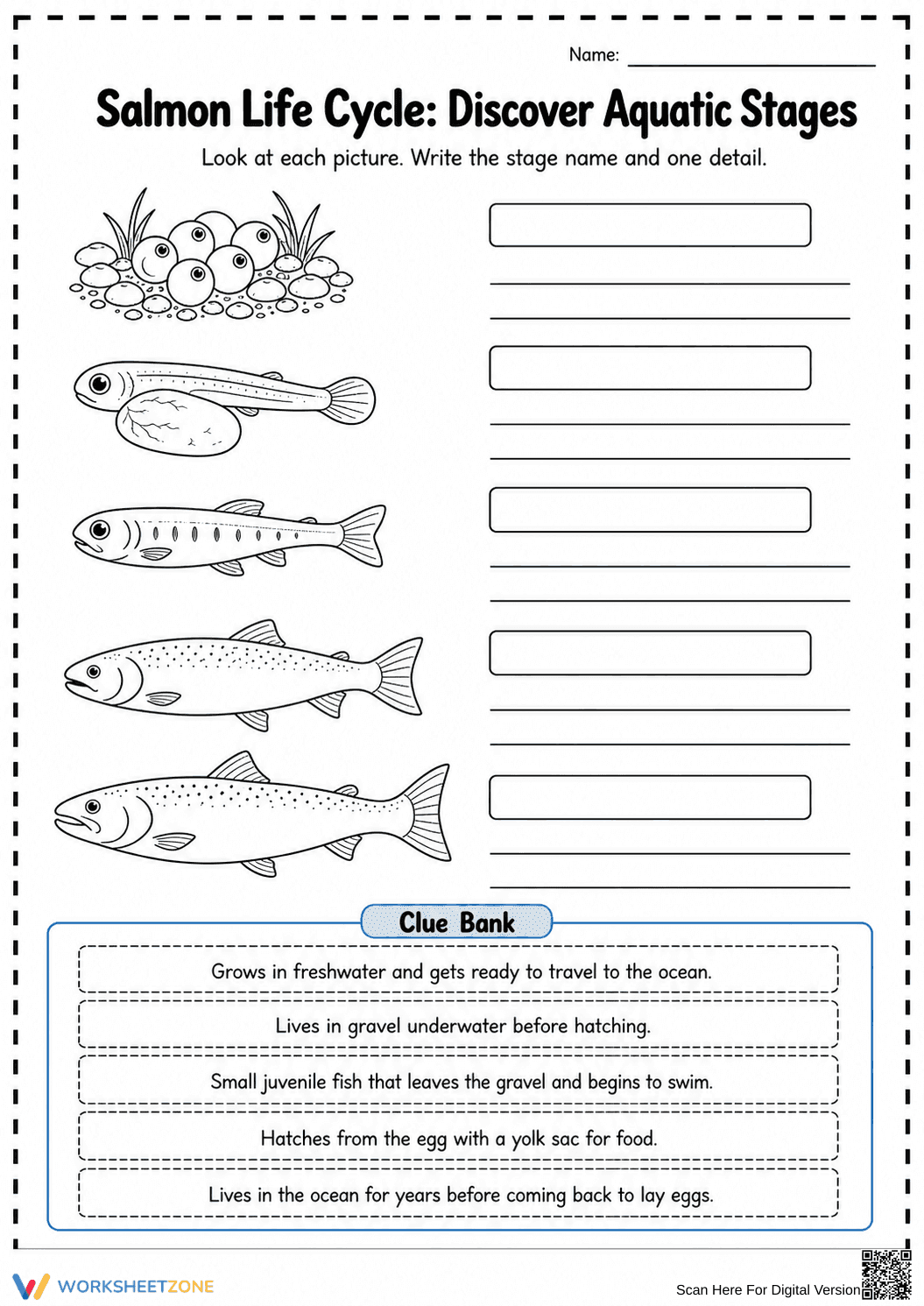
This Grade 3 science worksheet introduces students to the fascinating stages of the salmon life cycle, from egg to adult. By reading descriptive clues and matching them to detailed illustrations, students build foundational biology knowledge while practicing essential reading comprehension and scientific observation skills.
At a Glance
- Grade: 3 · Subject: Science
- Standard:
3-LS1-1— Describe that organisms have unique and diverse life cycles with common stages- Skill Focus: Animal life cycles
- Format: 2 pages · 5 problems · PDF
- Best For: Independent science practice
- Time: 15–20 minutes
What's Inside
This two-page resource features five distinct stages of the salmon's aquatic journey. Page one provides illustrations alongside descriptive sentences for students to match and rewrite. Page two offers a structured "Clue Bank" where learners identify the specific stage name and record one key detail about its habitat. The built-in word banks and clear visual cues provide excellent scaffolding for young learners.
Zero-Prep Workflow
Designed for a zero-prep classroom experience:
- Print (1 minute): Download and print the two-page set. No special materials required.
- Distribute (1 minute): Hand out the worksheets. The self-explanatory instructions allow students to begin immediately.
- Review (3 minutes): Go over the five stages together as a class, using the clue bank to verify correct terminology and sequence.
With under two minutes of total teacher prep time, this activity is an excellent addition to any biology unit or emergency sub plan.
Standards Alignment
Aligned to primary standard 3-LS1-1: Develop models to describe that organisms have unique and diverse life cycles but all have in common birth, growth, reproduction, and death. By sequencing the salmon's development, students observe these universal biological milestones. The standard code can be copied directly into lesson plans, IEP goals, or district curriculum mapping tools.
How to Use It
Use this worksheet during direct instruction to introduce aquatic ecosystems, or assign it as independent practice after reading about fish migration. As a formative assessment tip, observe whether students can accurately distinguish between the "alevin" and "fry" stages based on the presence of the yolk sac in the illustrations. Expected completion time ranges from 15 to 20 minutes, depending on the student's reading level and writing speed.
Who It's For
Ideal for third-grade students, this activity easily adapts for second-grade enrichment or fourth-grade review. The included clue banks and visual scaffolds make it highly accessible for English Language Learners and students who benefit from structured vocabulary support. Pair this worksheet with a visual anchor chart detailing freshwater versus saltwater habitats to deepen their understanding of the salmon's incredible migration journey.
Integrating structured visual models with descriptive text significantly enhances elementary science comprehension. According to a 2024 report by EdReports, instructional materials that require students to connect scientific vocabulary directly to sequential diagrams improve long-term retention of biological concepts. This worksheet applies that evidence-based approach by having learners actively match descriptive clues to specific developmental phases. By mastering standard 3-LS1-1, students learn to describe that organisms have unique and diverse life cycles with common stages. The combination of reading comprehension, visual discrimination, and targeted writing ensures that learners do not merely memorize terms, but actually understand the biological function of each stage. This dual-coding strategy—pairing linguistic information with clear visual representations—provides a robust framework for young scientists to grasp complex ecological processes like migration, growth, and reproduction in aquatic environments.


