


























Views
Downloads

Salmon Life Cycle Worksheet | Grade 3 Essential
Paste this activity's link or code into your existing LMS (Google Classroom, Canvas, Teams, Schoology, Moodle, etc.).
Students can open and work on the activity right away, with no student login required.
You'll still be able to track student progress and results from your teacher account.
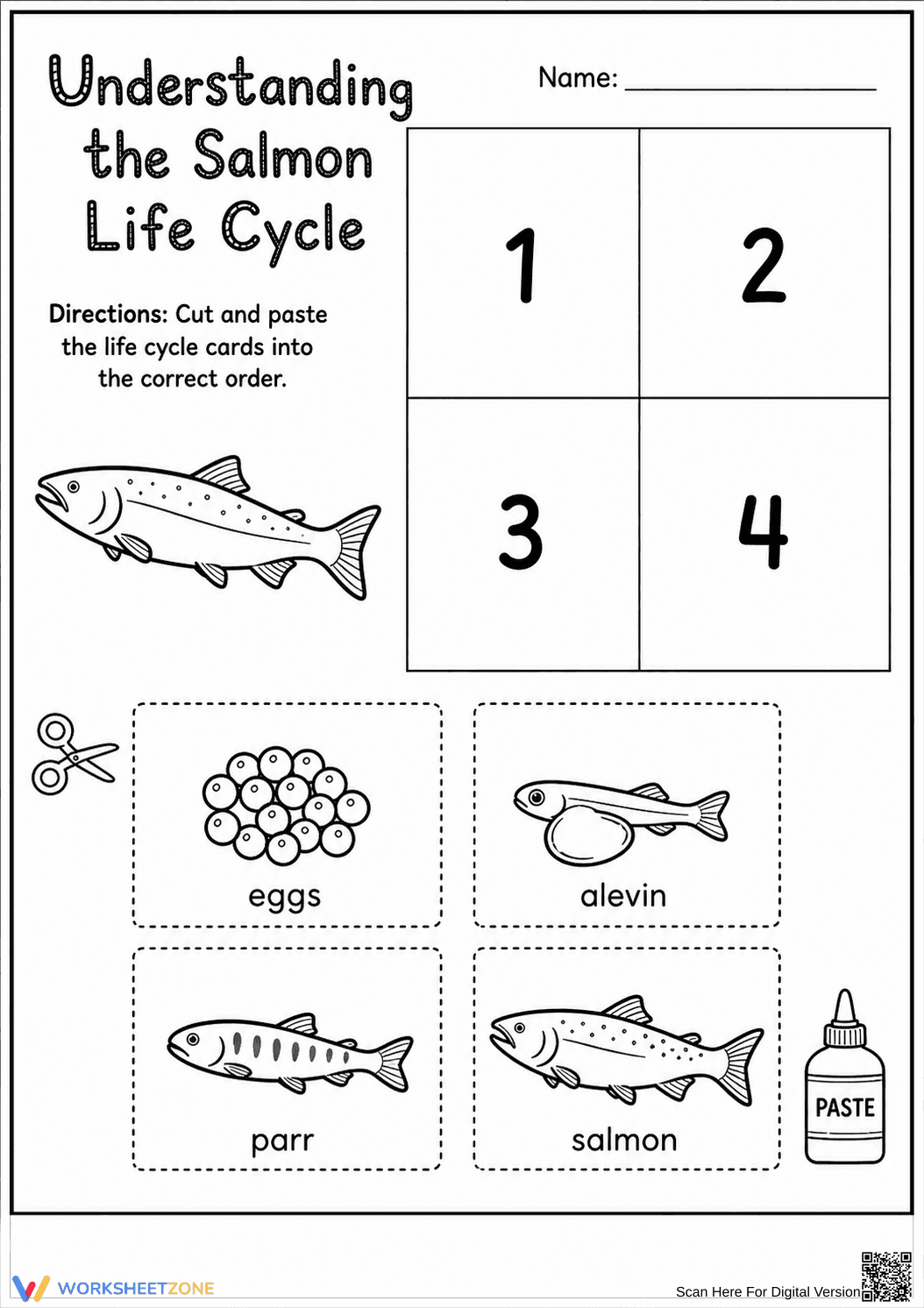
This printable science worksheet helps students master the biological stages of a salmon's development through a hands-on sequencing activity. By identifying and ordering specific growth phases, learners build a concrete understanding of how organisms change over time. This resource ensures students visualize the transition from eggs to adult salmon with clarity.
At a Glance
- Grade: 3 · Subject: Science
- Standard:
3-LS1-1— Develop models to describe that organisms have unique and diverse life cycles- Skill Focus: Salmon life cycle sequencing
- Format: 1 page · 4 problems · Answer key included · PDF
- Best For: Introduction to life cycles and biology
- Time: 15–20 minutes
Inside this resource, you will find a structured one-page activity designed for immediate classroom use. The worksheet features a clear four-box grid and a dedicated cut-out section containing high-quality illustrations of salmon eggs, alevin, parr, and adult salmon. The layout includes a name field and explicit directions, making it a self-contained tool for individual practice or small group centers. A full answer key is provided to facilitate quick grading.
Zero-Prep Workflow
- Print (1 minute): Select the single-page PDF and print enough copies for your class; no collating required.
- Distribute (1 minute): Hand out the sheets along with scissors and glue sticks to begin the hands-on learning process.
- Review (5 minutes): Use the included answer key to check for correct sequencing of the four biological stages during a whole-class wrap-up.
This streamlined process requires less than 2 minutes of teacher preparation, making it ideal for emergency sub plans or last-minute lessons.
Standards Alignment
This activity aligns to `3-LS1-1`. Students develop a model to describe that organisms have unique and diverse life cycles but all have in common birth, growth, reproduction, and death. This worksheet focuses on the growth and development phases of the salmon. This standard code can be copied directly into lesson plans, IEP goals, or curriculum mapping tools.
How to Use It
Use this worksheet during the "Explore" phase of a 5E lesson model to allow students to manipulate the stages of life before formal definitions are provided. It also serves as an excellent formative assessment tool after a lesson on aquatic ecosystems. Observe students as they work to identify if they can distinguish between the alevin and parr stages, which require closer visual inspection. Expect completion within 20 minutes.
Who It's For
This resource is designed for Grade 3 students but is highly effective for Grade 2 and Grade 4 learners who need visual reinforcement of biological concepts. It is particularly beneficial for English Language Learners (ELLs) and students with IEPs who thrive on tactile, kinesthetic activities. Pair this with a short video clip of a salmon run or an anchor chart showing various animal life cycles for a comprehensive experience.
The use of sequencing activities in early science education is supported by Fisher & Frey (2014), who emphasize that physical manipulation of content helps solidify the mental models required for complex biological understanding. By engaging with the `3-LS1-1` standard through a cut-and-paste format, students move beyond rote memorization of terms like alevin and parr toward a functional understanding of chronological development. Research from the RAND AIRS 2024 report indicates that high-quality, focused worksheets targeting specific life cycle stages improve retention of scientific vocabulary in elementary learners. This worksheet provides the necessary scaffolding to bridge the gap between observing nature and documenting scientific processes. It offers a clear, evidence-based path for students to demonstrate mastery of life cycle diversity while developing fine motor skills essential for early elementary success.


