


























Views
Downloads
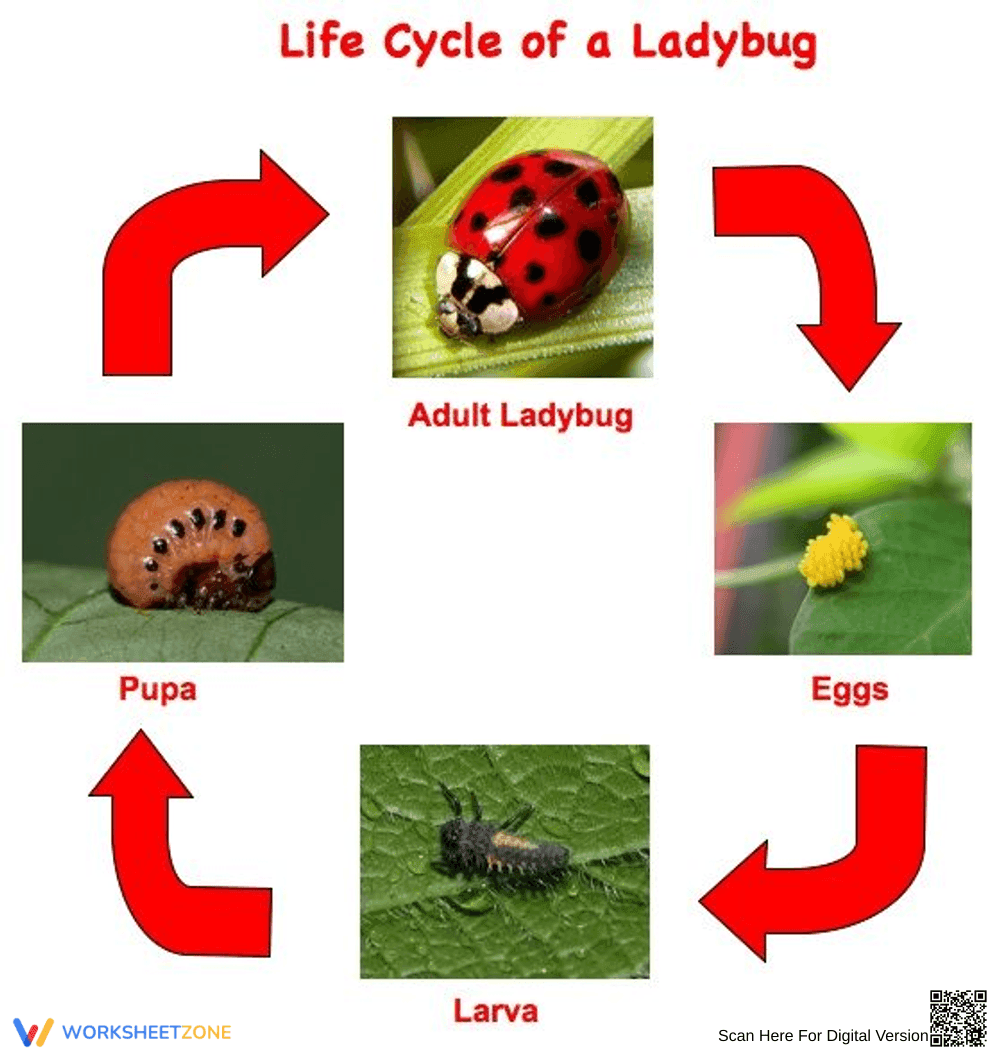

Printable Ladybug Life Cycle Worksheet | Grade 3
Paste this activity's link or code into your existing LMS (Google Classroom, Canvas, Teams, Schoology, Moodle, etc.).
Students can open and work on the activity right away, with no student login required.
You'll still be able to track student progress and results from your teacher account.
This printable ladybug life cycle worksheet helps students identify and sequence the four distinct stages of insect development. By examining clear photographs of eggs, larva, pupa, and adult ladybugs, learners build foundational biology skills while understanding how organisms grow and change over time.
At a Glance
- Grade: 3 · Subject: Science
- Standard:
3-LS1-1— Describe that organisms have unique and diverse life cycles.- Skill Focus: Sequencing life cycle stages
- Format: 1 page · 4 problems · Answer key included · PDF
- Best For: Independent practice or science centers
- Time: 10–15 minutes
Inside this resource, educators will find a single-page visual diagram featuring high-quality photographs of the ladybug life cycle. The worksheet includes four specific identification tasks where students must correctly sequence the eggs, larva, pupa, and adult stages using directional arrows. A complete answer key is provided to ensure accurate grading and immediate student feedback.
This resource is designed for immediate classroom implementation with a streamlined workflow:
- Print (1 minute): The single-page PDF format requires minimal ink and is ready for immediate duplication.
- Distribute (1 minute): Hand out the visual diagrams to students with zero required teacher setup or specialized materials.
- Review (3 minutes): Use the included answer key to quickly verify student comprehension of the four developmental stages.
With under two minutes of total teacher prep time, this activity serves as an excellent emergency sub plan or quick transition task.
This activity aligns directly with 3-LS1-1, requiring students to develop models to describe that organisms have unique and diverse life cycles but all have in common birth, growth, reproduction, and death. It also supports cross-cutting concepts regarding patterns in the natural world. Both standard codes can be copied directly into lesson plans, IEP goals, or district curriculum mapping tools.
Teachers can utilize this visual diagram during direct instruction to introduce the concept of complete metamorphosis. Alternatively, it functions perfectly as an independent science center activity after reading an informational text about insects. As a formative assessment tip, observe whether students can correctly identify the larva and pupa stages, as these are frequently confused by early elementary learners. The entire activity takes approximately 10 to 15 minutes to complete.
This resource is primarily designed for third-grade science students, though it remains highly accessible for second-grade learners needing visual supports or fourth-grade students requiring a quick review. The clear photographic evidence provides excellent scaffolding for English Language Learners acquiring new biology vocabulary. It pairs perfectly with an informational reading passage about beneficial garden insects or a hands-on ladybug habitat observation lesson.
Understanding biological development through visual models is a critical component of early elementary science education. This resource targets 3-LS1-1, helping students describe that organisms have unique and diverse life cycles. According to a 2024 report by EdReports, incorporating high-quality, real-world photographs into science materials significantly improves student retention of complex biological processes like metamorphosis. When learners connect abstract vocabulary terms such as larva and pupa to clear visual evidence, their conceptual understanding deepens. This worksheet provides that exact visual scaffolding, ensuring students can accurately sequence the four stages of development. By utilizing structured diagrams with directional arrows, educators can effectively reduce cognitive load while maintaining rigorous alignment to core science standards. This approach not only builds foundational biology knowledge but also fosters essential scientific observation skills required for future academic success.


