


























Views
Downloads
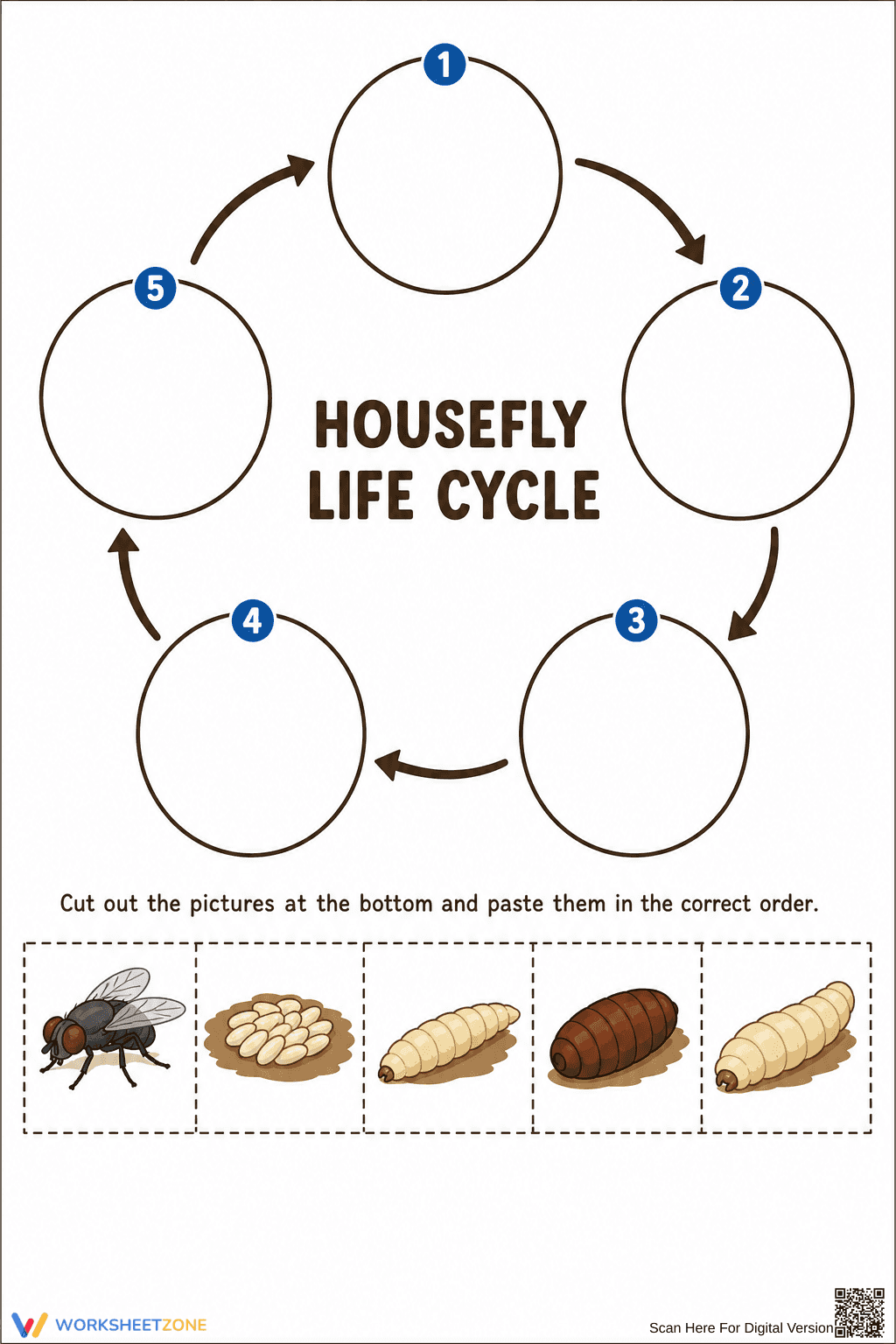

Housefly Life Cycle Worksheet | Grade 3 Essential
Paste this activity's link or code into your existing LMS (Google Classroom, Canvas, Teams, Schoology, Moodle, etc.).
Students can open and work on the activity right away, with no student login required.
You'll still be able to track student progress and results from your teacher account.
This housefly life cycle worksheet provides a clear, hands-on model for students to visualize the biological progression of common insects. By identifying and ordering the specific stages from egg to adult, learners develop a concrete understanding of metamorphosis and growth patterns. This activity ensures students can accurately describe the unique characteristics of each developmental phase.
At a Glance
- Grade: 3 · Subject: Science
- Standard:
3-LS1-1— Develop models to describe that organisms have unique and diverse life cycles- Skill Focus: Biological sequencing
- Format: 1 page · 5 problems · Answer key included · PDF
- Best For: Independent science centers and sub plans
- Time: 15–20 minutes
What's Inside
The resource features a single-page layout centered around a circular flow diagram with 5 numbered positions. At the bottom of the page, students will find 5 high-quality illustrations representing the eggs, larva (maggot) stages, pupa, and the adult housefly. The worksheet includes clear cutting lines and a structured workspace designed to help students organize their findings without visual clutter.
Zero-Prep Workflow
- Print (1 minute): Generate enough copies for your class or science center; no color ink is required for the activity to be effective.
- Distribute (30 seconds): Provide each student with the worksheet, scissors, and a glue stick.
- Review (5 minutes): Use the completed diagrams as a quick visual check for understanding or as a springboard for a class discussion on insect traits.
This streamlined workflow makes the worksheet an ideal choice for emergency sub plans or as a transition activity between direct instruction and independent study.
Standards Alignment
This resource aligns directly with `3-LS1-1`: "Develop models to describe that organisms have unique and diverse life cycles but all have in common birth, growth, reproduction, and death." It specifically addresses the "growth" and "birth" components by highlighting the transition from egg to larva and pupa. Both standard codes can be copied directly into lesson plans, IEP goals, or district curriculum mapping tools.
How to Use It
Assign this worksheet during the "Explore" phase of a 5E science lesson to allow students to manipulate the stages of life before formal vocabulary is introduced. For a formative assessment, observe students as they place the images before they apply glue; look for common misconceptions between the larval and pupal stages. Expected completion time is 15 to 20 minutes depending on fine motor speed.
Who It's For
This activity is designed for Grade 2 through Grade 4 students studying life sciences. It is particularly effective for English Language Learners (ELLs) and students with IEPs who benefit from visual aids and tactile learning. It pairs naturally with a classroom observation of live specimens or a non-fiction text about common household insects.
According to the RAND AIRS 2024 report on elementary science instruction, tactile sequencing activities like this housefly life cycle worksheet significantly improve long-term retention of biological concepts compared to passive reading alone. By engaging in the physical act of cutting and pasting, students build stronger neural pathways associated with the standard 3-LS1-1, which requires the development of models to describe diverse life cycles. Research indicates that 5-stage models provide the optimal level of complexity for Grade 3 learners, allowing them to distinguish between growth phases without becoming overwhelmed by microscopic details. This worksheet serves as a foundational tool for meeting NAEP science standards by requiring students to demonstrate knowledge of the life processes of organisms. The clear visual progression from egg to adult fly ensures that the plain-English skill of biological sequencing is mastered through active participation and evidence-based modeling.


